Carter Bankshares, Inc. (NASDAQ: CARE) Issues Q2 2026 Investor Presentation and 8-K Filing
Carter Bankshares, Inc. (NASDAQ: CARE), a regional bank headquartered in Martinsville, Virginia, has released its Second Quarter 2026 financial results, strategic update, and forward-looking statements in an 8-K report accompanied by a detailed investor presentation. Below are the key highlights and critical points for shareholders and potential investors.
Key Financial Highlights
- Strong Liquidity & Capital Position: The company reported a Common Equity Tier 1 Ratio (CET1) of 14.26%, a Total Risk-based Capital Ratio of 15.51%, and a Leverage Ratio of 11.65%. Total available liquidity stands at \$1.8 billion, covering 237.9% of uninsured deposits.
- Net Income and Adjusted Earnings: Q2 2026 net income was \$28.9 million, down from Q1 2026 due to large one-off gains in the prior quarter. Adjusted net income (excluding non-recurring items) was \$11.6 million, an increase both quarter-over-quarter and year-over-year.
- Balance Sheet Stability: Total assets at Q2 2026 were \$4.8 billion. Deposits declined slightly to \$4.2 billion, while shareholders’ equity increased to \$539.1 million. Loans excluding large nonperforming loans grew by \$226.2 million year-over-year, signaling healthy core loan growth.
- Return Metrics: Adjusted Return on Average Assets (ROA) was 0.96% (Q2), and adjusted Return on Average Shareholders’ Equity (ROE) was 8.83%, both showing improvement.
- Efficiency: The adjusted efficiency ratio improved to 62.66% in Q2 2026, compared to 72.66% in Q1 and 75.55% in Q2 2025, reflecting operational improvement and cost discipline.
Strategic and Price-Sensitive Developments
- Significant One-Off Transactions: The company recognized a \$35.9 million gain from an Insurance Transaction in Q2 and a \$65 million gain from a Loan Sale Transaction in Q1. There was also a \$12.5 million loss from securities portfolio repositioning in Q2. These items materially impacted reported net income and may affect future earnings comparability.
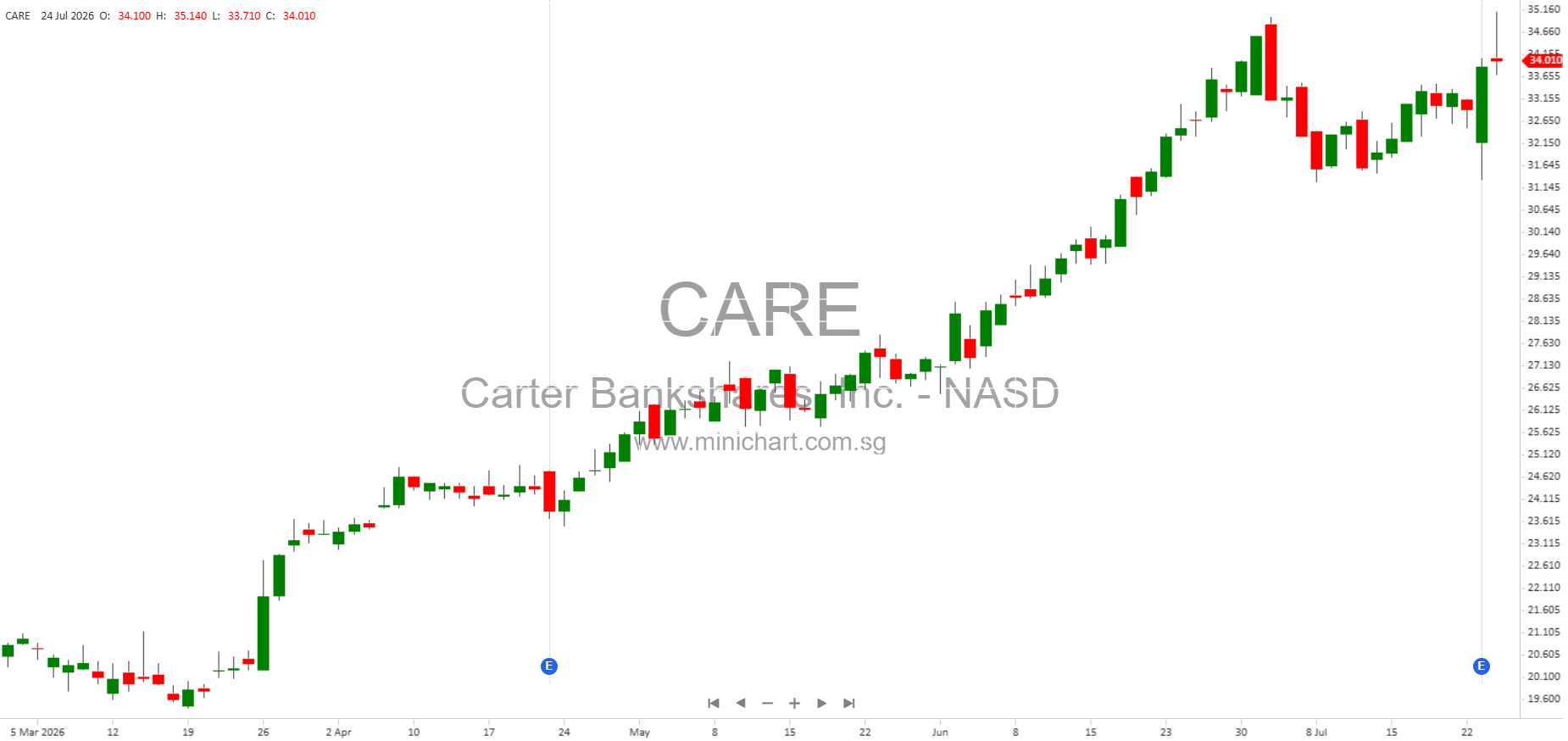
- Share Repurchase Program: In February 2026, Carter Bankshares’ Board authorized the repurchase of up to \$10 million in common stock over twelve months. As of June 30, 2026, the company repurchased 108,601 shares at a total cost of \$2.9 million and a weighted average price of \$26.50 per share. This is a price-sensitive action demonstrating management’s confidence and commitment to shareholder value.
- Asset Quality: Nonperforming loans (NPLs) to total portfolio loans improved to 1.01%, down significantly from 6.69% in Q2 2025, following the resolution and sale of the bank’s largest lending relationship. The allowance for credit losses (ACL) to NPLs stands at 146.88%, indicating robust coverage. Net recoveries/charge-offs to YTD average loans was (0.82)%, implying recoveries exceeded charge-offs.
- Deposit Mix and Funding Strategy: Deposits are diversified and granular, with 79.1% retail customers and 82.3% of deposits FDIC insured (including collateralized muni deposits). The CD portfolio (\$1.8 billion) is relatively short, with 79.2% maturing within 12 months, positioning the bank to reduce funding costs should rates decline.
- Market Position: Carter Bankshares is well-positioned in Virginia and North Carolina, including fast-growing markets such as Charlottesville, Charlotte, Greensboro, Roanoke, Raleigh, and Winston-Salem.
Operational Strategy and Outlook
- Growth Pillars: The bank aims to invest in human capital, technology, brand, and culture; enhance operational performance and customer experience; and expand market presence and product offerings. These efforts are designed to drive sustainable growth and operational leverage.
- Conservative Credit Culture: The company maintains strong credit discipline, with a focus on resolving nonperforming assets and maintaining high credit reserves.
- Forward-Looking Statements: Management cautions that actual results may differ materially due to risks including interest rate volatility, inflation, regulatory changes, cyber threats, real estate market conditions, and other macroeconomic factors.
Non-GAAP Financial Measures
Management utilizes several non-GAAP financial metrics, including adjusted ROA, ROE, efficiency ratio, book value, net interest income, net interest margin (FTE), and adjusted EPS. These measures provide additional insight into the bank’s core performance, excluding the effects of significant one-time items, and may be important for investors evaluating underlying trends.
Potential Share Price Drivers
- Resolution and Sale of Large Nonperforming Loans: The resolution of the bank’s largest NPL and related recoveries/releases have improved asset quality and reduced credit risk, which could positively influence investor sentiment and share price.
- Share Repurchase Activity: Ongoing buybacks may support the share price and reflect management’s confidence in the company’s valuation.
- Operational Improvements: Enhanced efficiency ratios and higher adjusted earnings highlight successful execution of strategic initiatives, which may drive market re-rating.
- Capital and Liquidity Strength: High regulatory capital ratios and liquidity coverage well above uninsured deposits reduce risk and bolster confidence, especially in the current macro environment.
Risks and Forward-Looking Considerations
Investors should note the presence of significant one-off gains and losses in recent quarters, which may not recur. Future results may be impacted by changes in interest rates, deposit flows, loan demand, real estate markets, regulatory actions, and macroeconomic events. Carter Bankshares remains vigilant on asset quality, especially in commercial real estate. The bank’s ability to continue delivering operational improvements, manage credit risk, and grow core deposits will be critical to sustaining shareholder value.
Disclaimer: The above article is based on information disclosed in Carter Bankshares, Inc.’s Q2 2026 8-K filing and investor presentation. Financial figures are unaudited and subject to change. Forward-looking statements involve risks and uncertainties that could cause actual results to differ materially from those projected. Investors should perform their own due diligence and consult professional advisors before making investment decisions.