Baxter International Inc. Q2 2026 Earnings Report: Key Highlights and Investor Insights
Executive Summary
Baxter International Inc. released its Form 10-Q for the quarter ended June 30, 2026, detailing financial performance, balance sheet metrics, and other disclosures. The report contains several notable elements that investors and shareholders should consider, especially those that may have an impact on the company’s share price.
Key Financial Highlights
-
Quarterly Revenue & Earnings:
- Baxter reported consolidated total assets of \$19.79 billion as of June 30, 2026, compared to \$20.06 billion at December 31, 2025. This slight decrease reflects changes in cash balances and operational movements.
- Cash and Cash Equivalents: Ended the quarter at \$350 million, down from \$1.97 billion at year-end 2025. The decrease in liquidity may be significant, signaling capital deployment or operational cash flows.
- Current Assets: \$6.99 billion, a modest increase from \$6.87 billion at the previous year-end.
- Total Liabilities: \$13.95 billion, compared to \$13.95 billion at year-end, indicating stability in leverage.
- Shareholders’ Equity: \$6.18 billion, up from \$6.10 billion, suggesting slight improvement in retained earnings and capital position.
- Outstanding Shares: The number of common shares outstanding as of July 23, 2026 was 516,995,999. This is a key metric for investors in terms of valuation and EPS calculations.
- Short-Term Debt: Short-term borrowings for the quarter were reported as zero, compared to \$1 million at year-end. This suggests a reduction in short-term leverage.
- Treasury Stock: The company held 166.5 million shares in treasury at cost, down slightly from 169.2 million at year-end. This indicates ongoing share buyback activity or changes in repurchased shares.
- Gross Profit: Gross profit for the six months ended June 30, 2026 was \$1.92 billion, demonstrating robust profitability.
- Operating Income: Operating income for the six months was \$283 million, up from \$249 million for the same period in 2025, indicating improved operational efficiency.
- Research & Development Expenses: R&D expenses totaled \$268 million for the six months, reflecting ongoing investment in new products and innovation.
Shareholder-Relevant & Potentially Price-Sensitive Information
- Liquidity Reduction: The significant decrease in cash and cash equivalents from \$1.97 billion to \$350 million warrants attention. Investors should seek further clarification on capital expenditure, acquisitions, or debt repayments that may have caused this drop.
- Share Buybacks: The treasury stock position decreased, suggesting share repurchases or reissuance. Share buybacks can be price supportive, but if repurchases slow, it may impact EPS growth.
- Stable Debt Position: Short-term borrowings have been eliminated, showing prudent debt management, which is positive for financial resilience.
- Consistent Equity Growth: The increase in shareholders’ equity, albeit modest, signals ongoing profitability and capital retention, which is reassuring for long-term holders.
- Commitments and Contingencies: The report lists commitments and contingencies, but no specific amounts are disclosed for the quarter. Investors should monitor future filings for updates on legal or regulatory issues that could impact financials.
- Segment Reporting: Baxter continues to report by key business segments and geography. No segment-specific revenue or profit figures are included in the balance sheet section, but investors should review the full 10-Q for segment performance.
- Regulatory Compliance: Baxter confirms compliance with SEC filing requirements and has submitted all required Interactive Data Files and maintains its status as a large accelerated filer. This is positive for transparency and governance.
Other Noteworthy Disclosures
- Securities Registration: Baxter’s common stock and 1.3% Global Notes due 2029 are registered on the New York Stock Exchange (NYSE), trading under “BAX” and “BAX 29”, respectively.
- Noncontrolling Interests: The company reports negative noncontrolling interests of \$27 million, unchanged from year-end, indicating losses attributable to minority interests.
- Commitment to Financial Standards: Baxter is not an emerging growth or shell company and has not elected to use the extended transition period for new financial accounting standards.
Potential Share Price Movers
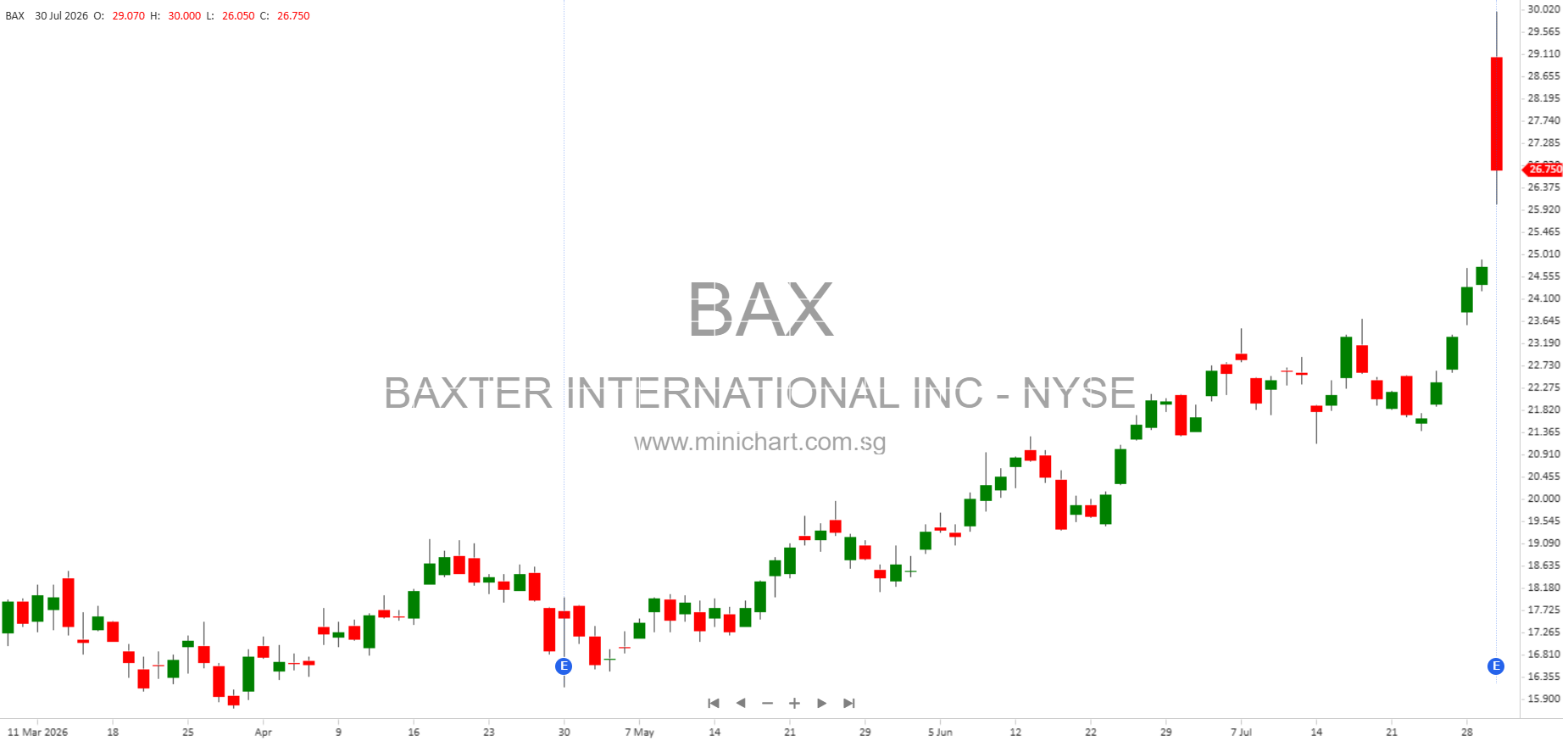
- Cash Position: The sharp decrease in cash may have immediate investor concern and could exert downward pressure on the share price unless clarified as part of strategic investments.
- Share Buybacks: Ongoing buybacks, as evidenced by reduced treasury stock, may support share price, but a slowdown could negatively impact future EPS growth.
- Operating Performance: Improved operating income and stable gross profit are positive signals for future earnings and valuation.
- Debt Reduction: Eliminating short-term borrowings enhances financial flexibility and reduces risk, which may positively influence investor sentiment.
Conclusion
Baxter International’s Q2 2026 financials indicate a stable operational environment, prudent debt management, and continued profitability. However, the substantial reduction in liquidity is a key area for investors to monitor, as it could signal either aggressive investment or potential capital constraints. Share buybacks and stable equity are positive, but any changes in these trends could impact the share price. Shareholders are encouraged to review the full management discussion and notes for further context on cash usage and future strategic direction.
Disclaimer: This article is based on Baxter International Inc.’s Q2 2026 financial filings and is for informational purposes only. It does not constitute investment advice. Investors should consult the original SEC filings and seek independent financial counsel before making investment decisions. The author assumes no responsibility for actions taken based on this analysis.