Hon Kwok Land Investment Company, Limited – FY2025/26 Annual Report: Key Takeaways for Investors
1. Executive Summary
Hon Kwok Land Investment Company, Limited (Stock Code: 160) released its annual report for the year ended 31 March 2026, revealing another challenging 12 months for the group. The property developer and investor, with a focus on Hong Kong, Mainland China (notably Shenzhen, Guangzhou, and Chongqing), and Japan, reported a substantial net loss, ongoing revaluation pressure on investment properties, but also saw bright spots in certain business segments and proactive financial management.
2. Financial Highlights
- Revenue: HK\$832 million, down 17.8% year-on-year (YoY)
- Net Loss: HK\$510 million (improved from prior year’s HK\$609 million loss)
- Shareholders’ Equity: HK\$10,347 million (marginal decrease from HK\$10,527 million)
- Net Assets Per Share: HK\$14.36
- Gearing Ratio: 48.6% (slightly improved YoY)
- Final Dividend: 1 HK cent (down from 3 HK cents in FY2025)
- Revaluation Loss on Investment Properties: HK\$641 million (slightly less than the previous year)
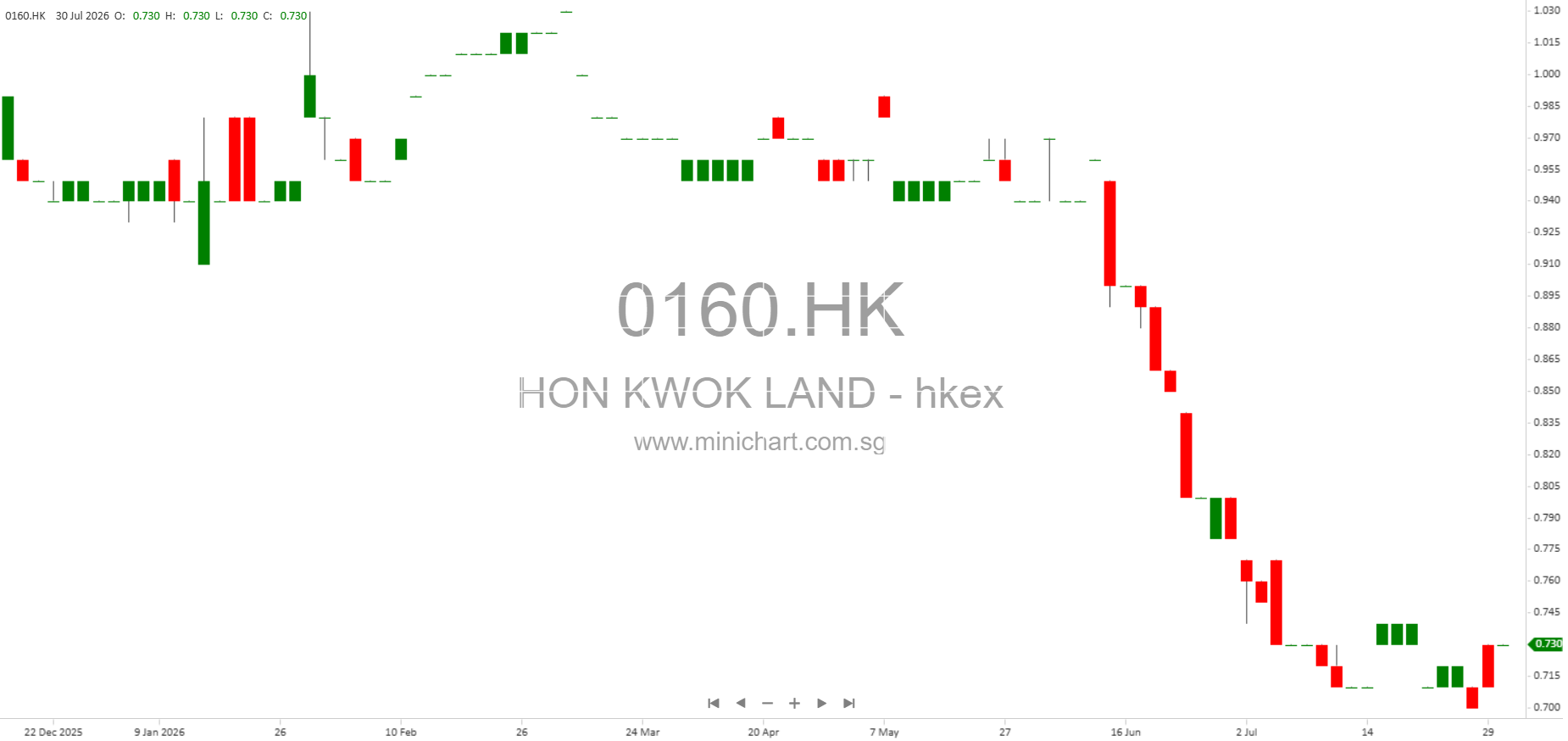
Key Price-Sensitive Point: The significant reduction in dividend and ongoing net loss, coupled with asset revaluation pressures, are likely to be closely watched by the market and may exert downward pressure on the share price in the near term.
3. Chairman’s Strategic Commentary
The Chairman’s statement was exceptionally candid, emphasizing, “Straight talk: We had another tough year. But there is light at the end of the tunnel.” Management openly acknowledged the difficult environment, with property sales declining sharply and operating profit down by over 30%. However, they highlighted several mitigating factors:
- Leasing income grew 5.1% to HK\$460 million, despite a weak office market, reflecting the quality of assets and successful leasing strategies.
- Disciplined financial management: Shareholders’ equity remained stable, and the company continued to protect the capital base.
- Stabilisation in revaluation losses: While investment properties were written down by HK\$641 million, this was a smaller loss than the previous year, suggesting market corrections are moderating.
- Actively managing debt: Debt was reduced from HK\$6,344 million to HK\$5,981 million, with gearing ratio marginally improved. Approximately 38.5% of borrowings mature within one year, and management is actively working on refinancing HK\$1,965 million in syndicated loans.
- Capital recycling: Disposed of The Bauhinia Hotel in Tsim Sha Tsui for HK\$338 million to reduce debt and focus on core assets, accepting a small loss for greater long-term flexibility.
- Dividend cut: To conserve cash, the Board proposed a final dividend of 1 cent per share, compared to 3 cents last year.
4. Operational Performance and Segment Review
China (Guangzhou & Shenzhen)
- The Riverside project in Guangzhou: Recognised HK\$308 million in revenue. The project continues to sell well due to its prime location and premium offering. More units are planned for release.
- Guangzhou commercial cluster success: Hon Kwok Building occupancy surged from 5% to 89%, Tung Hing Fong retail from 42% to 99% (as of post-year-end). The area is transforming into a vibrant commercial hub.
- Shenzhen Hon Kwok City Commercial Centre: Occupancy improved from 63% to 75%, with a hotel operator added to enhance the tenant mix. Targeting 80% by Q3 2026.
Hong Kong
- Oversupplied office market: Core rentals have stabilised, but peripheral areas remain weak. Retail is improving, and residential transactions are ticking up, but no “V-shaped” recovery is expected soon.
- Repulse Bay luxury joint venture: Infrastructure on track for Q3 2026 completion, with project completion expected in 2028.
- The Bauhinia Hotel and Serviced Apartment operations in Central: Strong revenue growth since reopening in January 2026, driven by increased visitor arrivals and overnight stays.
Japan
- Hotel segment a standout: Average occupancy at 91%, buoyed by Japan’s inbound tourism boom. Disposed of two hotel assets post-year-end at a premium, demonstrating the group’s ability to capture market upswings through disciplined capital recycling.
5. Balance Sheet and Liquidity
- Total interest-bearing debt: HK\$5,948 million, with average debt tenure of 2.7 years (down from 3.5 years).
- Liquidity: The group had net current liabilities of HK\$364 million at year-end, but management expects to meet obligations through asset sales, refinancing, and operating cash flow.
- Pledged assets: Properties with a carrying value of HK\$14,928 million pledged as security for banking facilities.
Key Price-Sensitive Point: The high proportion of borrowings due within a year and the need for refinancing could expose the group to liquidity risk if refinancing is delayed or market conditions worsen.
6. Risks, Outlook and Strategic Focus
- Key risks identified: Policy changes in China, currency and interest rate fluctuations, oversupply and regulatory risk in Hong Kong, contractor/counterparty risks, and refinancing risk due to debt maturities.
- Macro outlook: Management does not expect a rapid V-shaped recovery; instead, they see a period of stabilisation and gradual improvement. The company is focusing on disciplined capital allocation, recurring income, and recycling of non-core assets.
- Emerging opportunities: Structural growth in Greater Bay Area technology, robotics, AI, and data infrastructure is highlighted as a long-term positive for the group’s asset base and pipeline.
7. Dividend and Capital Management
- Proposed final dividend: 1 HK cent per share, subject to approval at the annual general meeting. Record date is 4 September 2026, payment on or before 8 October 2026.
- Dividend policy: The Board will prioritise maintaining robust cash reserves and a solid capital base, which may result in conservative dividend payouts under current conditions.
8. Corporate Governance and Other Noteworthy Points
- Board changes: Appointment of Rui-Hua Chang as Independent Non-Executive Director, re-election of Emily Yen Wong and Janie Fong proposed at AGM.
- No purchases, sales, or redemptions of listed securities by the company or its subsidiaries during the year.
- Charitable donations: HK\$1,119,000 made during the year.
- No significant legal proceedings or compliance breaches during the period.
9. What Investors Should Watch
- Dividend reduction and persistent losses signal ongoing operational challenges and may weigh on sentiment.
- Refinancing risk is a key issue: with 38.5% of debt maturing within one year, successful refinancing is vital to avoid liquidity pressure and potential asset sales at disadvantageous prices.
- Stabilising property valuations and improved leasing performance are green shoots, but broader market recovery is not yet visible.
- Active capital recycling and possible further asset disposals could affect future earnings, gearing, and NAV per share.
- Strategic focus on technology-linked assets in the Greater Bay Area could present upside, but investors should be patient as the cycle takes time to turn.
Potential Share Price Impact: The combination of ongoing losses, a lower dividend, and refinancing risk may put downward pressure on the shares in the near term, while successful asset recycling, operational improvements, and a stabilising market could offer future upside.
Disclaimer
This article is for information purposes only and does not constitute investment advice. Investors should conduct their own research or consult a licensed professional before making any investment decisions. Past performance is not indicative of future results. The author and publisher accept no liability for actions taken based on this summary.
漢國置業投資有限公司 2025/26 財政年度年報重點(粵語版)
1. 摘要
漢國置業投資有限公司(股份代號:160)發佈截至2026年3月31日止年度業績報告,反映集團經歷又一艱難年度。作為以香港、中國內地(深圳、廣州、重慶)及日本為重點的地產發展及投資企業,公司錄得重大淨虧損、投資物業重估壓力持續,但部分業務板塊表現理想且財務管理主動積極。
2. 財務重點
- 收入: 8.32億港元,同比下降17.8%
- 淨虧損: 5.1億港元(去年同期虧損6.09億港元,略有改善)
- 股東權益: 103.47億港元(較去年輕微下跌)
- 每股資產淨值: 14.36港元
- 資本負債比率: 48.6%(年比年改善)
- 末期息: 每股1港仙(對比去年3港仙大幅減少)
- 投資物業重估虧損: 6.41億港元(較去年略為收窄)
重點: 股息大幅削減及持續虧損,加上資產重估壓力,預計短期內會影響股價表現。
3. 主席戰略重點
- 租金收入逆市增長5.1%至4.6億港元,突顯資產質素及租務策略見效
- 嚴謹財務管理,股東權益保持穩定,資本基礎未受重大侵蝕
- 投資物業重估虧損速度放緩,市場修正有見穩定
- 債務由63.44億減至59.81億港元,負債比略降
- 有38.5%借款一年內到期,正積極展開19.65億港元再融資談判
- 出售尖沙咀蝴蝶酒店套現3.38億,減債並聚焦核心資產
- 末期息削減至1仙,保留現金以應對不穩市況
4. 營運及分部表現
內地(廣州、深圳)
- 廣州濱江花園年內確認收入3.08億港元,繼續穩定銷售,後續單位將持續推售
- 廣州商業群落活化,漢國大廈出租率由5%升至89%,東慶坊零售由42%升至99%,區域活力顯著提升
- 深圳漢國城市商業中心出租率由63%升至75%,增設酒店租戶,2026年三季度目標80%
香港
- 寫字樓市場供過於求,核心區租金見底,外圍仍弱,零售改善,住宅成交略升,惟難見V型反彈
- 淺水灣豪宅項目進展如期,2026年基建完工,2028年落成
- 中環蝴蝶酒店及服務式住宅2026年1月重開後收入強勁增長
日本
- 酒店組合平均入住率達91%,受惠旅遊業復甦,年結後再售出兩項資產,錄得可觀溢價
5. 資產負債及流動資金
- 有息負債總額59.48億港元,平均債務年期2.7年
- 現金流短期淨負債3.64億港元,惟透過賣盤、再融資及營運現金流應可應付
- 物業抵押貸款資產市值149.28億港元
重點: 資金短缺及再融資風險高,如未能成功再融資或市況惡化,或需低價賣資產套現。
6. 風險、前景與策略
- 中國政策、匯率及息率波動、香港供應過剩及監管、承建商風險、到期債務再融資風險等
- 短期難見急速復甦,集團以財務紀律、增加穩定收入、資產循環為主軸
- 大灣區科技、AI、數據基建帶來長遠機遇,惟需耐心等待週期翻轉
7. 股息及資本管理
- 建議末期息1仙,9月4日登記,10月8日前派發,較去年減少
- 董事會將以維持現金及穩健資本基礎為優先,短期息率或維持保守
8. 其他事項
- 董事局新成員:張瑞華獨立非執董,黃燕及方珍怡建議連任
- 年內無購回、發行或贖回股份
- 慈善捐款111.9萬港元
- 無重大訴訟或違規紀錄
9. 投資者須關注事項
- 減息及持續虧損反映經營困難,或影響股價表現
- 38.5%債務一年內到期,再融資成敗成關鍵
- 物業估值漸趨穩定,租務改善屬初現曙光
- 資產循環及可能進一步賣資產,將影響未來盈利、負債及每股資產淨值
- 聚焦大灣區科技基建資產,有長線潛力但需耐性
潛在股價影響: 持續虧損、削息及再融資風險或短期壓抑股價,若資產循環、營運改善及市場回穩則有望帶來反彈動力。
免責聲明
本文僅供資訊參考,並不構成任何投資建議,投資者應自行研究或諮詢持牌專業人士。過往表現不代表未來結果,作者及出版者對據此內容所作行動概不負責。