Diebold Nixdorf Q2 2026 Financial Results: Strong Growth and Strategic Execution Position Company for Upside
Key Highlights of the Report
- Revenue Growth: Q2 2026 revenue grew over 1% year-over-year (YoY) to \$930.8 million (GAAP), with non-GAAP revenue at \$927.6 million. Order entry increased 3% YoY, reflecting robust demand.
- Profitability: Net income (GAAP) reached \$16.2 million, up 27% YoY, with a net income margin expansion of 40 basis points (bps). Adjusted EBITDA rose 8% YoY to \$120.6 million, and adjusted EBITDA margin improved by 80 bps to 13%.
- Earnings Per Share (EPS): GAAP EPS grew 33% YoY to \$0.44. Adjusted EPS (non-GAAP) increased to \$1.10, up from \$0.94 last year, indicating significant bottom-line improvement.
- Share Buybacks: The company repurchased \$60 million in shares in Q2, with \$57 million remaining under the current \$200 million program, reflecting management’s confidence in valuation and future prospects.
- Full-Year Outlook Reaffirmed: Diebold Nixdorf reaffirmed its 2026 guidance:
- Total Revenue: \$3.86B – \$3.94B
- Adjusted EBITDA: \$510M – \$535M
- Free Cash Flow: \$255M – \$270M
- Adjusted EPS: \$5.25 – \$5.75
Operational and Strategic Highlights
- Retail Segment Momentum:
- Retail revenue grew over 20% YoY for the second consecutive quarter. All geographies showed double-digit growth, with European point-of-sale unit sales soaring nearly 170% YoY.
- Banking Segment Strength:
- Banking backlog increased sequentially, enhancing order visibility for the second half of 2026. The company shipped a record number of teller cash recyclers and secured major branch automation and service contracts.
- Major Wins and Deployments:
- Vynamic® Transaction Middleware is now live with some of the largest North American financial institutions, processing millions of transactions daily.
- VyStar Credit Union selected Diebold Nixdorf for branch automation solutions, optimizing a network of 200+ advanced ATMs.
- Secured new RFID self-checkout contracts with a large US and Canadian fashion retailer, and signed AI deployment contracts for 1,400 new lanes with two large European grocers—the largest such deployments to date.
Cash Flow and Balance Sheet Developments
- Cash Flow: Q2 2026 net cash used in operating activities was \$(13.6) million (GAAP), while free cash flow (excluding discrete tax payments) was \$(11.0) million. The negative figures were attributed to inventory build-up to meet growing demand.
- Tax Update: Due to increased profitability in German entities, Diebold Nixdorf used the last of its German NOL carryforwards. As a result, the company paid a \$50 million discrete German tax liability for 2024 in Q2 2026 and will pay additional German taxes covering 2024, 2025, and 2026 during 2026. These cash tax payments (attributable to prior years) are excluded from non-GAAP free cash flow figures to better reflect underlying cash generation.
- Balance Sheet: As of June 30, 2026, the company held \$282.4 million in cash and equivalents and had total assets of \$3.74 billion. Net debt stood at \$689.3 million, reflecting a significant debt load but manageable in the context of improving operations and cash flows.
Detailed Financial Performance
- Segment Gross Margins (Q2 2026, Non-GAAP):
- Banking Gross Margin: 28.5%
- Retail Gross Margin: 21.9%
- Total Gross Margin: 26.4%
- Six Months Results (June 30, 2026):
- Total sales: \$1.82 billion (up 3.4% YoY non-GAAP)
- Adjusted EBITDA: \$219.7 million (up 10.7% YoY)
- Net income attributable to Diebold Nixdorf: \$20.5 million (GAAP); \$57.6 million (Non-GAAP)
- Adjusted EPS for six months: \$1.62 (up from \$0.66 YoY)
- Cost Control: The company maintained cost discipline, with selling and administrative expenses down on a non-GAAP basis. Restructuring and savings initiatives contributed to improved profitability.
Risks and Forward-Looking Considerations
- Risks Identified:
- Execution on strategic initiatives and cost savings programs.
- Competitive pressures and technology disruption.
- International risks, including geopolitical instability, regulatory changes, and foreign exchange volatility.
- Potential impacts from new payment technologies reducing ATM and cash transaction volumes.
- Cybersecurity, supply chain, and AI implementation challenges.
- German cash tax payments will reduce reported free cash flow in 2026, but these are considered non-recurring.
- Management Outlook: CEO Octavio Marquez expressed confidence in the company’s ability to deliver on full-year objectives and long-term shareholder value, citing strong backlog, ongoing cost discipline, and traction in strategic growth areas.
Shareholder Considerations and Price-Sensitive Items
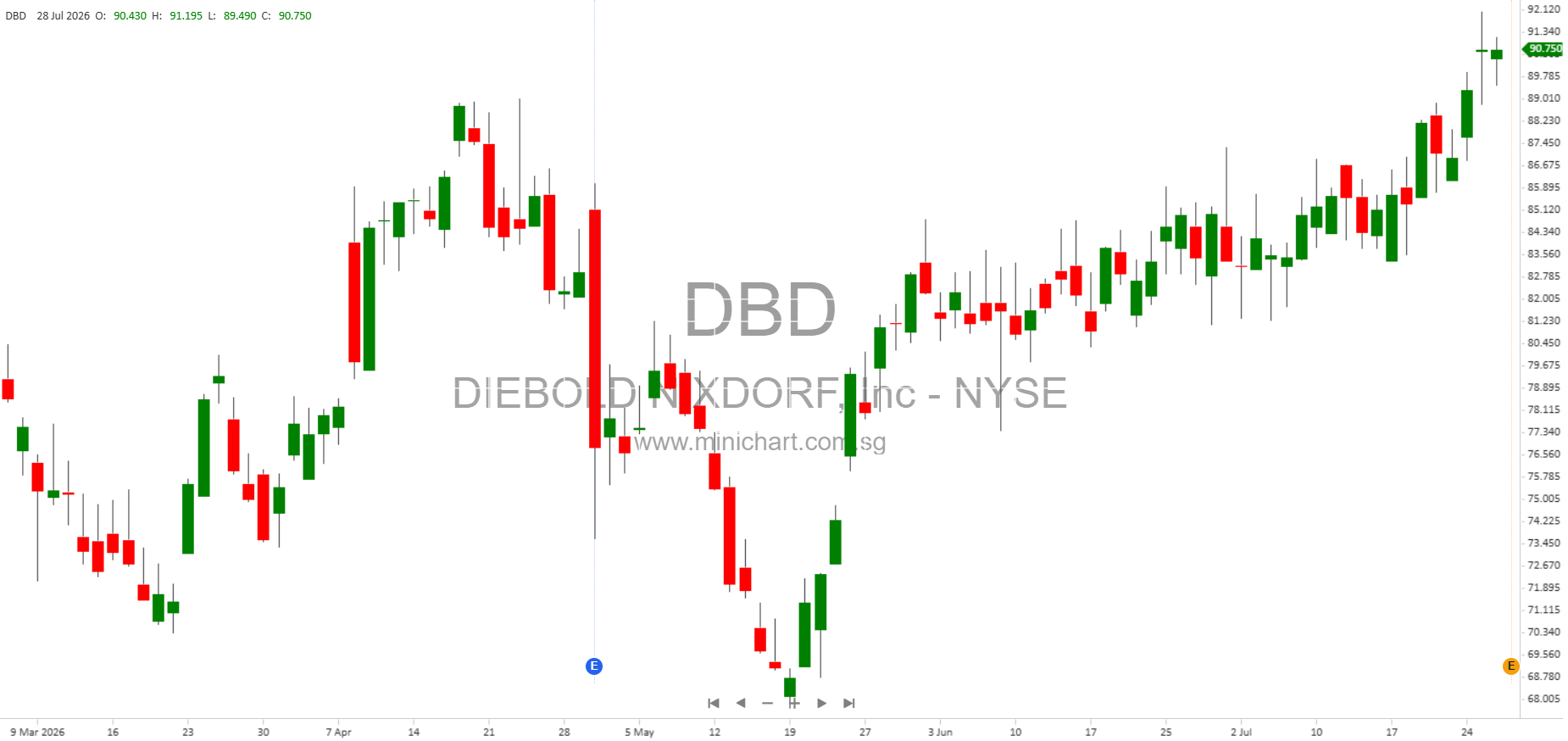
- Share Repurchases: Aggressive buybacks signal management’s view of undervaluation and can provide support to the share price.
- Retail and Banking Growth: Sustained double-digit growth in Retail and backlog expansion in Banking indicate strong demand and may drive positive sentiment.
- German Tax Developments: The transition to a cash taxpayer in Germany and related tax payments are noteworthy; while non-recurring, they impact reported cash flow and should be monitored by investors.
- Reaffirmed Guidance: The reaffirmation of strong full-year guidance, despite macroeconomic and operational headwinds, is a strong positive and could support share price appreciation if execution continues.
- Non-Core Turkey Operation Wind Down: The ongoing wind down (expected to complete in 2026) had a small negative impact on results but is not material to ongoing operations.
Conclusion
Diebold Nixdorf’s Q2 2026 results show broad-based revenue growth, significant improvements in profitability, and strong execution on strategic priorities. The company’s robust order backlog, continued retail and banking momentum, and disciplined cost controls underpin management’s confidence in meeting or exceeding full-year targets. Shareholders should note the impact of non-recurring German tax payments on reported free cash flow, aggressive share repurchases, and the company’s ability to grow in both core and new solution areas. These developments are likely to be price-sensitive and could positively influence the company’s share valuation, provided the business continues to execute as planned.
Disclaimer: This article is for informational purposes only and does not constitute investment advice. Investors should conduct their own due diligence and consult with financial advisors before making investment decisions. The author and publisher are not responsible for any investment actions taken based on this information.