Boeing Delivers Strong Q2 2026 Results: Revenue Growth, Record Backlog, and Key Program Updates
Key Financial Highlights
- Revenue: Boeing reported Q2 2026 revenue of \$24.6 billion, up 8% from \$22.7 billion in Q2 2025. The increase was primarily driven by higher commercial airplane deliveries (171 units, up 14% year-over-year).
- Loss Per Share: GAAP diluted loss per share improved to (\$0.67) from (\$0.92) in Q2 2025. Non-GAAP core loss per share was (\$0.76), better than (\$1.24) a year ago.
- Operating Cash Flow: Operating cash flow surged to \$1.4 billion from \$227 million in Q2 2025, reflecting both higher deliveries and favorable working capital timing.
- Free Cash Flow: Free cash flow (non-GAAP) was \$631 million, compared to a negative \$200 million in the prior year period.
- Backlog: Boeing’s total company backlog reached a record \$715 billion, including over 6,200 commercial airplanes valued at \$597 billion.
- Cash and Debt: Cash and investments in marketable securities stood at \$20.0 billion at quarter end, with consolidated debt reduced to \$45.9 billion (from \$47.2 billion at the start of the quarter).
Segment Performance
Commercial Airplanes
- Revenues: \$11.8 billion, up 8% year-over-year.
- Deliveries: 171 aircraft (up from 150 in Q2 2025), led by the 737 (129 units).
- Operating Margin: Improved to (2.7)% from (5.1)% last year, reflecting higher deliveries, favorable mix, and improved performance.
- Program Updates:
- The 737 program began transitioning to a 47-per-month production rate and activated low-rate initial production on the 737 North Line in July.
- Certification flight testing completed for 737-7 and 737-10; certification and first deliveries anticipated in 2026 and 2027, respectively.
- 777X program received FAA approval to begin certification flight testing under Type Inspection Authorization 4B, with first delivery expected in 2027.
- Commercial Airplanes booked 246 net orders in the quarter, including large deals with Korean Air, Delta Air Lines, and SMBC Capital.
Defense, Space & Security
- Revenue: \$7.5 billion (up 13%).
- Operating Margin: Slight loss at (0.2)%, reflecting \$280 million in losses on the VC-25B program (investment in additional production and certification resources).
- Backlog: \$85 billion, with 27% from non-U.S. customers.
- Key Program Milestones:
- Secured new contract from the U.S. Space Force for proprietary communications.
- Milestone C achieved for U.S. Navy MQ-25A Stingray; began low-rate initial production of U.S. Air Force T-7A Red Hawk.
Global Services
- Revenue: \$5.3 billion (up 1%).
- Operating Margin: 18.1% (down from 19.9%), reflecting impacts from the Digital Aviation Solutions divestiture, higher costs, and an unfavorable mix.
- Backlog: \$33 billion.
- Key Contracts:
- Awarded U.S. Navy contract for P-8A training systems.
- Agreement with Alaska Airlines to integrate Boeing Virtual Airplane training solution.
Other Noteworthy Developments
- R&D Investment: Research and development expense increased to \$921 million for the quarter.
- Debt Repayment: Boeing repaid \$8.4 billion in debt during the first half of 2026, further strengthening its balance sheet.
- Access to Credit: The company maintains \$10 billion in undrawn credit facilities, supporting strong liquidity.
- Shareholder Equity: Shareholders’ equity increased to \$6.1 billion from \$5.5 billion at the start of the year.
Management Commentary
“I’m very pleased with the progress our team is making as we execute our plan. Our operations are more stable and key certification programs remain on plan. Our focus has been on restoring trust and we are now building on that through a sustained focus on safety, quality, and on-time performance… While there is more work ahead in the second half of the year, the momentum we are building continues to move Boeing in the right direction.”
— Kelly Ortberg, President & CEO
Potential Share Price Sensitivities & Investor Considerations
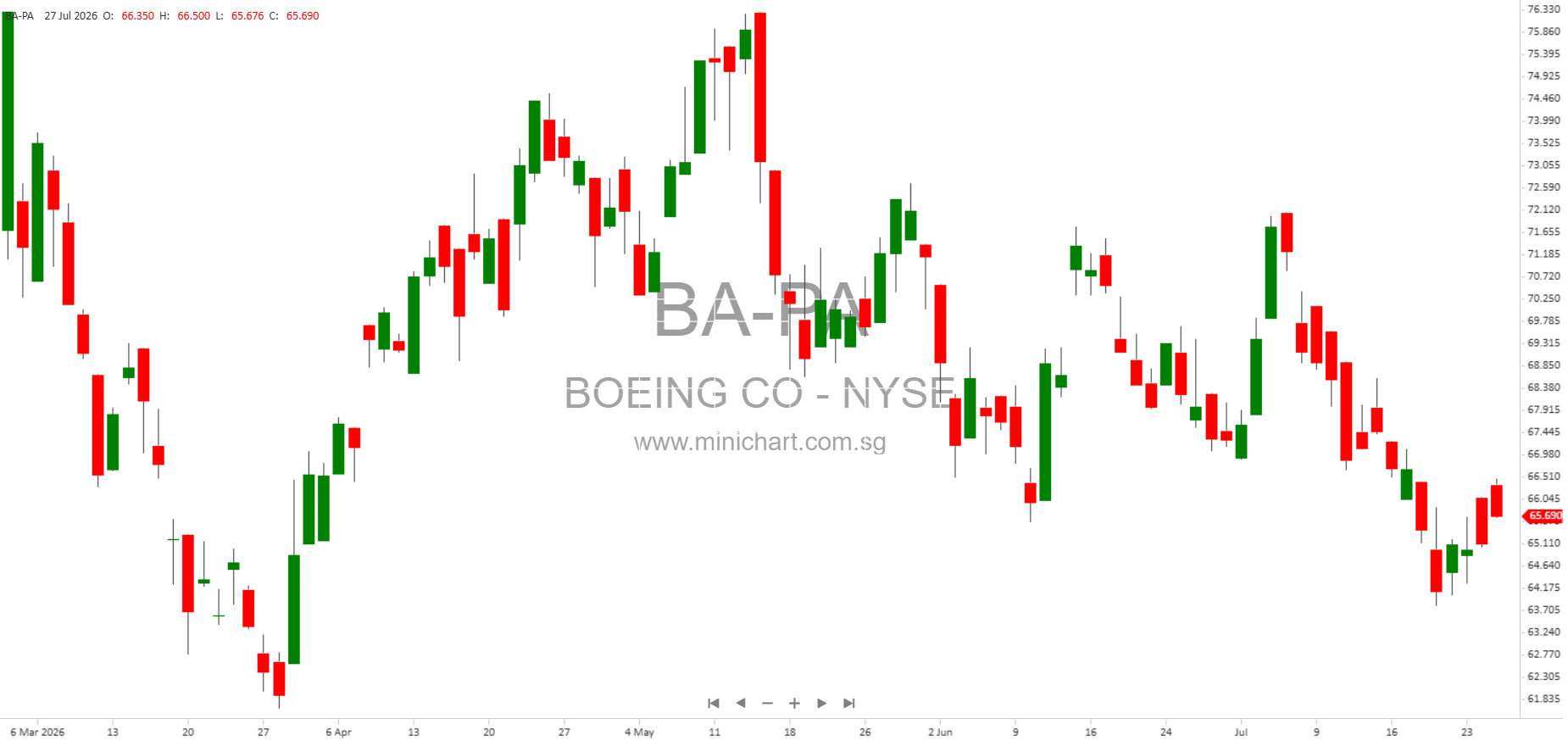
- Record Backlog: The company’s record \$715 billion backlog (with over 6,200 commercial aircraft) provides strong multi-year revenue visibility and may support share price appreciation.
- Cash Flow Strength: Significant operating and free cash flow generation, alongside debt reduction, improves Boeing’s financial flexibility and lowers risk.
- Commercial Airplane Recovery: Higher deliveries, program ramp-ups, and key certifications (737-7, 737-10, and 777X) are pivotal for Boeing’s long-term recovery and could positively impact market sentiment as milestones are met.
- Risks: Notable program charges (e.g., VC-25B), ongoing operating losses in some segments, and persistent net losses (though improved) remain concerns. Shareholders should monitor further execution on certifications, cost controls, and supply chain stability.
- Liquidity: Boeing’s substantial cash position and undrawn credit lines offer a buffer against operational or market shocks.
- Guidance: The report does not include new forward guidance, but management’s positive outlook and commentary suggest confidence in execution for the remainder of 2026.
Conclusion
Boeing’s Q2 2026 results demonstrate solid operational progress, stronger cash flows, and a record backlog—factors that could support share price appreciation. However, ongoing program risks, the need for successful aircraft certifications, and continued cost discipline are critical watch points for investors. The upcoming second half will be pivotal as the company seeks to build on its momentum.
Disclaimer: This article is for informational purposes only and does not constitute investment advice. Investors should review company filings and consult their financial advisors prior to making investment decisions. Past performance is not indicative of future results.