Synchrony Financial Q2 2026: Detailed Investor Report
Executive Summary
Synchrony Financial has released its Form 10-Q for the quarter ended June 30, 2026. This comprehensive report reveals key financial metrics, business trends, and regulatory updates that are highly relevant for shareholders and investors. The company’s performance, regulatory status, and risk disclosures are likely to influence share price movements. Below, we provide an in-depth breakdown of the most critical aspects of the report.
Key Highlights
- Net Earnings: Earnings before provision for income taxes were \$1.186 billion for Q2 2026, compared to \$1.256 billion in Q2 2025. For the first six months, earnings before provision for income taxes were \$2.233 billion in 2026 vs \$2.240 billion in 2025.
- Net Interest Income: After retailer share arrangements and provision for credit losses, net interest income was \$4.610 billion for Q2 2026, up from \$4.461 billion in Q2 2025. This reflects robust core business performance.
- Provision for Credit Losses: Increased to \$1.201 billion for Q2 2026 (vs \$1.146 billion in Q2 2025), signaling heightened credit risk or portfolio growth.
- Interest Income vs Expense: Interest income for Q2 2026 was \$5.583 billion, with interest expense at \$9.243 billion for the six months, indicating a tight spread environment and possible pressure on margins.
- Retailer Share Arrangements: Continued to impact profitability, with \$1.027 billion in negative adjustments for Q2 2026.
- Common Stock Outstanding: As of July 17, 2026, there were 325,370,840 shares outstanding.
- Regulatory Status: Synchrony is classified as a “Large Accelerated Filer,” not a shell or emerging growth company. It has been subject to heightened regulatory requirements due to having over \$100 billion in assets.
- Risk Factors: The report emphasizes macroeconomic and geopolitical risks, regulatory changes (especially related to the CFPB and Dodd-Frank Act), and credit loss provisioning as key factors for future performance.
- Forward-Looking Statements: Management warns of material uncertainties, including inflation, interest rates, tariffs, global conflicts, and possible recession impacts.
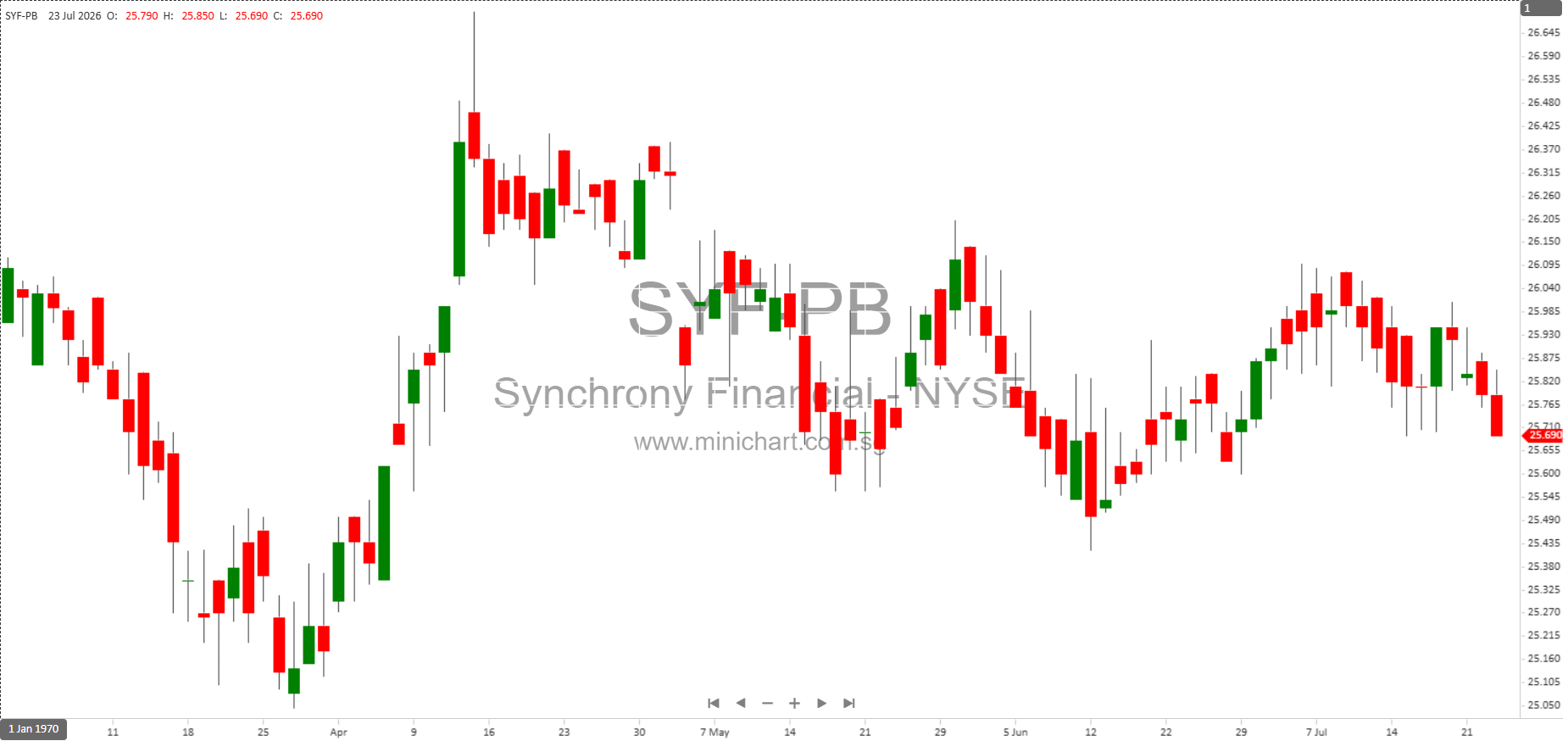
- Trading Symbols: SYF (common stock), SYFPrA and SYFPrB (preferred shares) listed on NYSE.
Detailed Financial Performance
| Metric | Q2 2026 | Q2 2025 | First 6 Months 2026 | First 6 Months 2025 |
|---|---|---|---|---|
| Interest Income (\$M) | 5,583 | 11,186 | 11,136 | 11,136 |
| Interest Expense (\$M) | 9,243 | 8,985 | 9,243 | 8,985 |
| Retailer Share Arrangements (\$M) | (1,027) | (2,097) | (1,887) | (2,097) |
| Provision for Credit Losses (\$M) | 1,201 | 1,146 | 2,536 | 2,637 |
| Net Interest Income after Retailer Share & Credit Losses (\$M) | 4,610 | 4,461 | 4,610 | 4,461 |
| Other Income (\$M) | 137 | 267 | 137 | 267 |
| Other Expense (\$M) | 1,331 | 1,245 | 2,647 | 2,488 |
| Earnings Before Income Taxes (\$M) | 1,186 | 1,256 | 2,233 | 2,240 |
| Provision for Income Taxes (\$M) | 301 | 301 | 301 | 301 |
Interpretation: Synchrony’s financials reflect continued profitability, although margins are tight and credit risks are rising. The provision for credit losses is climbing, which should be monitored as it could indicate either portfolio expansion or deteriorating credit quality.
Price-Sensitive & Shareholder-Relevant Items
- Credit Losses Increase: Rising credit loss provisions may signal greater risk in the loan portfolio, potentially impacting future earnings and valuation.
- Regulatory Risks: Synchrony is now subject to stricter CFPB and Dodd-Frank regulations due to asset size. This could restrict dividend payments, share buybacks, and impose new compliance costs.
- Macroeconomic Uncertainties: The company warns about inflation, interest rates, tariffs, global conflicts, and recession risks. These factors could materially impact earnings, customer demand, and credit quality.
- Share Count: The number of common shares outstanding (325,370,840) affects EPS calculations and dilution risk.
- Forward-Looking Statements: Management’s cautionary language regarding uncertainties and risks is a signal that investors should expect volatility and potential surprises in future quarters.
- Preferred Share Offerings: Series A and B preferred shares, with fixed and reset rates, are actively traded on NYSE. Changes in interest rates and credit spread could affect their value.
- Retailer Share Arrangements: Significant negative impact on profitability could continue, affecting net income.
Shareholders should monitor Synchrony’s credit risk profile, regulatory developments, and macroeconomic environment closely. These factors are likely to influence share price, dividend policy, and capital returns in coming quarters.
Business Trends and Risk Factors
- Consumer Confidence & Economic Growth: Management points to risks from inflation, interest rates, energy costs, global conflicts, and potential recession.
- Regulatory Developments: New rules from CFPB and Dodd-Frank Act could restrict capital distributions and require additional compliance investments.
- Privacy & Data Security: Ongoing emphasis on compliance with privacy, information security, and anti-money laundering laws.
- Third-Party Relationships: Potential risks from vendor and business partner management.
- Credit Score Trends: VantageScore credit profiles are used to monitor portfolio risk.
Implication: Investors should expect continued regulatory scrutiny and potential headwinds from economic and credit market conditions. Synchrony’s management is actively monitoring these trends, but uncertainties remain substantial.
Regulatory & Compliance Update
- SEC Filings: Synchrony continues to file all required reports and maintains good standing with regulatory agencies.
- Interactive Data: All interactive data requirements have been met.
- Filer Status: Large Accelerated Filer (not a shell or emerging growth company).
- Capital & Liquidity: Subject to Basel III and other capital adequacy requirements due to asset size.
Implication: Synchrony’s compliance status reduces headline risk but imposes additional regulatory burdens and costs.
Conclusion
Synchrony Financial’s Q2 2026 report presents a mixed picture: continued profitability, but with rising credit risks and tighter margins. Regulatory changes and macroeconomic uncertainties loom large and may influence the company’s ability to pay dividends, repurchase shares, and sustain earnings growth. These factors are likely to be price-sensitive and could affect share values in the upcoming quarters.