Office Properties Income Trust (OPI) Q1 2026 Supplemental Report: Key Details for Investors
Executive Summary
Office Properties Income Trust (OPI) has released its supplemental information for the first quarter ended March 31, 2026. This report contains significant developments regarding portfolio performance, lease renewals, capital expenditures, property dispositions, and the company’s ongoing bankruptcy and restructuring process. Key financial and operational metrics have shifted, which may have a substantial impact on shareholder value and the company’s future outlook.
Key Financial Highlights
- Rental Income: Q1 2026 rental income was \$99.7 million, down from \$103.9 million in Q1 2025.
- Same Property NOI: \$55.4 million (down 8.4% year-over-year), with a margin of 55.5%.
- Same Property Cash Basis NOI: \$52.6 million (down 0.5% year-over-year), with a margin of 54.2%.
- Occupancy: Portfolio occupancy dropped to 81.3% from 85.4% a year earlier.
- Leasing Activity: Overall leasing activity remains challenged, with new leases totaling only 35,000 sq. ft. this quarter and total leasing commitments per sq. ft. remaining high.
- Net Loss: A substantial net loss of \$93.0 million was reported for Q1 2026.
Portfolio and Leasing Developments
- Leased Portfolio Size: The total number of properties at period end was 117, with a rentable area of 16.35 million sq. ft.
- Declining Lease Rates: The percent leased has dropped by over 4 percentage points year-over-year, highlighting ongoing pressures in the office real estate market.
-
Leasing Costs:
- Leasing cost and concession commitments for Q1 2026 were \$4.5 million, or \$21.36 per sq. ft. (\$4.76 per sq. ft. per year).
- Renewal and new lease rates have exhibited volatility, with some new leases achieving positive rent spreads, but renewals often at negative spreads.
-
Tenant Quality:
- Investment grade tenants represent 60.1% of annualized rental income.
- The U.S. Government remains the single largest tenant, contributing 17.5% of total annualized rental income.
- The top 22 tenants account for 63.1% of annualized rental income, with significant exposure to Alphabet (Google), Bank of America, Northrop Grumman, and other blue-chip tenants.
-
Lease Expiration Schedule:
- Significant lease expirations are concentrated in 2027 (13.6% of leased sq. ft., 12.5% of annualized rent) and 2034 (13.4% of leased sq. ft., 12.6% of annualized rent).
- The weighted average remaining lease term is 6.4 years.
Property Dispositions and Capital Expenditures
- Three properties were sold since July 2025 for \$13.2 million in gross proceeds, at an average of \$84 per sq. ft. This includes two properties in Tempe, AZ and one in Detroit, MI.
- Total capital expenditures for Q1 2026 were \$10.9 million, with lease-related costs making up the bulk (\$8.5 million).
Unconsolidated Joint Venture
- OPI owns a 51% interest in the Prosperity Metro Plaza joint venture (Fairfax, VA), which is 89.8% leased with a weighted average remaining lease term of 4.6 years.
- The joint venture carries \$48.9 million in non-recourse mortgage debt at a 4.09% interest rate, maturing in December 2029.
- Q1 2026 results for OPI’s share of the joint venture include NOI of \$928,000 and Cash Basis NOI of \$842,000.
Balance Sheet and Debt
- OPI’s portfolio is financed through a variety of debt instruments, including credit agreements, senior notes due 2027 and 2029, mortgage notes, and debtor-in-possession financing.
- Gross book value of real estate assets as of March 31, 2026, stood at \$4.6 billion.
Bankruptcy and Reorganization
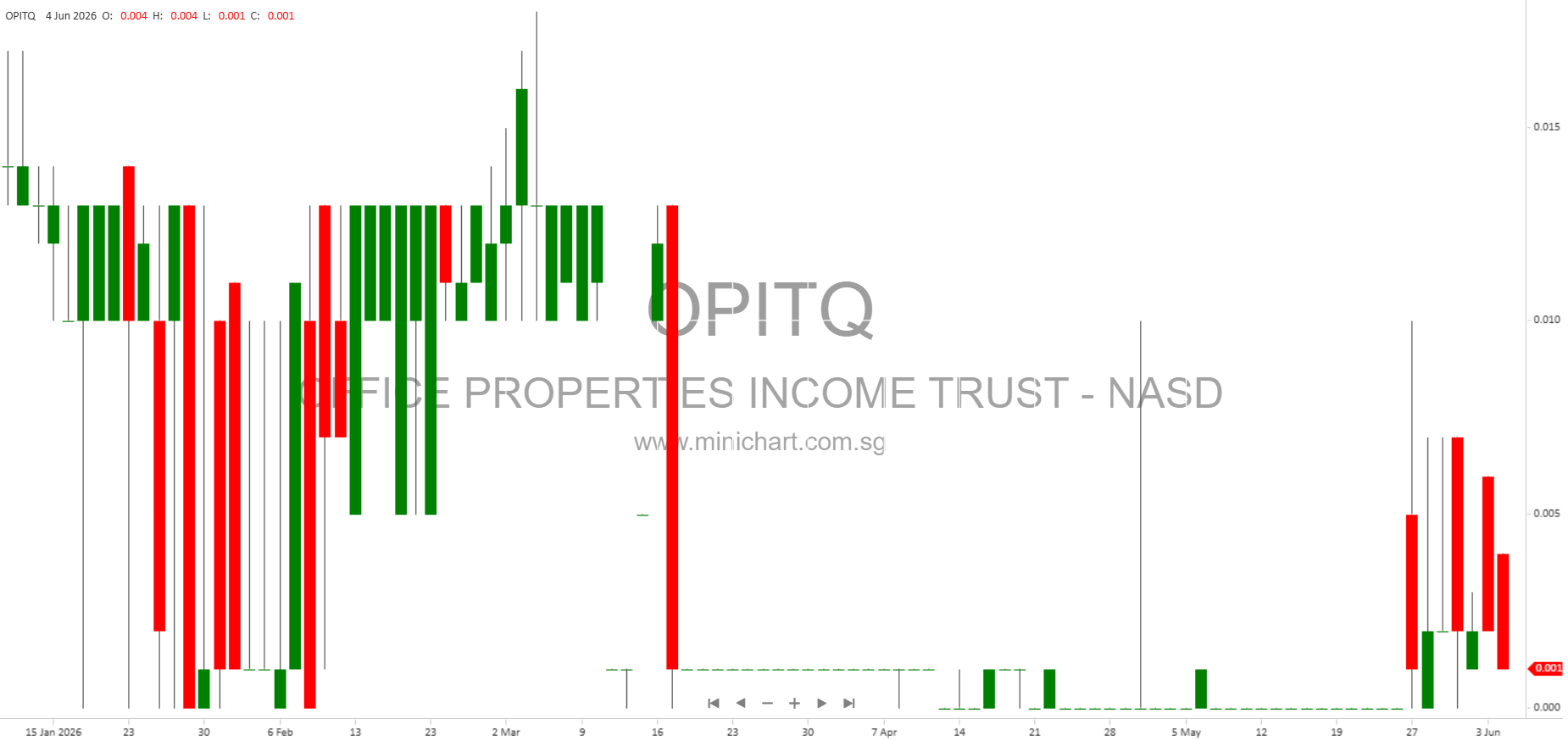
OPI is currently undergoing bankruptcy proceedings and a plan of reorganization. This is a critical and potentially price-sensitive development for shareholders:
- The company’s ability to continue as a going concern is subject to risks and uncertainties related to the bankruptcy process, including the finalization and consummation of its plan of reorganization.
- There are material uncertainties regarding OPI’s leverage levels, liquidity, refinancing prospects, lease renewal rates, and tenant stability.
- Forward-looking statements emphasize challenges from unfavorable market and real estate conditions, high inflation, interest rate volatility, government budget constraints, and changes in office space utilization.
Risks and Forward-Looking Statements
The report contains extensive warnings about forward-looking statements, including risks related to:
- Completion and outcomes of bankruptcy and reorganization
- Ability to manage debt, capital expenditures, and liquidity
- Potential further declines in occupancy and rental rates
- Market conditions, tenant defaults, and government lease renewals
- Regulatory changes, economic downturns, and other external risks
Key Takeaways for Shareholders
- Bankruptcy and Reorganization: The ongoing bankruptcy process is the most significant and price-sensitive factor, with the potential to materially affect share value depending on the outcome and recovery rates for equity holders.
- Weak Leasing and Occupancy Trends: Declining occupancy and NOI margins, as well as tenant concentration risks, could pressure future earnings and asset valuations.
- Asset Sales and Capital Allocation: OPI is actively selling assets and managing capital expenditures, but proceeds and redeployment opportunities appear limited.
- Uncertain Dividend and Distribution Prospects: The ability to pay distributions is uncertain and likely to be affected by the ongoing restructuring, high leverage, and operational challenges.
Conclusion
This report contains several price-sensitive developments for OPI shareholders, most notably the bankruptcy/reorganization process and the challenging leasing/operational environment. Investors should monitor the progress of the bankruptcy, lease renewals, occupancy trends, asset sales, and management’s ability to stabilize the portfolio and balance sheet.
Disclaimer: This article is for informational purposes only and does not constitute investment advice. Investors should review OPI’s filings with the SEC and consult their financial advisors before making any investment decisions. Forward-looking statements are inherently uncertain and subject to change.