Digital Core REIT 1Q26 Business & Operational Update: What Investors Need to Know
Summary of Key Highlights
- Strong Portfolio Performance: 97% occupancy, \$1.8 billion in Assets Under Management (AUM), and 4.4 years Weighted Average Lease Expiry (WALE) across 11 data centres.
- Resilient Financial Position: Aggregate leverage at 39.0%, with \$428 million debt headroom at 50% aggregate leverage, and 80% of debt at fixed rates, mitigating interest rate risks. Weighted average debt maturity stands at 3.5 years.
- Solid Distributable Income: US\$11.7 million distributable income in 1Q26; the Trust conducted a unit buyback of 7.1 million units at an average price of \$0.486, resulting in 0.3% DPU (Distribution per Unit) accretion.
- Strategic Growth Initiatives: Expansion and refurbishment of Linton Hall is expected to increase sellable capacity by 13% and generate a 35% increase over previous net rent.
- Favorable Market Dynamics: The rising demand for data centers, driven by digital economy and AI, positions the REIT well for continued growth. The sponsor’s global pipeline supports a path to a \$15 billion portfolio.
- Strong Customer Base: Over 79% of annualized rent comes from investment-grade or equivalent customers, with major hyperscale cloud service providers and technology giants accounting for the bulk of revenues.
- Significant Developments in Key Markets: Regulatory changes, new developments, and power grid constraints are shaping the trajectory in Northern Virginia, Silicon Valley, Los Angeles, Toronto, Frankfurt, and Osaka.
Detailed Operational and Financial Breakdown
Portfolio and Leasing Update
- Digital Core REIT continues to operate 11 high-quality data centers across the U.S., Canada, Germany, and Japan, maintaining a strong 97% occupancy rate.
- 1Q26 saw robust leasing activity with \$3 million in annualized new and renewal rents, and an impressive 44% cash rental reversion, notably in Frankfurt.
- The portfolio’s lease expiry profile is well staggered, reducing concentration risk. Weighted Average Lease Expiry (WALE) is 4.4 years, supporting income security.
- The Linton Hall refurbishment in Northern Virginia is set to add 13% more sellable capacity and deliver a significant 35% increase in net rent, enhancing cash flow visibility.
- All properties are 100% freehold in core markets, a key differentiator supporting long-term value and stability.
Financial Position and Capital Management
- Aggregate leverage stands at 39.0%, providing ample headroom for further growth and acquisitions before reaching the regulatory 50% limit.
- Debt maturity is well managed with a 3.5-year weighted average and 80% of borrowings hedged at fixed rates, reducing exposure to rising interest rates.
- The Trust’s interest coverage ratio is healthy at 3.3x, and the average cost of debt is 3.5%, supporting strong debt serviceability.
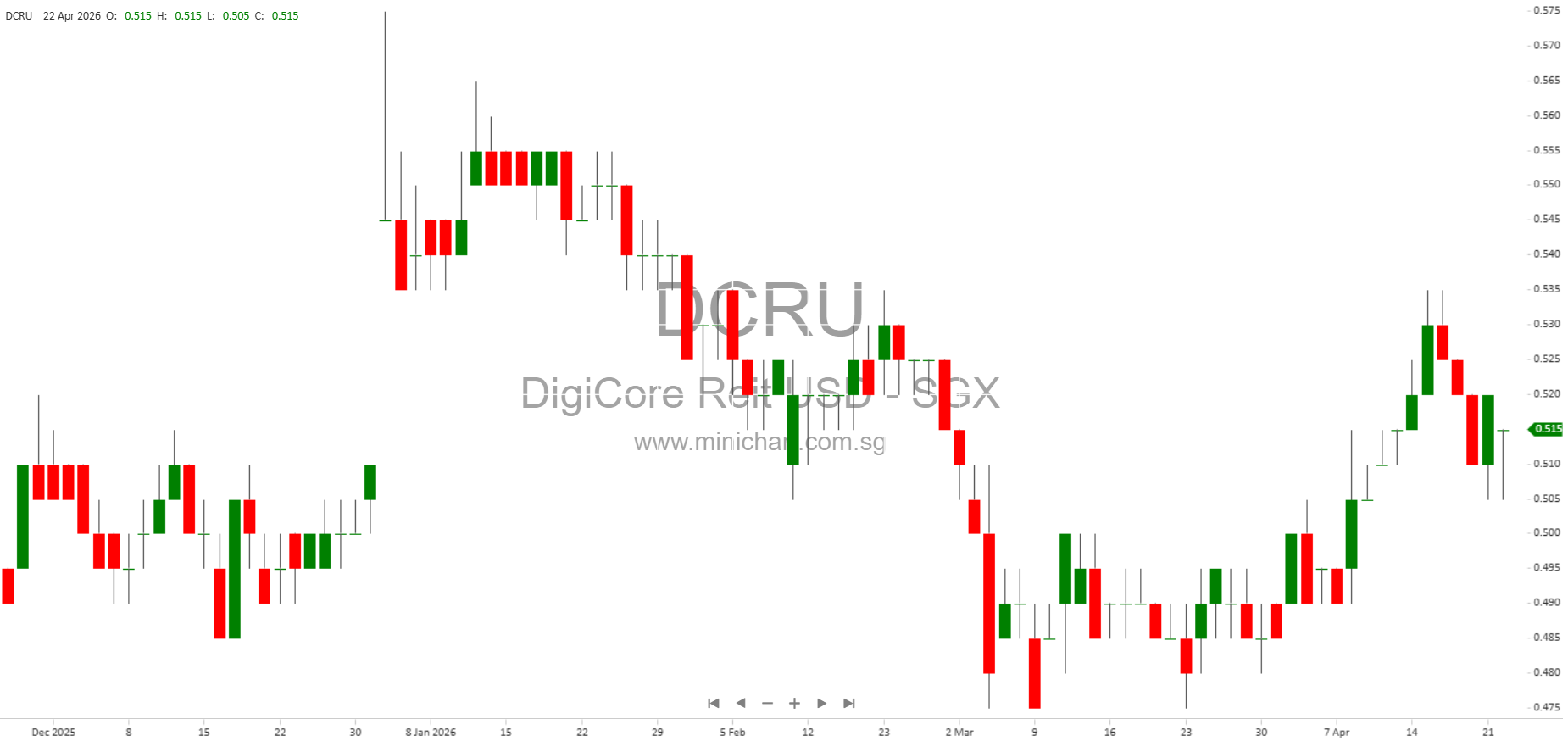
- Net Asset Value (NAV) per unit is \$0.79, while the unit price as of 31 March 2026 was \$0.485, representing a significant discount to NAV.
- The Trust repurchased 7.1 million units in 1Q26, delivering 0.3% DPU accretion—a move likely to be viewed as value-accretive by shareholders.
Customer and Revenue Profile
- The REIT’s top 10 customers contribute 86.4% of annualized rent, with the largest being a Fortune 50 software company (30.5% of rent), followed by other major global tech and cloud firms. This concentration among blue-chip tenants provides strong cash flow visibility but may be a risk if any key tenant downsizes or departs.
- 79% of tenant revenue comes from investment-grade or equivalent credit tenants, further underpinning the REIT’s risk profile.
- There are more than 120 customers, including hyperscale cloud service providers, social media companies, IT service providers, and other technology firms.
Market Trends and Regulatory Developments
- Northern Virginia: The region faces regulatory uncertainty with the ongoing debate over data center sales and use tax exemptions (worth \$1.6-1.9 billion/year, expiring 2035), new impact assessments for large projects, stricter generator standards, and a zoning amendment that will end by-right approvals, potentially slowing new supply and supporting pricing.
- Silicon Valley: Power scarcity in Santa Clara has stalled the activation of completed facilities, shifting new development toward San Jose. This presents both a risk (unutilized assets) and an opportunity (first-mover advantage in new submarkets).
- Los Angeles: Monterey Park is moving to permanently ban data centers, which would tighten supply and concentrate future development in areas like Vernon with favorable zoning and power availability.
- Toronto: Ontario’s Bill 40 established a clearer framework for grid connections, providing regulatory certainty for new data center projects. The Canadian government is also soliciting proposals for sovereign AI data centers, signaling continued demand growth.
- Frankfurt: Germany’s National Data Centre Strategy aims to double capacity by 2030, with new grid access rules and tax incentives. However, local politics can block new projects, as seen with Vantage Data Centers’ failed expansion attempt.
- Osaka: The market is seeing rapid AI-driven expansion, strong interest from international investors, and new liquid cooling deployments for AI workloads.
- Pricing Power: Across most markets, wholesale and hyperscale pricing has increased significantly since 2023, reflecting tightening supply and robust demand.
Growth Outlook and Pipeline
- The sponsor’s global platform provides access to over 300 stabilized data centers and a pipeline supporting potential portfolio growth to \$15 billion in AUM. External growth opportunities are concentrated in North America (52%), EMEA (28%), APAC (10%), Latin America (5%), and Africa (5%).
- Minimum acquisition criteria include at least 90% occupancy, market-comparable rental rates, and no major enhancement needs within two years of purchase, ensuring quality and stability of additions.
Potentially Price-Sensitive Developments for Shareholders
- Unit Buyback: The REIT’s repurchase of 7.1 million units at a discount to NAV and resulting DPU accretion is a positive signal of management’s confidence in the portfolio’s intrinsic value and may support share price appreciation.
- Portfolio Expansion: The Linton Hall refurbishment unlocking 13% additional capacity and 35% higher net rent is materially positive for future earnings and valuation.
- Regulatory Risks and Supply Dynamics: Regulatory actions in Northern Virginia (tax exemption uncertainty, new permitting requirements) and Silicon Valley (power grid delays) could slow new supply, bolstering rental growth and asset values for existing operators, including Digital Core REIT.
- Discount to NAV: Units trading at a substantial discount to NAV (approx. \$0.485 vs \$0.79) may represent a value opportunity if the market recognizes the resilience and growth prospects outlined by management.
- Market Positioning for AI: The REIT is well-positioned to capture the expected surge in AI inference workloads, which are projected to become the dominant driver of data center demand by 2027.
Strategic Risks and Considerations
- Customer Concentration: High reliance on a handful of major tenants, while positive for credit quality, presents a risk in the event of consolidation or tenant loss.
- Macro and Regulatory Risks: Unresolved policy debates (especially on tax exemptions in the US) and local opposition to new data centers (e.g., in Los Angeles and Frankfurt) could impact the pace of portfolio growth and asset values.
- Power Availability: Constraints in Silicon Valley and select US markets could delay revenue realization from completed facilities and affect near-term returns.
Conclusion
The 1Q26 update from Digital Core REIT reveals a robust, resilient, and growing data center platform well-positioned to benefit from global digital transformation and AI adoption. The REIT’s strong balance sheet, disciplined capital management, high-quality tenant base, and exposure to key global metros provide a solid foundation for growth. However, investors should closely monitor regulatory developments and supply/demand shifts, which could materially impact both risks and opportunities in the coming quarters.
Disclaimer: This article is for informational purposes only and should not be construed as investment advice or a recommendation to buy or sell any securities. All information is based on the company’s April 2026 investor update and is subject to change. Investors should conduct their own due diligence and consider their own investment objectives and risk tolerance before making any investment decisions. Past performance is not indicative of future results.