USBC, Inc. Transition Report: Key Investor Insights and Shareholder Risks
Summary of Key Points
- Change in Fiscal Year-End: USBC, Inc. shifted its fiscal year end from September 30 to December 31, effective 2026. The current report covers a three-month transition period (October 1, 2025 – December 31, 2025) and aligns future reporting with common industry practice and internal planning.
- Significant Recapitalization and Stock Increase: Outstanding shares of common stock increased dramatically from approximately 3 million as of December 31, 2024, to 388 million as of December 31, 2025, as part of a recapitalization and equity incentive plan. As of March 24, 2026, 388,144,429 shares were outstanding.
- Bitcoin Treasury Strategy: USBC, Inc. has adopted a strategy of holding Bitcoin as a treasury reserve asset. The company also engages in derivative trading (through external advisors) to generate yield on its Bitcoin holdings. This exposes the company to Bitcoin price volatility and related risks.
- NYSE American Listing Compliance Risks: USBC is currently operating under a compliance plan with NYSE American after failing to meet certain continued listing standards. If proposed stricter rules are adopted, USBC could face suspension or delisting if its share price or market capitalization falls below new thresholds.
- Equity Incentive Repricing and Dilution: In March 2026, the Board approved a repricing of all outstanding stock options and granted new equity awards. This will increase future stock-based compensation expense and may result in further dilution for current shareholders.
- “Controlled Company” Status: CEO Greg Kidd, through Goldeneye 1995 LLC, controls the majority of the company’s voting power, qualifying USBC as a “controlled company” under NYSE American rules. This allows exemption from certain governance standards, potentially reducing minority shareholder protections.
- Risks Related to Bitcoin and Digital Asset Exposure: The company’s financial results and share price are highly sensitive to movements in Bitcoin’s price. Regulatory, accounting, and custody risks add to earnings volatility and operational uncertainty.
- No Anticipated Dividends: USBC does not expect to pay cash dividends in the foreseeable future, with all earnings to be reinvested in growth and development.
In-Depth Details for Investors
1. Fiscal Year-End Change
USBC, Inc. changed its fiscal year-end to December 31 to align with industry peers and streamline budgeting and reporting. The current filing is a “Transition Report” covering the short three-month period from October 1, 2025 to December 31, 2025, after which regular calendar-year reporting will resume.
2. Recapitalization, Stock Increase, and Equity Dilution
In 2025, USBC underwent a major recapitalization and adopted an Amended and Restated 2021 Equity Incentive Plan. This resulted in a massive increase in shares outstanding—from about 3 million (end of 2024) to approximately 388 million (end of 2025). This fundamental change in capitalization is highly material for shareholders, as it significantly dilutes the value of each share and may impact earnings per share and future share price.
In March 2026, all outstanding stock options were repriced, and additional equity awards were granted. This will be accounted for as a modification and will cause an increase in stock-based compensation expense, further diluting shareholders. The company expects to continue granting equity awards, which may further dilute existing shareholders and affect the market price.
3. Bitcoin Treasury and Derivatives Strategy
USBC holds Bitcoin as a core treasury asset and utilizes derivatives to generate yield through a third-party advisor. The company does not operate a third-party trading desk, and all derivative activity is for corporate treasury purposes only. This strategy exposes USBC to Bitcoin price volatility, market manipulation risks, limited liquidity (especially in stress scenarios), and counterparty risks, as well as to regulatory and accounting uncertainties.
Shareholders should note: The company’s financial results and market value are highly sensitive to Bitcoin price swings. Fluctuations in Bitcoin’s price may lead to substantial unrealized gains or losses, which directly impact reported income/loss and share price, regardless of operational performance.
4. NYSE American Listing Compliance & Delisting Risks
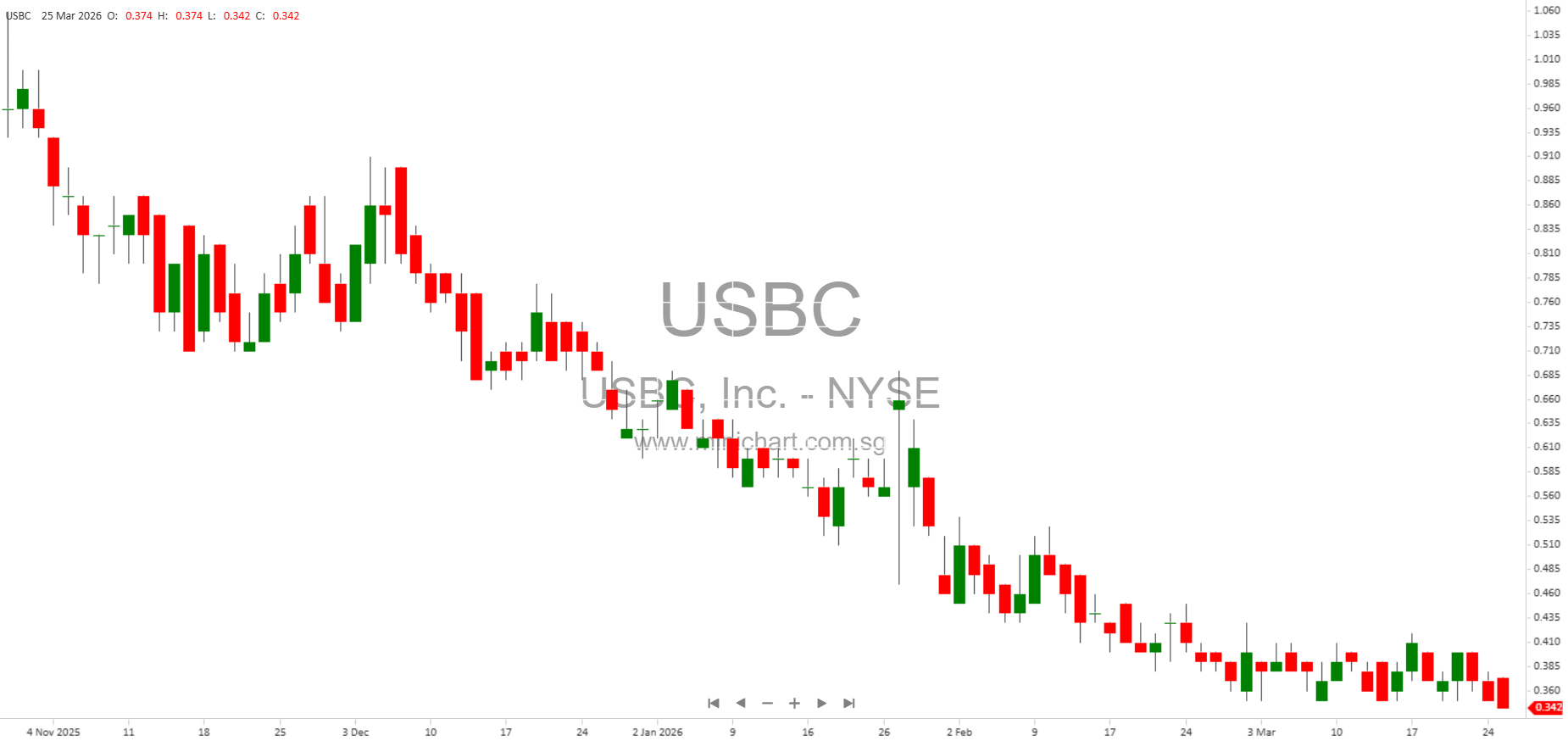
USBC is currently under a compliance plan with NYSE American after failing to meet certain listing standards (including minimum stockholders’ equity and market capitalization). Proposed new rules could lead to immediate suspension and delisting if the company’s average market cap falls below \$5 million or the share price falls below \$0.25. USBC’s recent trading price has been close to this threshold, putting it at risk of delisting if the rules are adopted. Delisting risks include loss of liquidity, reduced analyst coverage, classification as a “penny stock,” and impaired ability to raise capital.
The company has not ruled out a future reverse stock split to support compliance, but notes that previous reverse splits have not always resulted in sustained price improvement and may reduce liquidity.
5. Controlled Company Structure
CEO Greg Kidd, through Goldeneye 1995 LLC, controls a majority of the company’s voting power. This qualifies USBC as a “controlled company” under NYSE American rules, making it exempt from certain corporate governance requirements. This concentration of control may give rise to conflicts of interest, especially with respect to treasury-management decisions, and reduces protections for minority shareholders.
6. Forward-Looking Risks and Regulatory Uncertainty
USBC operates in a rapidly changing regulatory environment, with exposure to federal and state securities, commodities, money-transmission, tax, and prudential regulations, as well as evolving rules on digital assets. The company adopted new fair-value accounting for crypto assets in 2025, which increases earnings volatility. If Bitcoin were ever classified as a “security,” USBC could be forced to sell assets or restructure to comply with the Investment Company Act.
The company’s valuation and internal controls for digital assets are complex and subject to significant judgment; errors could result in restatements or material weaknesses in financial reporting.
7. No Cash Dividends Anticipated
USBC has never paid cash dividends and intends to continue retaining all earnings to fund business growth and development. Any appreciation in stock value will be the primary source of investor return.
8. Other Price-Sensitive Risks
- Volatility in Bitcoin’s market price and USBC’s financial results may cause the stock to trade as a proxy for Bitcoin rather than reflecting operational fundamentals.
- Significant stock-based compensation, future equity financings, or sales by large shareholders may further dilute share value.
- Potential delisting would reduce liquidity, impair capital raising, and could result in classification as a “penny stock.”
- Yield-generating and derivative strategies in Bitcoin are relatively untested at public-company scale and entail counterparty and liquidity risks.
- The company’s Science Division’s sensor technologies may face regulatory delays or higher costs if classified as medical devices by the FDA.
Potential Share Price Movers
- Risk of NYSE American Delisting: If USBC fails to maintain compliance with NYSE American standards or if new, stricter rules are approved, the company faces immediate suspension and delisting risk. This would severely impact share liquidity and value.
- Massive Dilution and Recapitalization: The rapid increase in shares outstanding and ongoing equity awards are highly dilutive and may drive down share price.
- Bitcoin Price Volatility: The company’s financials and stock price are now closely tied to Bitcoin’s market price, which is extremely volatile and affected by many unpredictable factors.
- “Controlled Company” Risks: Minority shareholders have reduced influence, and major decisions—including treasury management—are controlled by a single entity.
Disclaimer: This article is based on the company’s SEC filings and is intended for informational purposes only. It does not constitute investment advice or a recommendation to buy or sell securities. Investors should perform their own due diligence and consult with a qualified financial advisor before making investment decisions. The information reflects the company’s disclosures as of the dates indicated and may be subject to change or revision. Investing in USBC, Inc. involves significant risks, including but not limited to those highlighted above.