Prime US REIT 2025 Full-Year Investor Update: Portfolio Strengthening and Resilient Performance
Prime US REIT (SGX: OXMU) has released its full-year investor update for FY2025, highlighting a robust rebound in portfolio fundamentals, improved leasing momentum, and disciplined capital management. The REIT, which owns 13 Class A, freehold office properties strategically located across 12 non-gateway U.S. submarkets, enters 2026 on a firmer footing. This comprehensive update details the developments investors must pay attention to, with several price-sensitive factors that could affect share value.
1. Portfolio Performance and Valuation
- Portfolio Value: The REIT’s portfolio was valued at US\$1.4 billion as of 31 December 2025, reflecting a 3.5% year-on-year increase. This was driven by broad-based gains across most assets, primarily due to improved contracted cash flows.
- Occupancy and Leasing: Occupancy improved significantly to 82.7% from a low of 78.9%. Weighted Average Lease Expiry (WALE) was extended to 5.6 years from 4.4 years. In FY2025, the REIT leased out 680,000 sq ft (16% of Net Lettable Area) with a +5.6% rental reversion, a substantial improvement over FY2024 (+1.8% rental reversion).
- Resilient Asset Values: Notably, several properties saw double-digit valuation increases. For example, Tower 909 in Dallas rose 20.4%, Waterfront at Washingtonian (Suburban Maryland, DC) jumped 29.2%, and Reston Square advanced 23.5%. Some assets, like 171 17th Street in Atlanta and Tower I at Emeryville, experienced valuation declines due to higher cap and discount rates, reflecting localized challenges and comparable distressed sales.
2. Financials and Distribution
- Distribution Per Unit (DPU): For FY2025, DPU normalized to 0.61 US cents (up from 0.29 US cents in FY2024), with the distribution payout ratio significantly increased to 65% from 10% in the previous year. This is a direct result of stronger leasing and higher committed occupancy.
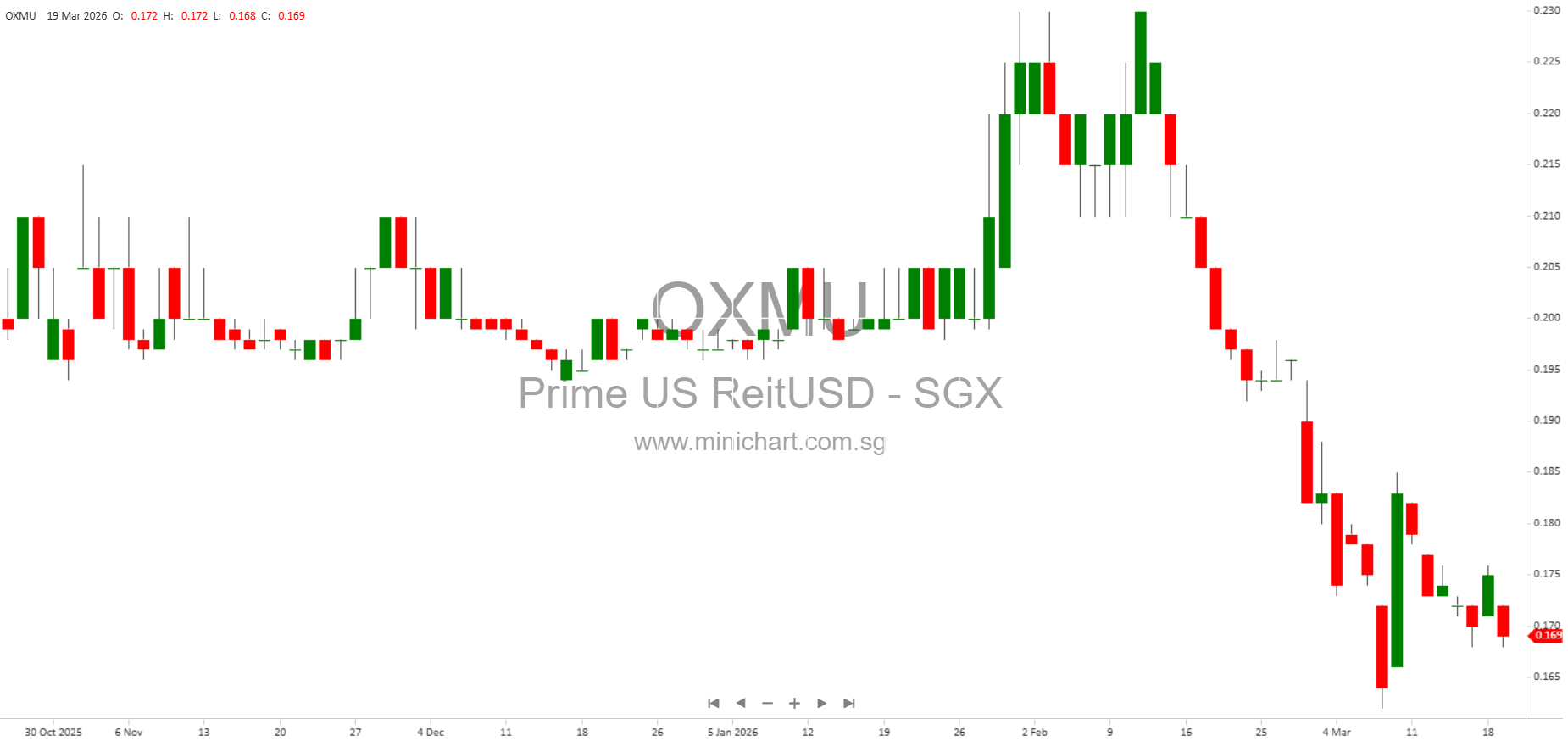
- Net Asset Value (NAV) and Unit Price: NAV per unit stands at US\$0.53, while the unit price was trading at US\$0.197 at year-end, representing a 63% discount to NAV. This deep discount may draw attention from value investors and could be a catalyst for share price movement if sentiment improves.
- Leverage and Liquidity: Aggregate leverage was managed down to 45.0%, with US\$144 million in debt headroom and US\$65 million in undrawn facilities. A US\$25 million equity fund raise in October 2025, alongside prior earnings retention, fortified the balance sheet and funded leasing capex and tenant incentives, supporting current cash flow visibility and payout step-up.
- Interest Coverage: The interest coverage ratio is at 1.7x, with a weighted average interest rate of 5.4%.
3. Market Trends and Outlook
- US Office Market Recovery: The sector is showing signs of an expansionary cycle with two consecutive quarters of positive net absorption, a 5.2% YoY increase in leasing activity, and a 35% rise in investment sales activity in 2025. The “flight to quality” trend persists, with demand focused on highly-amenitized, Class A, and newer assets.
- Return-to-Office Momentum: By end-2025, 97% of Fortune 100 employees were subject to hybrid or full-time office requirements. The normalization of attendance policies and recent rightsizing has left many major occupiers in need of expansion space.
- Macroeconomic Environment: The US economy grew at 0.7% in 4Q2025, unemployment remained low at 4.4%, and inflation was at 2.4%. The Federal Reserve maintained rates at 3.50% to 3.75%.
4. Key Portfolio Developments and Leasing Activity
- Major New Leases: Park Tower (Sacramento) signed a 121,000 sq ft lease with the Sacramento County District Attorney’s Office, boosting occupancy from 65.1% to 89.9%. 222 Main (Salt Lake City) secured a 61,000 sq ft lease with the U.S. Attorney’s Office, raising leased occupancy close to 90%.
- Waterfront at Washingtonian’s valuation rose 29.2% following a 120,000 sq ft lease with X-energy and an impending further expansion, expected to drive occupancy above 90%.
- Village Center Station I is in advanced negotiations for 39,000 sq ft with a financial firm and a 12-20,000 sq ft expansion from a newly signed tenant, which will lift occupancy above 80%.
- Sector & Tenant Diversification: The top 10 tenants contribute 42.4% of cash rental income, with the largest tenant, Charter Communications, at 10.5%. Sectors include communications, health care, finance, legal, government, and more—supporting income stability.
- Lease Expiry Profile: WALE is 5.6 years with only 6.8% of leases (by NLA) expiring in 2026. Annual rent escalations of 2-3% are in place for nearly all leases.
5. Strategic Focus and Asset Enhancement
- Re-amenitisation: Village Center Station I underwent major amenity upgrades, including a redesigned lobby, new tenant lounge, conference room, and security enhancements, positioning it to attract higher-quality tenants and further boost occupancy.
- Occupancy-Driven Growth: Management remains focused on increasing occupancy and tenant retention through proactive leasing, capital discipline, and asset quality maintenance.
6. Shareholder and Price-Sensitive Information
- Deep Discount to NAV: The persistent 63% discount to NAV is a major point for value-seeking investors and could trigger price movements should sector sentiment or asset performance improve.
- Distribution Normalization: The step-up in payout ratio to 65% and visible contracted rental cash flows provide clarity on future distributions, likely to be well-received by income-focused investors.
- Asset Valuation Swings: Large swings in asset valuations, both up and down, could affect NAV and investor sentiment, particularly in markets like Atlanta and Emeryville, where cap rates are volatile.
- Improved Liquidity and Debt Headroom: The REIT’s improved liquidity position gives it the flexibility to pursue large-scale tenants and weather market uncertainties, a key consideration for institutional investors.
Conclusion
Prime US REIT’s 2025 update signals a clear turnaround in portfolio fundamentals, supported by strong leasing activity, rising asset values, normalized distributions, and a robust balance sheet. The REIT’s focus on asset quality, tenant retention, and disciplined capital management places it in a strong position to benefit from the ongoing recovery in the U.S. office market. The significant discount to NAV, normalization of distributions, and visible rental cash flows are all potentially price-moving factors that shareholders and investors should closely monitor in the coming quarters.
Disclaimer: This article is for informational purposes only and does not constitute investment advice. Forward-looking statements are subject to risks and uncertainties. Investors should conduct their own research or consult with a professional advisor before making investment decisions. The value of investments can rise or fall, and past performance is not indicative of future results.