Ranpak Holdings Corp. Reports Strong Second Quarter 2026 Financial Results, Driven by Surging Automation Revenue
Key Points
- Net revenue rose 14.0% year-over-year to \$105.2 million (12.2% on a constant currency basis).
- Automation product line net revenue increased 139.4% year-over-year on a constant currency basis (excluding warrants), with Automation expected to achieve nearly \$60 million in FY2026 revenue.
- Adjusted EBITDA (AEBITDA) grew 15.8% to \$19.1 million (up 13.9% on a constant currency basis).
- Net loss slightly widened to \$7.9 million from \$7.5 million last year.
- PPS system placement decreased 2.3% year-over-year to ~141,700 machines as of June 30, 2026.
- Strong liquidity position: \$43.2 million in cash, no borrowings on the \$50 million revolver (maturing December 2029).
- Guidance reaffirmed for full-year targets amid ongoing cost discipline and margin focus.
Detailed Analysis
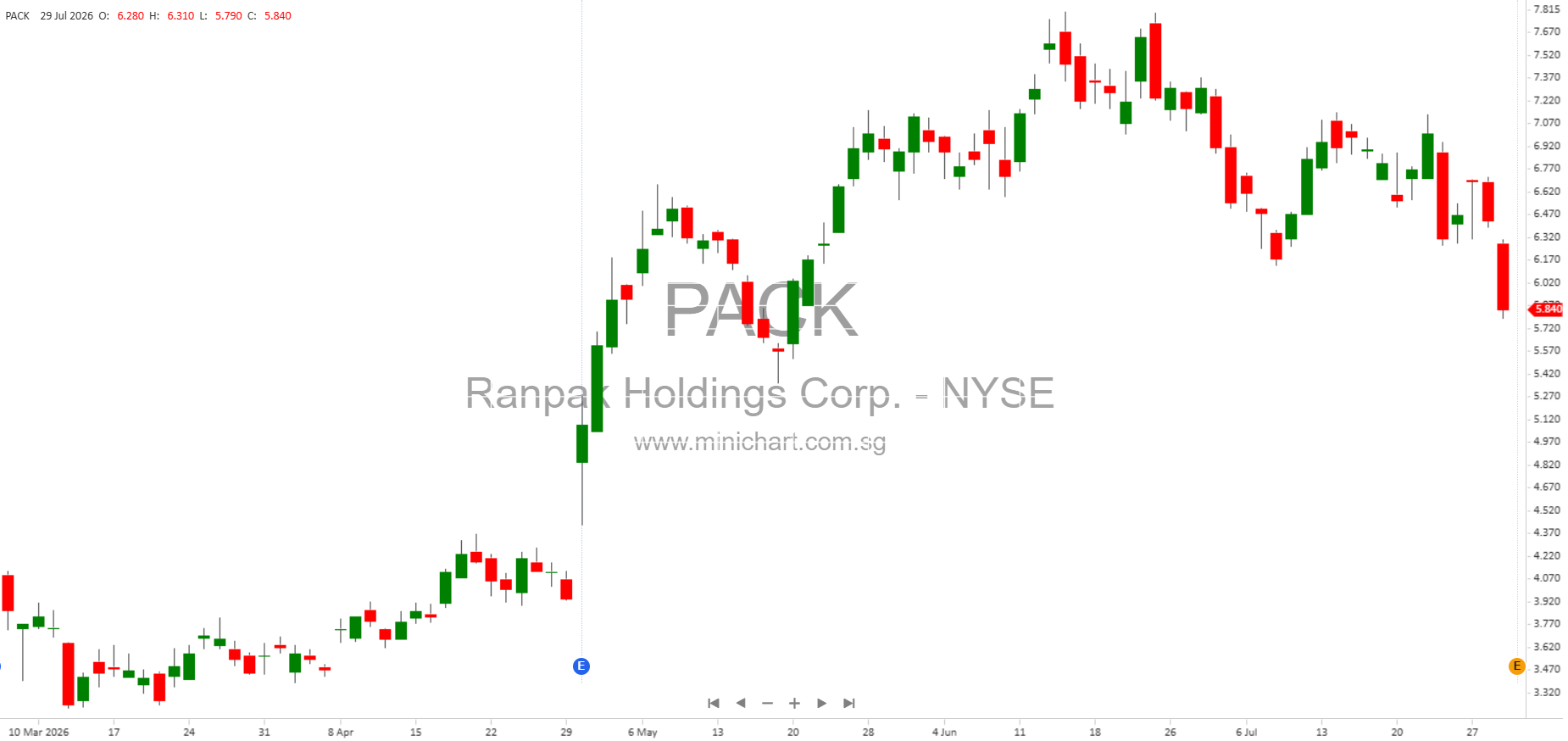
Ranpak Holdings Corp. (NYSE: PACK), a leader in sustainable, systems-based product protection and automation solutions for e-commerce and industrial supply chains, announced robust second quarter 2026 results, reflecting continued execution on its automation growth strategy and resilience in dynamic market conditions.
Financial Performance
- Net Revenue: The company delivered Q2 net revenue of \$105.2 million, up 14.0% from \$92.3 million a year ago, and up 12.2% on a constant currency basis. This figure includes a \$1.7 million non-cash reduction related to warrants issued to major customers (Amazon and Walmart), compared to a \$1.2 million reduction in the prior period. Automation, void-fill, and wrapping products were the biggest contributors, while cushioning revenue declined.
- Revenue by Product Line:
- Automation: \$16.6 million (up 133.8% from \$7.1 million)
- Void-Fill: \$44.8 million (up 9.0% from \$41.1 million)
- Wrapping: \$8.7 million (up 19.2% from \$7.3 million)
- Cushioning: \$35.1 million (down 4.6% from \$36.8 million)
- Volume Drivers: Growth was driven by a 10.0% increase in automation equipment sales, a 2.4% rise in paper consumable volumes, and a 1.8% positive impact from foreign currency, partly offset by an increase in non-cash warrant provisions.
- Profitability: Gross profit improved to \$34.5 million (32.8% margin vs. 31.3% last year). AEBITDA rose 15.8% year-over-year to \$19.1 million (18.2% margin), primarily due to higher automation sales and ongoing cost control. The net loss was \$7.9 million, slightly higher than the \$7.5 million loss in Q2 2025.
Operational and Balance Sheet Highlights
- PPS System Placements: The installed base of PPS systems decreased 2.3% to 141,700 units, with void-fill, cushioning, and wrapping categories all seeing modest declines.
- Liquidity: Ranpak ended the quarter with \$43.2 million in cash, no borrowings on its \$50 million revolver (which matures in December 2029), and \$47.2 million available under the facility after accounting for letters of credit. Total debt was \$403.9 million under the U.S. first lien term loan (maturing December 2031).
- Balance Sheet: Total assets were \$1.1 billion, with shareholders’ equity at \$519.9 million (down from \$534.9 million at year-end 2025 due to the net loss and other comprehensive loss items).
Management Commentary and Strategic Updates
- Automation is the Key Growth Driver: CEO Omar Asali emphasized the “excellent growth in Automation,” noting that the company remains on track for approximately \$60 million in automation revenue for 2026, with continued strong momentum and market acceptance of Ranpak’s automation solutions (including box customization and automated dunnage insertion).
- Geographical Performance: PPS volumes increased 2.4% year-over-year, led by growth in EMEA (Europe, Middle East, and Africa), which outperformed expectations.
- Portfolio Evolution: Ranpak is focused on expanding its portfolio in automation and sustainable cold chain solutions, reducing exposure to commoditized products with limited growth opportunities.
- Cost Discipline: The company continues to exercise discipline on costs and investments, positioning itself to achieve both near-term guidance and long-term revenue targets via expanded capacity in the second half of 2026.
Other Investor-Relevant Information
- Non-GAAP Financials: Ranpak uses AEBITDA and constant currency metrics to provide a clearer picture of core operating performance, but cautions that these are non-GAAP measures and have analytical limitations.
- Conference Call: Management hosted an investor call on July 30, 2026, with a webcast replay available.
Risks and Forward-Looking Statements
Ranpak highlighted a number of risks that could impact future results, including:
- Supply chain pressures and potential shortages of key inputs like paper
- Rising costs for labor, energy, and freight
- Geopolitical conflicts, tariffs, and macroeconomic uncertainty (including inflation)
- Competition and changes in customer preferences or inventory strategies
- Potential loss of key customers or failure of new products to achieve market acceptance
- Challenges in meeting ESG targets and compliance with evolving disclosure requirements
Management reaffirmed their guidance for the year but warned that ongoing volatility could affect results.
Shareholder-Relevant, Price-Sensitive Items
- Automation revenue more than doubled and is expected to reach nearly \$60 million for FY2026—a major growth catalyst and likely to be viewed as highly positive by the market.
- Strong double-digit revenue and AEBITDA growth with improved gross margins, despite macroeconomic headwinds.
- PPS system placements declined, which may be a minor concern, but was offset by automation momentum.
- Guidance reaffirmed, indicating management confidence in delivering on targets.
- Strong liquidity position and no borrowings on the revolver provide financial flexibility.
- Ongoing warrant-related non-cash reductions in revenue tied to Amazon and Walmart agreements should be monitored by shareholders as they affect headline numbers but not underlying cash flows.
Conclusion
Ranpak’s Q2 2026 results highlight a business in transition, with automation rapidly becoming the engine for growth and margin improvement. Broad-based revenue and AEBITDA gains, strong liquidity, and reaffirmed guidance are all positive signals for investors. However, shareholders should remain aware of ongoing macro risks, competitive pressures, and the impact of non-cash warrant-related items on reported results.
Disclaimer: This article is for informational purposes only and does not constitute investment advice. Investors should consult the company’s official filings and their own advisors before making investment decisions. Past performance is not indicative of future results.