Morningstar, Inc. Reports Robust Second-Quarter 2026 Results: Revenue, Income, and Cash Flow Surge
Chicago, July 29, 2026 – Morningstar, Inc. (Nasdaq: MORN), a leading provider of independent investment insights, announced strong financial results for the second quarter and first half of 2026, indicating continued operational momentum and strategic execution. The company reported significant increases in revenue, operating and adjusted operating income, profit margins, and cash flows, all of which are critical metrics for current and prospective shareholders.
Key Financial Highlights
- Q2 2026 Revenue Growth: Total revenue rose 9.6% year-over-year to \$663.2 million. Organic revenue (excluding M&A, currency, and discontinued products) increased 6.8%, and would have grown 8.2% if not for the sunsetting of certain products.
- Operating Income: Operating income soared 28.4% to \$160.6 million. Adjusted operating income was up 22.7% to \$175.9 million. Operating margins improved to 24.2% from 20.7% a year ago, with adjusted margin expanding to 26.5% from 23.7%.
- Profitability: Diluted net income per share jumped 35.4% to \$2.83, with adjusted diluted net income per share up 29.2% to \$3.10. Year-to-date, diluted EPS rose 41.9% to \$5.55, with adjusted diluted EPS up 35.4% to \$6.27.
- Cash Flow Strength: Cash provided by operating activities in Q2 surged 57.3% to \$155.7 million, while free cash flow nearly doubled, rising 96.3% to \$122.5 million. Year-to-date, operating cash flow increased 30.1% to \$247.2 million and free cash flow climbed 45.3% to \$176.1 million.
- Capital Allocation: The company repurchased 567,844 shares for \$100 million in Q2 and 2,291,256 shares for \$400 million year-to-date. Dividends paid in Q2 totaled \$19 million.
- Healthy Balance Sheet: As of June 30, 2026, Morningstar held \$523.8 million in cash, equivalents, and investments, and \$1.7 billion in debt, up from \$528.7 million and \$1.1 billion, respectively, at year-end 2025.
Operational and Strategic Highlights
- Acceleration of AI and Data Initiatives: CEO Kunal Kapoor highlighted the company’s “ambitious strategy” to accelerate insight delivery by building agentic workflows and tools on top of Morningstar’s proprietary data, research, and intellectual property. This includes increased cloud spending and investments in AI initiatives.
- Expanded Distribution and Collaborations: Morningstar is broadening access to its content through new partnerships with leading model and enterprise technology providers, supporting a wider client base and new use cases.
- Growth in Credit and Wealth Segments: Morningstar Credit was a standout performer, with revenue climbing 23.4% year-over-year to \$104.9 million, driven by robust issuance, particularly in US structured finance ratings and North American corporates. Adjusted operating income in this segment leapt 26.2% with margin rising to 36.7%.
- Wealth Division Under Transition, but Improving: Morningstar Wealth revenue declined 6.2% (4.6% organically) to \$60.3 million, mostly due to the sunsetting of Morningstar Office. However, excluding this impact, organic revenue would have increased 5.3%. Adjusted operating income in Wealth surged 163.3% to \$7.9 million, with margin up to 13.1%.
- Retirement Business Growth: Morningstar Retirement revenue grew 17.0% to \$37.9 million, with AUMA up 9.0% to \$311 billion. Adjusted operating income rose 26.0% to \$19.4 million, and margin reached 51.2%.
- PitchBook Platform Steady: PitchBook revenue increased 4.9% to \$174.7 million, with growth contributions from core investor/advisor segments and direct data business. Adjusted operating income was stable at \$53.0 million, but margin declined to 30.3% due to higher compensation and tech spend.
- Acquisition of CRSP: The February 2026 acquisition of the Center for Research in Security Prices (CRSP) was accretive to operating margins and added significant index-linked assets (\$3.3 trillion as of June 30, 2026).
- Shareholder Returns: The company continued aggressive share repurchases and paid regular dividends, demonstrating confidence in long-term growth and commitment to returning capital to shareholders.
Segment Performance Details
- Morningstar Direct Platform: Revenue reached \$222.1 million (up 6.2%), with adjusted operating income at \$100.3 million (up 4.2%). Margin declined slightly to 45.2% due to higher compensation and technology costs, primarily associated with supporting growth priorities and cloud migration.
- PitchBook: Revenue was \$174.7 million (+4.9%), adjusted operating income \$53.0 million (+0.4%), but margin shrank by 1.4 points to 30.3%, reflecting increased investment in headcount and AI initiatives.
- Morningstar Credit: Revenue up 23.4% to \$104.9 million, with operating leverage driving margin to 36.7%.
- Morningstar Wealth: Revenue fell to \$60.3 million, but underlying investment management saw growth, and operating income and margins improved sharply after cost actions and product transitions.
- Retirement: Strong performance with 17% revenue growth and robust margins (51.2%).
- Indexes and Sustainalytics: Morningstar Indexes saw revenue jump, especially due to CRSP, while Sustainalytics’ revenue declined due to the retirement of the second-party opinions product.
Other Noteworthy Developments and Risks
- Tax Rate Increase: The company’s effective tax rate increased to 26.2% from 22.8% in the prior year, mainly due to unfavorable stock-based compensation vesting impacts and deferred taxes on unremitted foreign earnings. This could impact net income growth rates going forward.
- Cost Pressures: Compensation costs remain a key expense driver across segments, given higher salaries, bonuses (reflecting strong performance), and increased hiring to support growth and AI/data initiatives.
- Debt Levels: Morningstar’s debt increased to \$1.7 billion from \$1.1 billion at year-end, primarily to fund acquisitions and share repurchases. While manageable given cash flow, rising interest rates or leverage could become a concern if not offset by sustained earnings growth.
- Product Sunsetting Impact: The retirement of Morningstar Office and certain Sustainalytics offerings has temporarily depressed organic revenue growth rates. However, underlying growth in core products remains strong.
- Risks and Forward Guidance: Management highlighted ongoing risks, including failure to achieve benefits from acquisitions (notably CRSP), brand/reputation risks, cybersecurity, macroeconomic or market volatility, challenges in product innovation, AI-related risks, talent retention, regulatory issues, and execution risk on strategic initiatives. These factors could impact future performance and share value.
What Investors Should Watch
- Continued Growth in Core Segments: Watch the performance of Morningstar Credit, Direct, and Retirement as they continue to drive organic growth.
- Execution of AI and Tech Initiatives: The company’s increased investments in AI and data infrastructure are designed to drive future growth but come with execution and cost risks.
- Impact of CRSP Acquisition: This acquisition is already accretive to margins and index-linked assets, but long-term integration and revenue realization will be key for future value.
- Capital Returns: Aggressive share repurchases and dividend payments are supportive for shareholder value, but investors should monitor leverage and balance sheet health.
- Margin Sustainability: Margin improvement has been a highlight, but offsetting cost pressures and technology investment will be ongoing challenges.
Conclusion
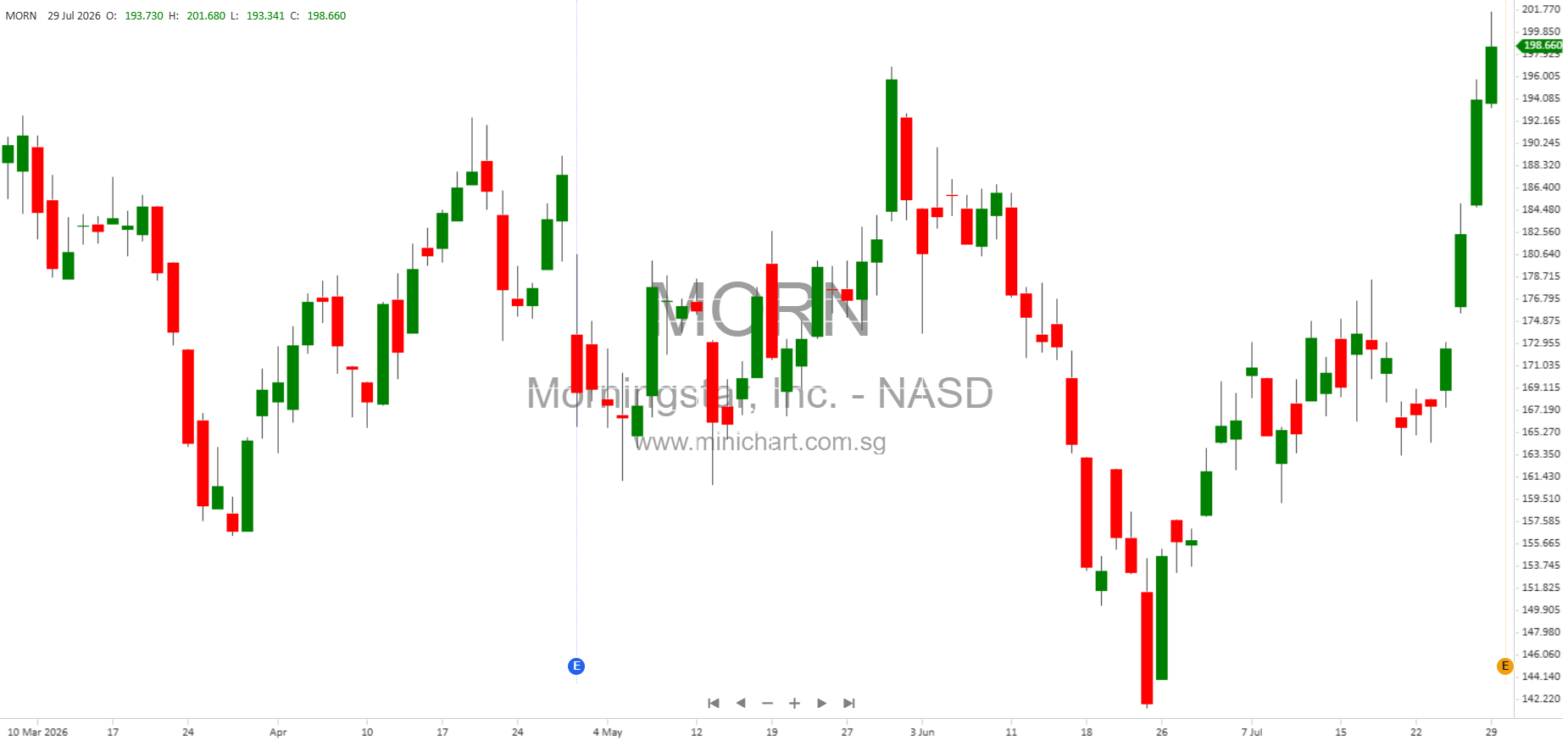
Morningstar’s Q2 2026 results demonstrate strong growth, improved profitability, and robust cash generation, all of which are positive indicators for the company’s future outlook and have the potential to move the share price. Investors should closely monitor the ongoing execution of strategic technology investments, the impact and integration of recent acquisitions, and the sustainability of margin and cash flow improvements.
Disclaimer: This article is for informational purposes only and does not constitute investment advice or a recommendation to buy or sell any securities. Investors should conduct their own due diligence and consult with their financial advisor before making investment decisions. Forward-looking statements in the article are based on management’s current expectations and are subject to risks and uncertainties, which may cause actual results to differ materially.