Altria Group, Inc. Reports Q2 2026 and First-Half Results, Narrows Full-Year Guidance
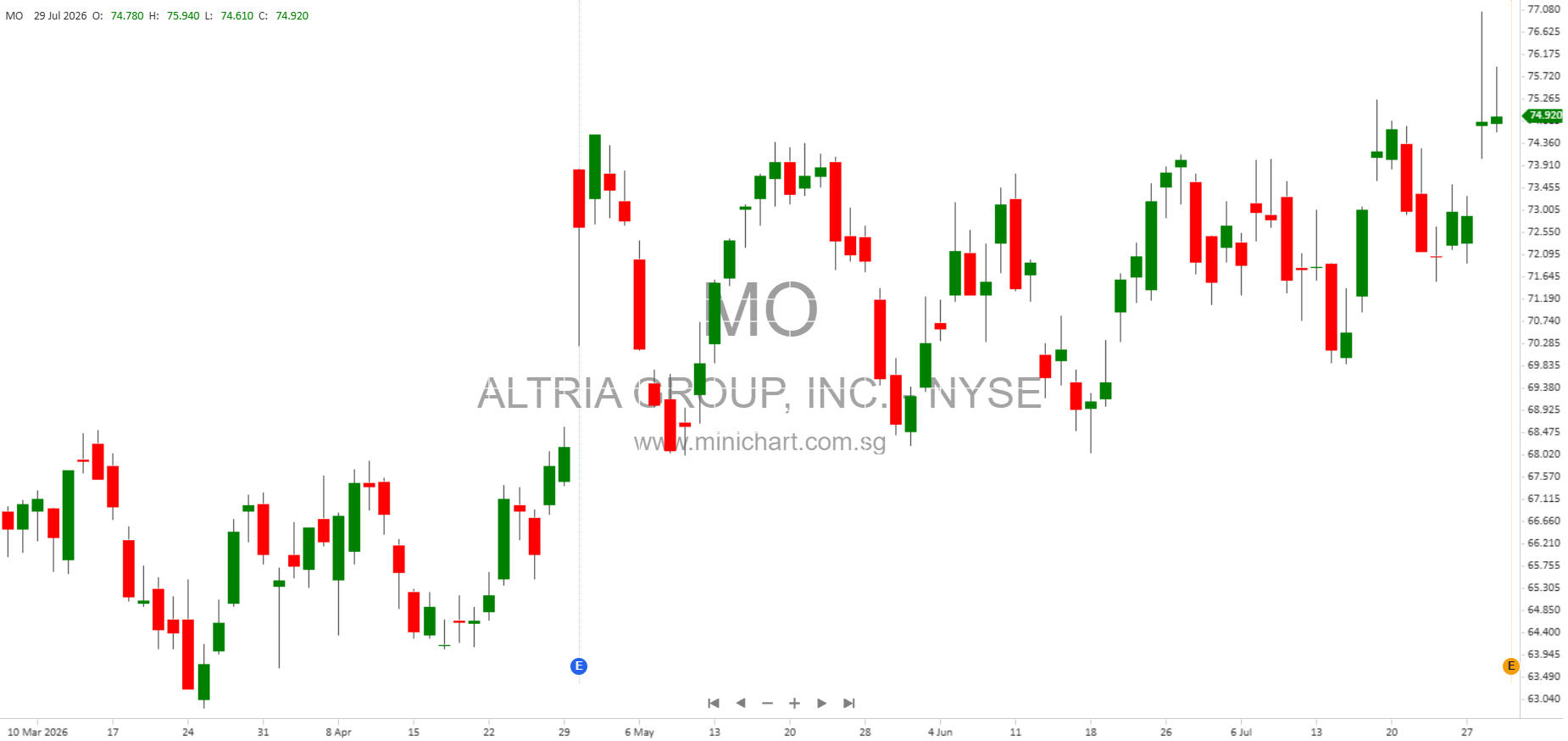
RICHMOND, Va. – Altria Group, Inc. (NYSE: MO) has released its financial and operational results for the second quarter and first half of 2026, accompanied by a narrowed full-year earnings guidance. The update contains several important announcements and developments that may significantly impact shareholder value and the company’s share price.
1. Key Financial Highlights
- Net Revenues: Q2 2026 net revenues were \$6.11 billion, nearly flat year-over-year (+0.1%), while first-half 2026 net revenues rose 1.6% to \$11.54 billion.
- Revenues Net of Excise Taxes: Q2 up 1.2% to \$5.36 billion; first half up 3.1% to \$10.11 billion.
- Adjusted Diluted EPS: Q2 2026 increased 2.8% to \$1.48; first half up 4.9% to \$2.80.
- Reported Diluted EPS: Q2 decreased by 2.8% to \$1.37, but first half surged 30.9% to \$2.67, largely due to the absence of a 2025 impairment charge that weighed on the prior year.
- Cash Returns to Shareholders: Nearly \$3.9 billion returned to shareholders in the first half via dividends and share repurchases.
- Share Repurchases: 5.3 million shares bought at an average price of \$62.78 each, with \$665 million remaining under the current \$2 billion program expiring December 31, 2026.
- Dividends: \$3.6 billion paid in the first half of 2026.
2. Updated 2026 Full-Year Guidance
- Narrowed EPS Guidance: Adjusted diluted EPS guidance tightened to \$5.61–\$5.72 (previously wider), representing 3.5%–5.5% growth over 2025’s base of \$5.42.
- Capital Expenditures: Capex guidance raised to \$375–\$450 million (previously \$300–\$375 million), mainly to support USSTC manufacturing consolidation.
- Assumptions: Guidance reflects expectations around moderated e-vapor growth, macroeconomic uncertainty for adult nicotine consumers, investments in contract manufacturing, non-return of NJOY ACE to market in 2026, reinvestment of cost savings, and greater benefit from cigarette import/export activity in H2 2026.
3. Operational Developments and Segment Performance
Smoke-Free Portfolio
- Helix (on! PLUS): Expanded to 120,000 stores; resumed shipments of 12-mg on! PLUS in key states (FL, NC, TX) with national expansion planned in Q3 and new flavors launching in Q4 (Blueberry Mint, Mango Pineapple).
Smokeable Products
- Marlboro: “Cowboy Cut” generated strong interest among premium smokers; Basic brand gained traction in the discount segment.
- Net Revenues: Q2 up 0.7%, first half up 1.7%; revenue net of excise taxes up 2.0% (Q2) and 3.5% (H1).
- Adjusted OCI Margin: Q2 increased to 64.8%, H1 up to 64.9%.
- Shipment Volume: Domestic cigarette shipments down 3.2% in Q2 (adjusted -4.5%), reflecting industry decline and consumer pressure, partially offset by retail share gains; reported cigar volume up 5.0%.
- Retail Share: Marlboro’s total share fell to 39.5% (-1.5pt YoY), but premium segment share stable at 59.6%. Discount segment share rose to 33.8% (+2.6pt YoY), reflecting consumer downtrading amid economic pressures.
Oral Tobacco Products
- Net Revenues: Q2 down 5.3%, H1 down 1.8%.
- Adjusted OCI: Q2 down 8%, H1 down 4.2%.
- Shipment Volume: Q2 volume down 8.5% (adjusted -2%), H1 down 6% (adjusted -5.5%), driven by share losses and inventory movement.
- on! Pouches: Gained retail share in Q2 to 8.6%, but H1 share slipped slightly. The nicotine pouch category now comprises 59–60% of oral tobacco sales, up over 8 points year-over-year, though on!’s share within the pouch segment declined YoY.
4. Special Items and One-Time Charges
- Litigation and Restructuring: Notable pre-tax charges in Q2 2026 include \$88 million for USSTC consolidation and \$95 million for tobacco/health litigation, alongside \$77 million in ABI-related dilution losses.
- Prior Year Comparison: H1 2025 included a massive \$873 million impairment charge in e-vapor goodwill, impacting year-over-year comparisons.
5. Balance Sheet and Financial Condition
- Cash Position: \$2.37 billion as of June 30, 2026 (down from \$4.48 billion at year-end 2025).
- Total Debt: \$24.58 billion, down from \$25.71 billion at year-end 2025.
- Stockholders’ Equity: Negative \$2.67 billion, reflecting ongoing share repurchases and dividends.
6. Strategic and Market Risks
- Guidance Risks: The company’s outlook is subject to e-vapor growth trends, regulatory actions, litigation, macroeconomic shifts (inflation, consumer downtrading), and competitive pressures (especially illicit nicotine products).
- Regulatory & Litigation: Ongoing exposure to FDA actions, tax increases, and further litigation, with the risk of significant monetary/non-monetary penalties or import bans.
- Supply Chain/Operational: Increased capex signals ongoing operational shifts (notably USSTC consolidation). Disruptions or cost overruns could impact future results.
- International Exposure: Equity stakes in Anheuser-Busch InBev and Cronos add further market and regulatory complexity, and recent ABI share dilution resulted in special losses.
7. Shareholder Actions and Capital Allocation
- Share Buybacks: Continued repurchases support EPS growth and share value, but only \$665 million remains authorized for the rest of 2026.
- Dividend Policy: Consistent, substantial dividends—\$3.6 billion YTD—remain a core part of Altria’s strategy.
8. Strategic Initiatives and Vision
- “Moving Beyond Smoking”: The company continues its transformation toward smoke-free products, including investments and product launches in oral nicotine and e-vapor, and seeks new growth beyond U.S. borders and nicotine itself.
- Manufacturing Transformation: USSTC consolidation is a major capex and restructuring focus through 2026.
Conclusion: Investor Implications
Altria’s Q2 2026 results reveal a company in transition, balancing a declining combustible tobacco business with growth in smoke-free alternatives. The narrowed earnings guidance, increased capital spending for manufacturing consolidation, and ongoing litigation and regulatory risks are all critical factors for investors. Shareholder returns remain robust, with significant buybacks and dividends, but the company faces headwinds from consumer downtrading, regulatory uncertainty, and the shift to non-combustible nicotine products. Performance in the second half will depend heavily on execution in smoke-free categories and the realization of expected benefits from product and operational initiatives.
Disclaimer: This article is for informational purposes only and does not constitute financial advice or a recommendation to buy or sell securities. Investors should conduct their own research and consult with qualified financial advisors before making investment decisions. The author and publisher are not responsible for any actions taken based on the contents of this article.