John Marshall Bancorp, Inc. Delivers Strong Q2 2026 Results: Earnings Surge, Asset Quality Remains Pristine
Key Highlights from the Q2 2026 Financial Report
- Net income reaches record levels: Net income for Q2 2026 was \$7.0 million, marking a 15% increase over Q1 2026, and an annualized quarter-over-quarter increase of 60.4%. This also represented the eighth consecutive quarter of net income growth and the highest quarterly net income since Q4 2022.
- Ninth consecutive quarter of Net Interest Margin (NIM) expansion: NIM grew by 12 basis points to 2.99% in Q2 2026, up from 2.87% in Q1 2026 and 2.69% in Q2 2025. This reflects sustained pricing power and effective asset-liability management.
- Loan portfolio surpasses \$2.0 billion: Loans, net of unearned income, grew by \$41.2 million (8.4% annualized) during Q2 2026 and increased by \$98.0 million (5.1%) year-over-year. The total loan book exceeded the \$2.0 billion milestone for the first time in company history.
- Core deposit growth supports funding stability: Total deposits increased by \$96.1 million (5.1%) year-over-year, underscoring success in deposit gathering and relationship-driven banking.
- Operating leverage improves: Total revenue (net interest income plus non-interest income) increased by 21.7% year-over-year, while non-interest expense grew by only 14.2%, driving the efficiency ratio down from 53.9% to 50.5%.
- Maintained outstanding asset quality: As of June 30, 2026, John Marshall Bancorp reported no non-accrual loans and no other real estate owned (OREO) assets. This marks several years of zero non-accruing assets, far outperforming the industry average.
- Book value per share and dividend growth: Book value per share increased 8.8% from \$17.83 (June 30, 2025) to \$19.40 (June 30, 2026). The quarterly cash dividend was raised to \$0.10 per share, up 11.1% from the previous quarter, and representing a 33.3% increase over 2025’s annual dividend.
- Robust capital position: All regulatory capital ratios remain well above the “well-capitalized” thresholds, with a Tier 1 leverage ratio of 12.9% and a Total Risk-Based Capital Ratio of 16.7% as of June 30, 2026.
- Share repurchase program extended: The Board extended authorization to repurchase up to 700,000 shares, with over 240,000 shares already repurchased at a weighted average price of \$18.59. The company may continue repurchases depending on market and capital conditions.
Franchise and Market Position
- Strategic focus on the Washington, D.C. MSA: The bank operates eight full-service regional centers in high-growth, high-income suburbs, with a focus on core funding and local loan growth.
- Attractive market characteristics: The D.C. area boasts high educational attainment, low unemployment, and strong projected population and income growth, positioning the bank for continued expansion.
- Deposits market share on the rise: John Marshall Bancorp’s market deposits grew from \$430 million (0.3% share) in 2013 to \$1.9 billion (0.6% share) in 2025, reflecting considerable organic growth relative to peers.
Financial and Credit Discipline
- Prudent cost control: Non-interest expense to average assets stood at 1.6% in Q2 2026, well below the industry average of 2.6%. The efficiency ratio improved to 50.5%.
- CRE and construction concentration reductions: As of June 30, 2026, Acquisition, Development & Construction (ADC) loans comprised 70% and Commercial Real Estate (CRE) loans 337% of Total Risk-Based Capital, significantly reduced from peak levels of 148% and 407% in 2017.
- Conservative loan loss reserve: Allowance for Credit Losses (ACL) remains at 1.00% of loans. No equity capital has been issued since November 2013, supporting shareholder value.
- Bond portfolio safety: 95% of the bond portfolio carries the implied guarantee of the U.S. government or its agencies, with average monthly cash flows of \$2.9 million projected for the remainder of 2026.
Management Strength and Strategy
- Experienced leadership team: CEO Chris Bergstrom (appointed 2018) and his team leverage decades of in-market banking experience, having previously built and sold Cardinal Financial Corporation.
- FinTech partnerships enhance efficiency: Selective technology investments are driving customer experience, operating leverage, and risk mitigation.
- Disciplined underwriting and risk management: The bank employs rigorous loan review, quarterly stress testing, CRM, and construction finance technology to support credit quality and growth.
Shareholder Considerations and Potential Price-Sensitive Factors
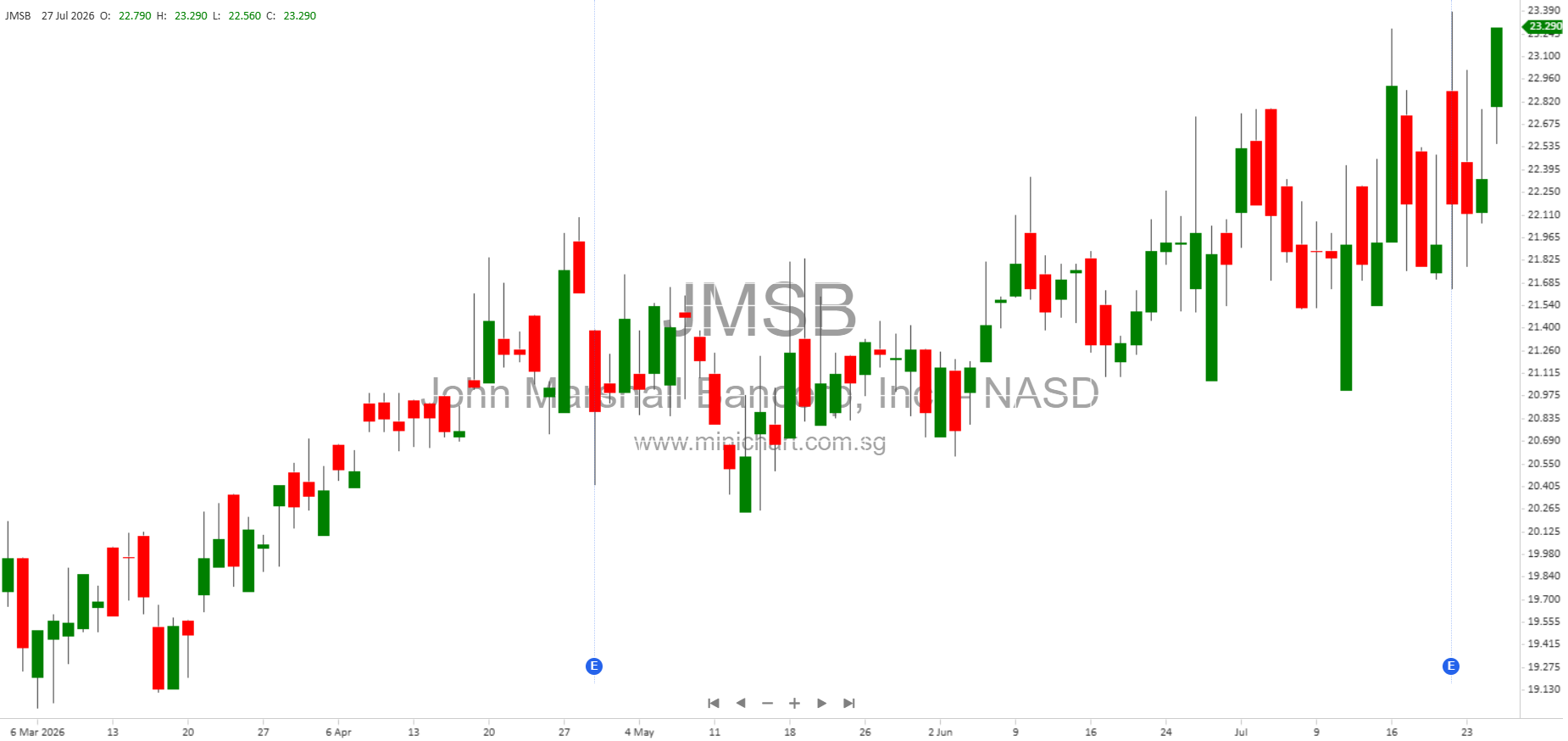
- Accelerating earnings and margin expansion: Sustained profitability and margin growth could positively impact share valuation.
- Dividend increases: The upward revision in the dividend signals confidence in future earnings and return of capital to shareholders.
- Share buyback program: The extension of the share repurchase authorization demonstrates a commitment to shareholder value and may support the stock price.
- Exceptional asset quality: Zero non-accrual loans and OREO assets, especially in the current economic cycle, position the bank as a low-risk, high-quality franchise relative to peers.
- Capital strength: High capital ratios provide flexibility for future growth, M&A, or further capital returns.
- Market share gains: Continued increases in deposits and loan market share in the D.C. region highlight competitive positioning for long-term growth.
Conclusion
John Marshall Bancorp, Inc. delivered a standout Q2 2026 performance, underscored by record earnings, robust loan and deposit growth, expanding margins, and pristine credit quality. The company’s capital strength, prudent cost management, growing dividend, and active share repurchase program all bode well for shareholders. With a seasoned leadership team, strategic focus on high-value markets, and advanced technology adoption, the bank is well-positioned for continued growth and value creation.
Disclaimer
The information contained in this article is based on the company’s Q2 2026 financial report and is intended for informational purposes only. This is not investment advice. Investors should conduct their own due diligence and consider their own financial circumstances before making any investment decisions. The company’s future performance is subject to various risks and uncertainties as outlined in its SEC filings.