Apple Hospitality REIT, Inc. (NYSE: APLE) – 2026 Investor Update: Detailed Analysis for Investors
Overview
Apple Hospitality REIT, Inc. (“APLE”) remains one of the largest owners of upscale, rooms-focused hotels in the U.S., with a portfolio spanning 216 hotels under 15 brands across 37 states. The company’s focus on room-centric, select-service hotels, coupled with its disciplined capital allocation and strong balance sheet, continues to drive robust performance and shareholder returns.
Key Financial and Operational Highlights
- Revenue and Profitability: For full year 2025, APLE generated \$1.4 billion in revenue and paid out \$240.4 million in distributions. 2025 Modified Funds From Operations (MFFO) per share was \$1.55, with net income per share at \$0.74. Comparable hotels reported a strong adjusted hotel EBITDA margin of 33.9% for the trailing twelve months ending March 31, 2026.
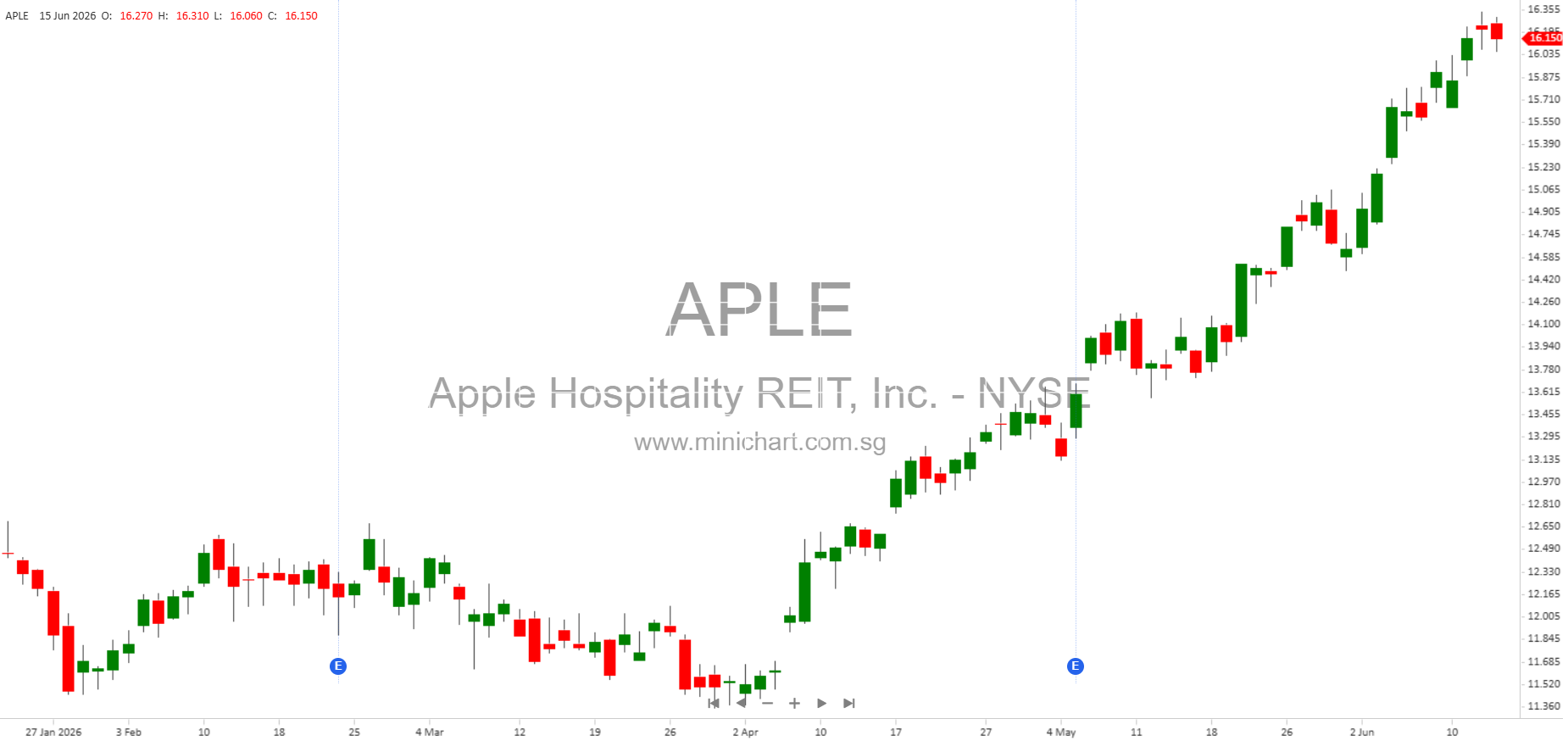
- Dividend Yield: The company declared an annualized distribution of \$0.96 per common share, representing a yield of approximately 6.1% based on a June 10, 2026 closing price of \$15.86. Dividends are paid monthly, with \$57 million distributed in Q1 2026 alone.
- Total Shareholder Return (TSR): APLE outperformed industry benchmarks, exceeding the Dow Jones U.S. Real Estate Hotels Index by 12.7 percentage points and the Nareit Lodging & Resorts Index by 20.5 points from 2021-2025.
- Balance Sheet Strength: As of March 31, 2026, net debt was \$1.6 billion, equating to 37% net total debt to total capitalization. The company maintains \$559 million in available revolving credit and a conservative 3.4x net debt to EBITDA ratio. Notably, 207 of its hotels are unencumbered.
- Portfolio Management: APLE has actively managed its portfolio post-pandemic, acquiring 24 hotels for \$1.2 billion and selling 39 hotels for \$399 million since January 2023. The average effective age of its assets is now just 5 years, and 76% of hotels were built or renovated in the last 8 years. Recent acquisitions have focused on high-growth markets and newer properties, while dispositions have reduced near-term CapEx requirements.
- Capital Expenditures: 2026 estimated CapEx is \$80–90 million, reflecting prudent reinvestment in the portfolio while maintaining high free cash flow to support dividends and strategic growth.
- Growth Pipeline: Under contract are a 160-room AC Hotel by Marriott in Anchorage, Alaska (anticipated completion Q4 2027, \$65.5 million) and a dual-branded 237-room AC Hotel and 160-room Residence Inn in Las Vegas (completion Q2 2028, \$143.7 million).
Operational Performance and Strategic Positioning
- Q1 2026 Performance: Comparable hotels reported RevPAR growth of 2.2% year-over-year, with adjusted hotel EBITDA up 3.5%. Occupancy increased to 72.8% and ADR rose to \$157.35. Despite margin pressure (32.2%, down 20bps), the company outperformed expectations, especially in markets benefiting from event-driven demand.
- Efficient Operating Model: Rooms-focused hotels deliver higher margins and require less CapEx compared to full-service portfolios. APLE’s average utility cost per occupied room was \$6.09 in 2024, significantly below the industry average for full-service hotels (\$12.63).
- Supply Outlook: New supply risk is muted, with 57% of APLE’s hotels facing no new construction within a five-mile radius. National hotel supply growth is forecast at 0.8% for the next four quarters, well below historical averages.
- Geographic and Brand Diversification: The portfolio is diversified across 83 markets, balancing exposure to business and leisure demand generators, and is heavily weighted to business-friendly, high-growth regions. Major brands include Hilton, Marriott, and Hyatt, with 100% of properties operated by third-party managers, allowing for best-in-class benchmarking and operational flexibility.
Shareholder-Focused Capital Allocation
- Strong Track Record: Since inception, APLE and predecessor entities have acquired 458 hotels and sold 242, with a cumulative \$7.4 billion invested in hotel assets and \$1.3 billion in CapEx/renovations. Over \$779 million in dividends have been paid since January 2023, alongside \$270 million in capital reinvestment.
- Disciplined Dispositions: Recent sales have targeted older or lower-growth assets, with an average age at sale of 18 years, further reducing CapEx needs and enabling reinvestment in newer, higher-growth markets.
- Accretive Acquisitions: New properties acquired at attractive yields (~8.4% TTM yield after CapEx) and younger ages (average 4 years at acquisition), supporting long-term growth and cash flow stability.
Environmental, Social, and Governance (ESG) Initiatives
- Environmental Stewardship: The company operates a comprehensive sustainability program, focusing on reductions in energy, water, and waste. In 2024, total energy intensity was 19.82 kWh per square foot, outperforming the full-service REIT average of 26.35 kWh. All properties are enrolled in ENERGY STAR® Portfolio Manager®.
- Social Responsibility: APLE and its employees have volunteered over 1,000 hours and supported 160+ nonprofits since 2017. Policies on health, safety, well-being, human rights, and vendor conduct are in place to ensure ethical operations company-wide.
- Governance: The Board is fully independent in its key committees, with annual director elections and robust share ownership requirements for executives. 76% of executive compensation is incentive based and over 50% is linked to shareholder returns.
Potential Price-Sensitive Issues for Shareholders
- Dividend Yield and Payouts: The 6.1% yield and monthly payouts are a key attraction, but any changes to capital allocation policy, distribution rates, or acquisition/disposition strategy could impact share value.
- Ongoing Acquisitions and Pipeline Risks: While new hotels under contract in Anchorage and Las Vegas are expected to be accretive, closing is subject to conditions and delays or cancellations could affect growth projections.
- Exposure to Economic Cycles: APLE’s diversified, rooms-focused strategy has historically provided resilience, but the company remains exposed to macroeconomic risks including recession, inflation, interest rate changes, and potential reductions in business/leisure travel.
- Balance Sheet Health: The company’s low leverage and strong liquidity position it to weather downturns and act on growth opportunities. Shareholders should monitor any significant changes in debt levels, interest rates, or refinancing terms.
- ESG and Regulatory Factors: Increasingly, investor focus on ESG performance and regulatory developments could impact APLE’s cost of capital, brand value, or compliance costs, especially as new reporting standards evolve.
Summary
Apple Hospitality REIT, Inc. continues to execute on its strategy of disciplined capital allocation, operational excellence, and shareholder returns. With a well-diversified, young, and efficiently managed portfolio, strong balance sheet, and pipeline of accretive growth opportunities, APLE is positioned for continued outperformance across economic cycles. However, investors should remain attentive to developments regarding acquisition closings, the evolving macroeconomic and regulatory landscape, and any changes to dividend/distribution policies.
Disclaimer: This article is for informational purposes only and is not investment advice. All financial figures are based on reported results and projections as of June 2026 and are subject to risks and uncertainties, including those detailed in Apple Hospitality REIT, Inc.’s filings with the SEC. Investors should conduct their own due diligence and consult with a financial advisor before making any investment decisions.