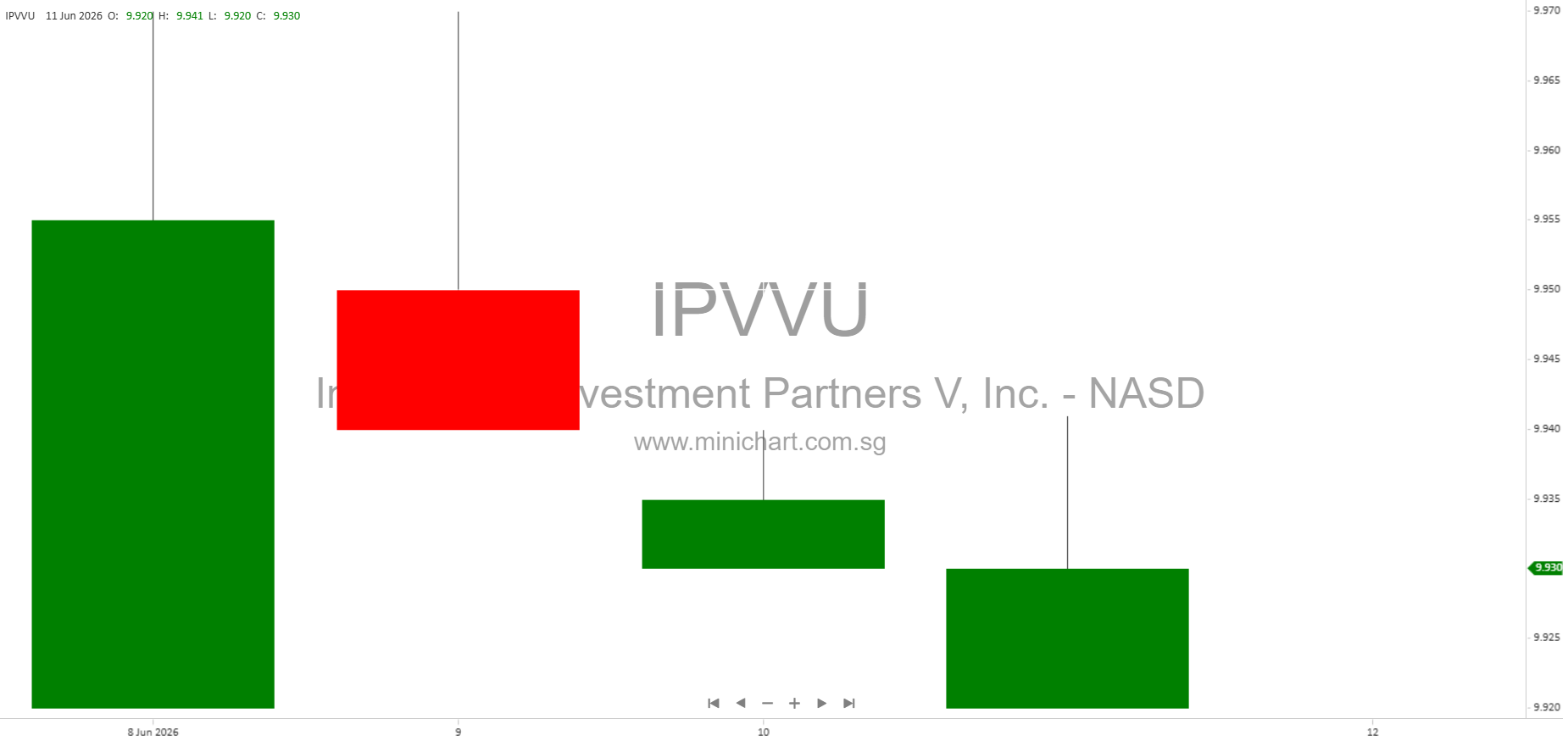
InterPrivate Investment Partners V, Inc. Announces Audited Balance Sheet and Key Business Updates Following IPO
Summary of Key Points
- IPO Completion: InterPrivate Investment Partners V, Inc. (“the Company”) completed its Initial Public Offering (IPO) on June 5, 2026, raising gross proceeds of \$201.25 million.
- Trust Account Funded: All IPO proceeds, totaling \$201.25 million, were placed into a secure trust account, to be used exclusively for a future business combination.
- Balance Sheet Highlights: The Company has total assets of \$202.54 million, with \$1.26 million in cash and \$201.25 million in the trust account.
- Share Structure: 20,125,000 Class A shares (subject to possible redemption) and 5,031,250 Class B shares are outstanding. Only 540,000 Class A ordinary shares are not subject to redemption.
- Redemption Rights: Public shareholders may redeem their shares at \$10.00 per share if no business combination is completed within 24 months.
- Warrants Issued: Each IPO unit included one-third of a redeemable warrant. There are 6,888,333 warrants outstanding, including public and private placement warrants.
- Deferred Underwriting Fees: \$8.575 million in deferred underwriting fees contingent on the completion of a business combination.
- Risks and Uncertainties: The company highlights significant risks from ongoing geopolitical issues (Russia-Ukraine conflict, Israel-Hamas conflict), which could impact its ability to identify or consummate a business combination.
- Related Party Transactions: Sponsor loans and private placement details; sponsor has provided capital and may provide further working capital loans if necessary.
- Going Concern: Management believes there are sufficient funds for at least one year from the balance sheet date, but acknowledges uncertainties if business combination costs are underestimated.
Detailed Financial and Business Update
IPO and Trust Account
InterPrivate Investment Partners V, Inc., a blank check company incorporated in the Cayman Islands, completed its IPO on June 5, 2026. The company sold 20,125,000 units at \$10.00 per unit, including the full exercise of the underwriters’ over-allotment option, raising \$201.25 million. Each unit consists of one Class A ordinary share and one-third of a redeemable warrant.
Simultaneously, 540,000 private placement units were sold at \$10.00 per unit, generating an additional \$5.4 million in proceeds. These units have similar features to the public units, with some transfer restrictions and registration rights.
The entire \$201.25 million IPO proceeds have been placed in a trust account, to be used solely for a business combination or returned to shareholders if no combination is completed within 24 months.
Balance Sheet and Capital Structure
- Total Assets: \$202,542,736, comprising mainly cash (\$1,258,273) and cash in trust (\$201,250,000).
- Liabilities: \$8,669,500, including \$8,575,000 in deferred underwriting fees, payable only upon successful business combination.
- Shareholders’ Deficit: \$(7,376,764), reflecting accumulated deficit and IPO costs expensed.
- Class A Ordinary Shares: 20,125,000 shares subject to possible redemption (\$10.00 per share), classified as temporary equity. 540,000 Class A shares (non-redeemable) and 5,031,250 Class B shares (founders) are also outstanding.
Shareholder Redemption Rights and Timeline
Public shareholders have the right to redeem their shares for cash at \$10.00 per share, plus any interest earned, if they do not wish to participate in a proposed business combination. If no business combination is completed within 24 months, the company will redeem all public shares, returning the trust funds to shareholders. This provides significant downside protection for investors.
Warrants and Future Dilution
Each IPO and private placement unit included one-third of a warrant, with each whole warrant exercisable for one Class A share at \$11.50 per share. Warrants become exercisable 30 days after a business combination and expire five years thereafter. The company has 6,888,333 warrants outstanding, which may result in future dilution if exercised.
Risks, Commitments, and Uncertainties
- Geopolitical Risks: The company identifies ongoing global conflicts (Russia-Ukraine, Israel-Hamas) as sources of potential market volatility, supply chain disruption, and capital market instability, which may impact its ability to consummate a business combination.
- Redemption and Liquidation Risks: If no business combination is completed, all trust funds, less taxes and up to \$100,000 for dissolution expenses, will be returned to shareholders, and the company will be dissolved.
- Contingent Liabilities: The Sponsor has agreed to indemnify the trust account from third-party claims, but there is no assurance the Sponsor has sufficient resources to cover all claims.
- Deferred Underwriting Fees: Payment of \$8.575 million is contingent on completing a business combination; failure to do so means no payment is due.
- Related Party Loans: The Sponsor provided a \$250,000 loan for IPO expenses (fully repaid) and may lend up to an additional \$1.5 million for working capital, convertible into units at the Sponsor’s option.
Accounting Policies and Share Structure Details
- Temporary Equity Classification: Redeemable Class A shares are classified as temporary equity at redemption value, with changes in value immediately recognized.
- Warrant Accounting: Warrants are classified as equity. The fair value of the public warrants at issuance was \$3,266,958, using a Monte Carlo simulation model.
- Founder Shares: Sponsor holds 5,031,250 Class B shares, purchased for \$25,000 (\$0.005 per share). These shares convert to Class A shares (one-for-one) at the time of a business combination, subject to anti-dilution adjustments.
- Lock-Up Agreements: Founder shares and private placement units are subject to lock-up provisions post-business combination, providing alignment of interests between management and public investors.
Potential Share Price Sensitivities
- Business Combination Progress: Any updates regarding a potential business combination could significantly affect share price, as IPO proceeds and shareholder value are tied to the successful completion of a deal.
- Redemption Risk: If no business combination is announced or completed within 24 months, the company will liquidate, returning only the IPO proceeds (plus interest, less taxes and expenses) to shareholders, potentially capping upside but protecting downside.
- Global Market Uncertainties: Ongoing geopolitical risks and market volatility could delay or complicate the company’s search for an acquisition target, impacting investor sentiment.
- Warrant Exercise and Dilution: Future warrant exercise could dilute existing shareholders; however, warrants are not exercisable until after a business combination is completed and are subject to redemption by the company under certain conditions.
- Deferred Underwriting Fees: Large contingent fees payable only on successful deal completion could impact post-combination financials.
Conclusion
InterPrivate Investment Partners V, Inc. is well-capitalized following its IPO and has placed all proceeds into a secure trust account. The company is actively seeking a business combination, but investors should note the 24-month timeline, the structure of redemption rights, and ongoing global uncertainties that could impact its ability to complete a transaction.
Shareholders should closely monitor any announcements regarding a potential business combination or changes to the trust account, as these will have a direct impact on share value.
Disclaimer: This article is for informational purposes only and does not constitute investment advice. Investors should conduct their own due diligence and consult with a financial advisor before making any investment decisions. The information above is based on the company’s audited financial statements and related disclosures as of June 5, 2026. Actual future outcomes may differ materially from the information provided herein due to risks and uncertainties.