Tyson Foods, Inc. 8-K Report: Detailed Investor Analysis
Executive Summary
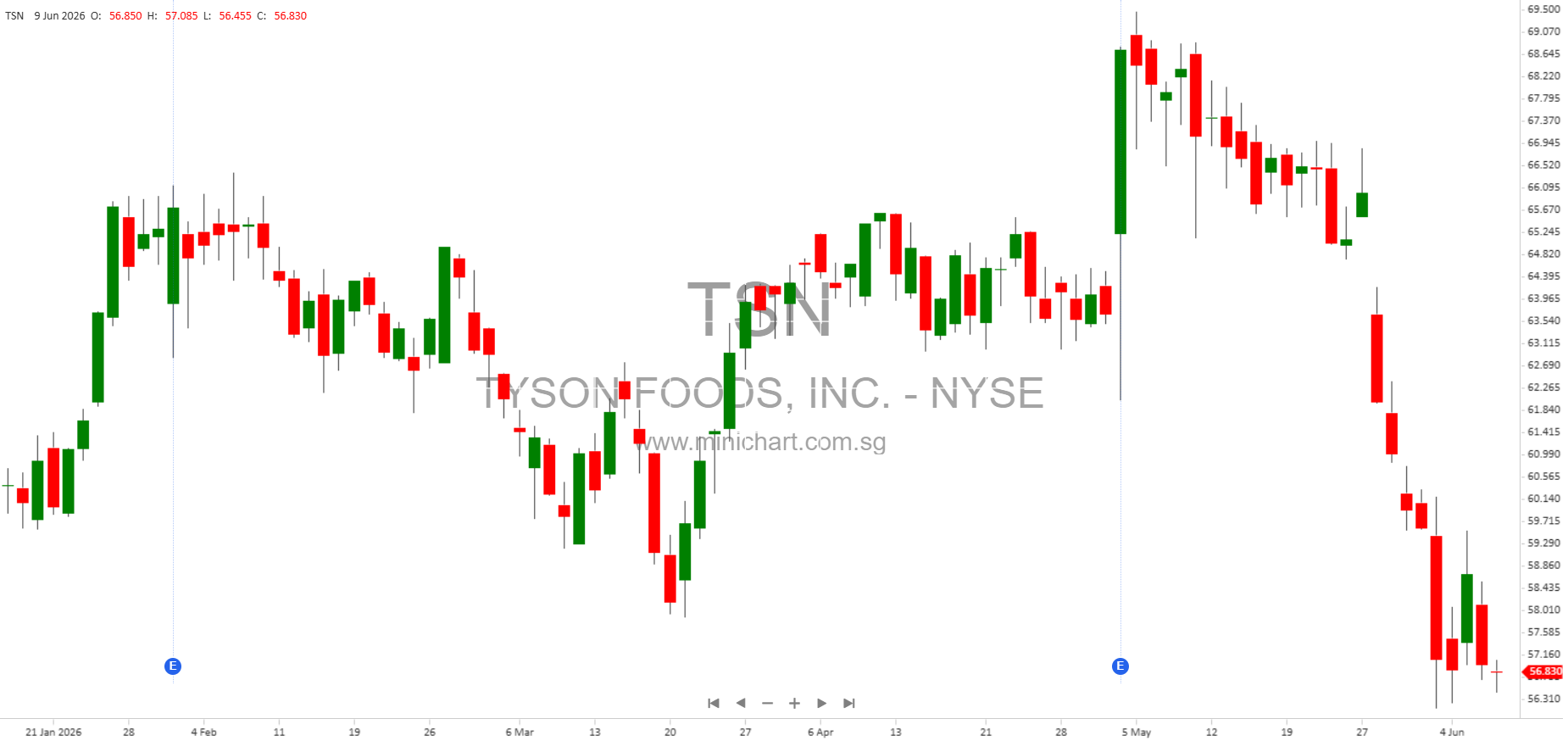
Tyson Foods, Inc. has released its latest 8-K report, which includes recast financials to reflect changes in segment reporting, major operational updates, and important financial metrics for the fiscal year ended September 27, 2025. The report contains several items that may be of interest to shareholders and could potentially impact share value.
Key Highlights
- Segment Reporting Changes: Tyson has revised its segment profit measure, now excluding corporate expenses and amortization, and has identified International as a new reportable segment. This change aligns reporting with how the business is managed and affects comparability with prior periods.
-
Financial Performance:
- Sales for FY2025 were \$54.4 billion, up from \$53.3 billion in FY2024, marking a 2.1% increase. Sales volume was flat, but higher average sales prices contributed to growth.
- Net income attributable to Tyson was \$474 million, down from \$800 million in FY2024.
- EBITDA was \$2.5 billion vs. \$2.87 billion in FY2024, with net debt to EBITDA ratio rising to 3.0x from 2.8x.
- Effective tax rate increased to 34.1% from 24.8%, mainly due to a non-deductible goodwill impairment.
-
Impairment Charges:
- Tyson recorded a \$343 million goodwill impairment charge in its Beef segment during FY2025, fully impairing remaining goodwill. This follows heightened risk of impairment flagged for Beef and certain Chicken segment units.
- In FY2023, a total of \$781 million in goodwill impairments was recognized across Beef, Chicken, and International segments.
-
Legal and Restructuring Costs:
- Legal contingency accruals: \$318 million in FY2025, \$174 million in FY2024.
- Plant closure and disposal charges: \$17 million in FY2025, \$182 million in FY2024.
- Restructuring and related charges: \$31 million in FY2024.
-
Cash Flow and Capital Structure:
- Operating cash flow: \$2.16 billion FY2025, down from \$2.59 billion FY2024.
- Capital expenditures: \$978 million in FY2025; guidance for FY2026 is \$0.7 to \$1.0 billion.
- Debt: Net debt decreased to \$7.6 billion from \$8.06 billion; senior notes and term loans were repaid or refinanced during the year.
- Credit facilities: \$2.5 billion revolving credit facility, \$1.75 billion commercial paper program, no commercial paper outstanding as of fiscal year-end.
-
Dividend and Share Repurchases:
- Board approved a quarterly dividend increase: \$0.51/share for Class A and \$0.459/share for Class B, payable December 15, 2025.
- Total share repurchases in FY2025: 3.5 million shares for \$196 million; 47.2 million shares remain authorized for repurchase.
-
Critical Audit Matter:
- Auditor highlighted the interim goodwill impairment assessment for the Beef reporting unit as a critical audit matter due to significant management judgment and complex valuation assumptions involving sales growth, operating margin, and discount rate.
-
Risks and Uncertainties:
- Forward-looking statements caution about risks from operational optimization, input costs, livestock disease outbreaks, consumer trends, legal/regulatory changes, climate change, cyber incidents, and leverage.
- Climate change regulations and compliance remain uncertain but are being monitored; no material costs incurred yet.
- Litigation and labor-related claims are ongoing but no significant liabilities recognized at this stage.
-
Accounting Changes:
- Several new FASB accounting pronouncements adopted or pending, including enhanced segment disclosures and tax transparency, which may affect future financial reporting.
Segment Operating Results
| Segment | Sales (2025) | Operating Income (Loss) | Key Notes |
|---|---|---|---|
| Beef | \$19.2B | (\$1.51B) | Significant impairment charge, lower supply of market-ready cattle. |
| Pork | \$6.1B | \$29M | Flat volume, higher prices offset by input costs. |
| Chicken | \$17.1B | \$1.44B | Volume growth, price decreases. |
| Prepared Foods | \$10.0B | \$1.14B | Higher prices, brand discontinuations. |
| International | \$2.6B | \$29M | Now a reportable segment. |
Potential Price-Sensitive Items
- Goodwill Impairment: The \$343 million charge in the Beef segment could signal ongoing operational challenges and may impact investor sentiment and valuation multiples.
- Dividend Increase: The Board’s approval of a higher quarterly dividend is a positive signal for income-focused investors.
- Segment Reporting Change: The identification of International as a standalone segment and exclusion of corporate expenses/amortization from segment profit will affect comparability and may influence future analyst forecasts.
- Debt and Liquidity: Repayment and refinancing of term loans and senior notes improve the balance sheet, but the rise in net debt to EBITDA ratio warrants attention.
- Legal, Restructuring, and Climate Risks: Ongoing legal contingency accruals, restructuring costs, and climate-related uncertainties could affect future profitability and cash flows.
Investor Takeaways
- Tyson Foods remains a global leader in protein, but faces operational headwinds in its Beef segment and broader challenges from input cost volatility, labor and legal matters, and uncertain climate regulations.
- The company’s commitment to capital returns via dividends and share repurchases, as well as ongoing investments in production capacity and technology, are positive for long-term holders.
- Shareholders should monitor future impairment risks, segment performance, and the impact of new accounting standards on reported results.
Disclaimer
This article is for informational purposes only and does not constitute investment advice, a recommendation, or an offer to buy or sell any securities. Investors should conduct their own due diligence and consult with a qualified financial advisor before making any investment decisions. The information herein is based on Tyson Foods, Inc.’s official filings and is subject to change. The author is not responsible for any losses arising from reliance on this information.