Jade Biosciences Unveils Promising Interim Phase 1 Data for JADE101 in IgA Nephropathy (IgAN) – Potential Best-in-Class Therapy
Key Highlights from JADE101 Phase 1 Interim Results
- JADE101 Phase 1 met or exceeded all objectives, demonstrating robust clinical potential for every-12-week subcutaneous dosing with a best-in-class, disease-modifying profile.
- Favorable safety profile observed across all tested doses, with no severe adverse events, deaths, or discontinuations due to adverse events. All treatment-emergent adverse events (TEAEs) were mild or moderate, and no significant lab or ECG changes were detected.
- Deep and sustained reduction in Immunoglobulin A (IgA): ~70% reduction sustained at 12 weeks with 700 mg induction dose, modeled to be maintained with a single 350 mg SC maintenance dose every 12 weeks.
- Ultra-high APRIL binding affinity and an extended half-life (24.2 days at 700 mg) – 8.7x longer than povetacicept and 2.6x longer than sibeprenlimab.
- Potential for best-in-class properties: Fully-human monoclonal antibody (mAb) with ultra-high binding affinity and validated YTE Fc modification for half-life extension.
- IgA-lowering potency is approximately 379-fold higher than sibeprenlimab and 26-fold higher than povetacicept.
- Minimal immunogenicity: No apparent impact of anti-drug antibodies (ADA) on pharmacokinetics (PK) or pharmacodynamics (PD).
- IgG sparing mechanism: No cases of IgG ≤ 3 g/L reported, supporting a favorable safety profile for long-term use.
Market Opportunity and Competitive Position
- IgAN represents a \$20+ billion market in the U.S. alone, with over 169,000 potential patients domestically and more than 1 million globally, per international guidelines and recent regulatory prevalence estimates.
- The updated KDIGO guidelines are expected to expand the eligible patient population, lowering proteinuria treatment thresholds and positioning anti-APRIL agents as foundational therapy in IgAN.
- Projected pricing for anti-APRIL therapies is in the range of \$360,000–\$390,000 per year in the U.S., suggesting significant revenue potential if JADE101 captures market share.
Clinical Program: Next Steps and Timeline
- Phase 2 trial in IgAN patients has been initiated, with interim data anticipated in 2027. The trial includes adults with IgAN diagnosed within 5 years, proteinuria ≥0.75 g/g, and eGFR ≥30 mL/min/m2.
- Two maintenance dosing regimens will be evaluated: every 12 weeks (Q12W) and every 8 weeks (Q8W), following a 700 mg induction dose and 350 mg maintenance doses. This design aligns with regulatory expectations for dose-finding and may enable accelerated Phase 3 initiation without waiting for full Phase 2 data.
- Phase 3 trial is planned for 1H 2027, with the potential for this study to serve as a registrational trial if successful.
- Jade Biosciences is well-capitalized, with \$311 million in cash and equivalents as of March 31, 2026, providing financial runway into the first half of 2028, supporting ongoing and future clinical programs.
Details for Investors and Shareholders
- The magnitude and durability of IgA reductions with JADE101 are the largest reported for an anti-APRIL or dual APRIL/BAFF agent, which may set a new standard for disease-modifying therapy in IgAN.
- JADE101’s extended dosing interval (every 12 weeks) offers a potential convenience and adherence advantage over existing therapies, which typically require significantly more frequent dosing (every 1-4 weeks).
- Cross-study comparisons show JADE101’s binding affinity and IgA-lowering potency to be substantially higher than first-generation competitors, based on internal modeling and digitized third-party data. However, no head-to-head clinical trials have been conducted, and cross-study comparisons are inherently limited.
- Intellectual property protections are in place, with patent applications filed covering JADE101 and its novel anti-APRIL mechanism.
- Jade has exclusive license agreements with Paragon Therapeutics for JADE101 and JADE201, and an option for JADE301, further supporting the company’s pipeline and competitive moat.
Potential Share Price Catalysts & Risks
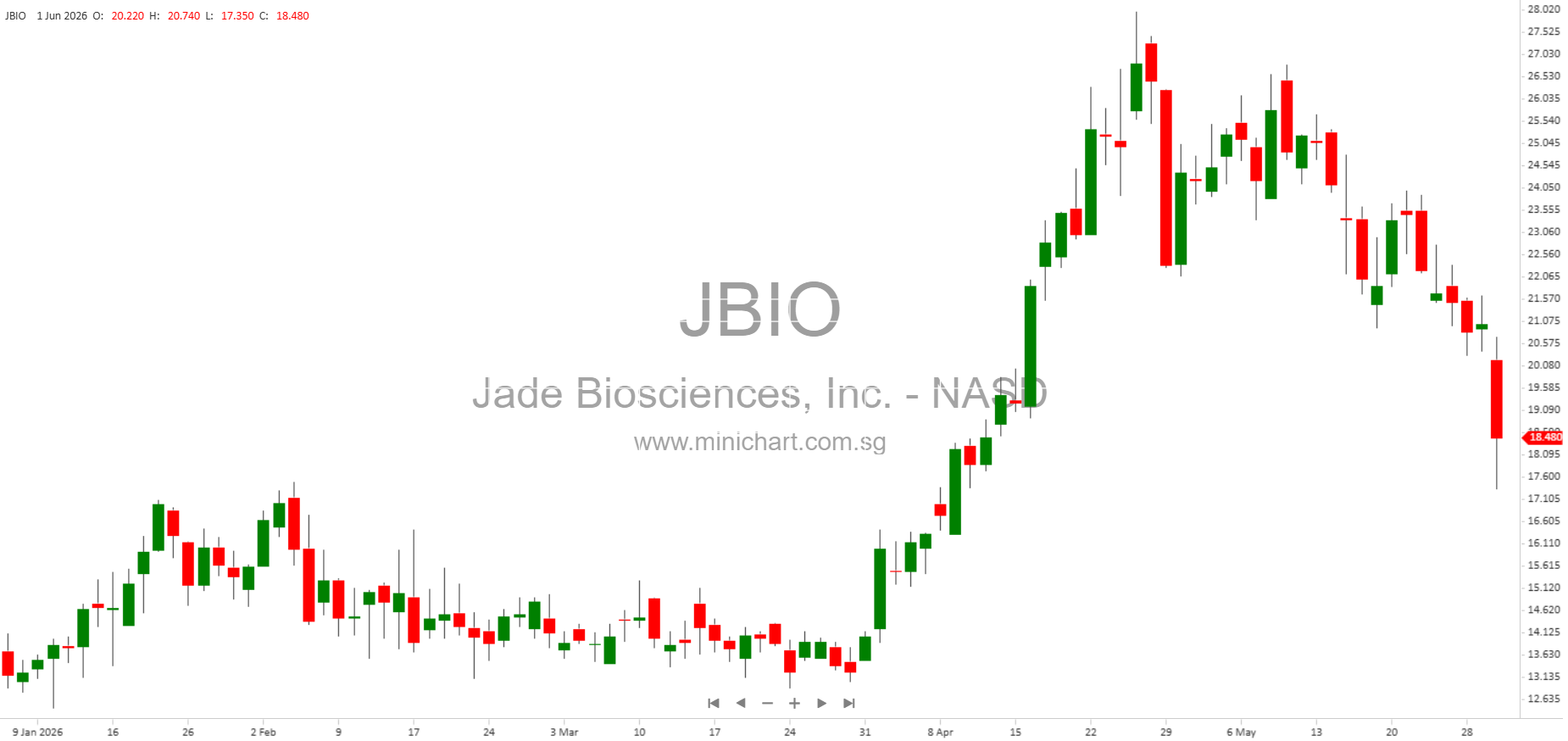
- Positive interim Phase 1 data demonstrating best-in-class potential, high market value, and a strong safety profile are likely to be price-sensitive and could drive share appreciation.
- Upcoming milestones such as Phase 2 interim data (expected 2027) and Phase 3 initiation (1H 2027) are significant catalysts for the company.
- Risks include the possibility that interim results may not be replicated in larger or longer-term studies, potential regulatory delays, and uncertainties inherent to clinical development, as well as dependence on third-party manufacturing and supply chains.
- Market size estimates and pricing are based on current guidelines and public data, but could shift with changes in reimbursement, competition, or medical practice.
Summary
Jade Biosciences’ JADE101 program has delivered highly encouraging Phase 1 interim data, positioning the company as a potential leader in the IgAN therapeutic space. With best-in-class potency, a highly differentiated extended dosing profile, and a favorable safety and immunogenicity track record, JADE101 could address significant unmet needs in a large and underserved market. The company’s strong cash position and clear clinical milestones add to the investment case. Investors should monitor upcoming Phase 2 data and regulatory milestones closely, as these will be pivotal for future share performance.
Disclaimer: This article is for informational purposes only and does not constitute investment advice. All forward-looking statements are subject to risks and uncertainties, and actual results may differ materially. Investors should review Jade Biosciences’ latest filings with the SEC and consult their own advisors before making investment decisions. The company has not conducted head-to-head clinical trials; cross-study comparisons are for hypothesis generation only and may not be directly comparable.