OKP Holdings Limited: AGM 2026 – Key Highlights & Investor Insights
Date: 28 April 2026
Venue: 30 Tagore Lane, Singapore 787484
Chairman: Mr Or Toh Wat
Summary of AGM Proceedings
- All resolutions at the AGM were passed by poll with overwhelming majority.
- Board and management provided detailed responses to shareholder questions, with clear forward-looking statements and operational updates.
- Dividend payments, director appointments, and mandates on share issuance and buybacks were discussed and approved.
Financial Performance & Dividends
Financial Results:
The audited financial statements for FY2025 were received and adopted unanimously. This reflects continued confidence in the company’s financial management.
Dividends:
Shareholders approved a final one-tier tax exempt dividend of \$0.007 per ordinary share and a special one-tier tax exempt dividend of \$0.013 per ordinary share for FY2025. The total payout amounts to \$0.02 per share, scheduled for payment on 26 May 2026.
Board Changes & Directors’ Fees
- Re-election of key directors: Mr Or Kim Peow, Mr Or Kiam Meng, and Mr Tay Peng Huat were re-elected, with Mr Tay continuing as chairman of the Audit Committee and considered independent under SGX rules.
- Directors’ fees for FY2026 set at \$130,000, approved by shareholders.
- Re-appointment of CLA Global TS Public Accounting Corporation as independent auditor with authorization for directors to fix their remuneration.
Mandates on Share Issuance and Buybacks
- Share Issuance Authority: Directors are authorized to issue shares or instruments up to 50% of the issued share capital, with a maximum of 20% on a non pro-rata basis. This mandate lasts until the next AGM.
- Performance Share Scheme: Directors may grant awards under the OKP Performance Share Scheme, limited to 15% of issued share capital. Notably, shareholders eligible for the scheme abstained from voting.
- Share Purchase Mandate Renewal: The Board has renewed authority to buy back up to 10% of issued shares, either via market or off-market purchases. The maximum price is set at 105% of average closing price for market purchases and 120% of highest last dealt price for off-market purchases.
Operational & Strategic Updates
- Industry Outlook: OKP expects improved margins due to increased demand in the construction industry, driven by large national projects (e.g., Changi Terminal 5, Marina Bay Sands expansion). While OKP is not directly involved in these mega-projects, industry-wide demand lifts overall pricing and margins.
- Project Mix: OKP’s core strength is in public infrastructure and commuter projects (e.g., cycling paths, covered walkways). These contracts are lower risk, allow for quicker cash recycling, and are less competitive than mega-projects, supporting stable profitability.
- Contract Values: Some contract values have been revised upwards due to extensions (notably TR387). Maintenance contracts are based on provisional quantities and are subject to adjustment depending on final work completed.
- Profit Margins: Gross profit margins have improved post-pandemic, but management cautions they may not sustain 30% margins as seen in recent years. Margins depend on market demand and competition for future tenders.
- Technology & AI: OKP is actively exploring technology and AI to improve productivity and safety. AI analysis has been incorporated into video surveillance systems. However, tender preparation still relies on engineers, and over-reliance on AI is cautioned.
Key Risks & Challenges
- Cost pressures (energy crisis, wages, materials) remain relevant. OKP aims to mitigate these via focus on specialty projects and cost control.
- Maintenance contracts typically yield lower margins due to intense competition.
- Delays in ongoing projects are minimal, with bulk of work completed. Price adjustments for delays are rare, but manpower can be redeployed with minimal additional cost.
Potential Price-Sensitive Information
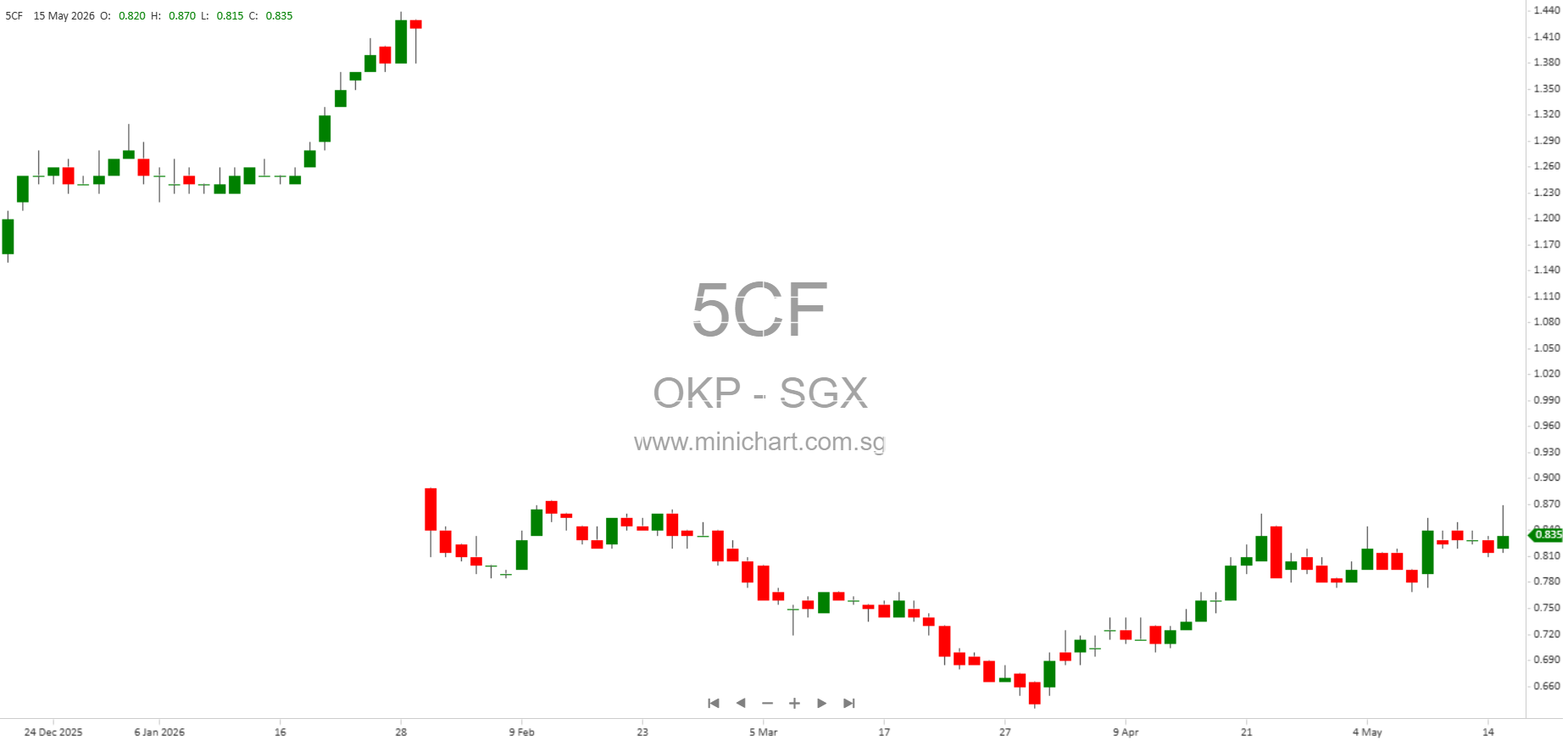
- Dividend payout of \$0.02 per share may attract income investors and could support share price.
- Mandate renewal for share buybacks (up to 10%) provides flexibility and may support price stability or upside if executed.
- Authority to allot new shares (up to 50% of capital) could impact dilution risk, but also supports capital raising for growth opportunities.
- Improved margins and positive outlook for commuter infrastructure projects, supported by industry-wide demand increase, may be price-accretive.
- Management’s cautious comments on sustaining high profit margins should temper expectations for continued margin expansion.
- Active technology adoption in operations, including AI, positions OKP for productivity gains and cost efficiency, albeit with traditional business limitations.
Questions & Answers – Investor Insights
- OKP is not currently involved in new airport projects but has previously worked with Changi Airport Group on runway projects.
- Project life cycle: Construction contracts typically have a 12-month defect liability period, with maintenance contracts tendered separately. Maintenance yields lower margins but supports cash recycling and risk management.
- Competition is limited by OKP’s niche expertise in commuter infrastructure; mega-project contractors do not usually compete for these projects.
- AI adoption is focused on operational safety rather than tender document preparation; engineers remain crucial for problem-solving.
Conclusion
The 2026 AGM reaffirms OKP Holdings Limited’s commitment to shareholder value via dividends, disciplined capital management, and operational focus on specialty commuter infrastructure projects. The renewed buyback mandate and share issuance authority provide strategic flexibility. Industry-wide demand for construction is expected to support margins, but management remains cautious on sustainability of high profit margins. Investors should monitor ongoing developments, especially in technology adoption and competitive dynamics.
Disclaimer: This article is for informational purposes only and does not constitute financial advice or a recommendation to buy or sell securities. Investors should conduct their own due diligence and consult professional advisors before making investment decisions.