HeartCore Enterprises, Inc. Reports First Quarter 2026 Financial Results
Key Highlights and Shareholder Insights
- Revenue for Q1 2026 dropped sharply to \$1.2 million from \$2.1 million in Q1 2025.
- Net loss improved to \$2.0 million, compared to a \$3.1 million loss in the prior year.
- Gross profit plunged to \$74,000 from \$0.5 million last year.
- Cash and cash equivalents fell to \$0.8 million as of March 31, 2026.
- Company currently engaged with 16 Go IPO clients; 6 are in advanced stages of U.S. listing preparation.
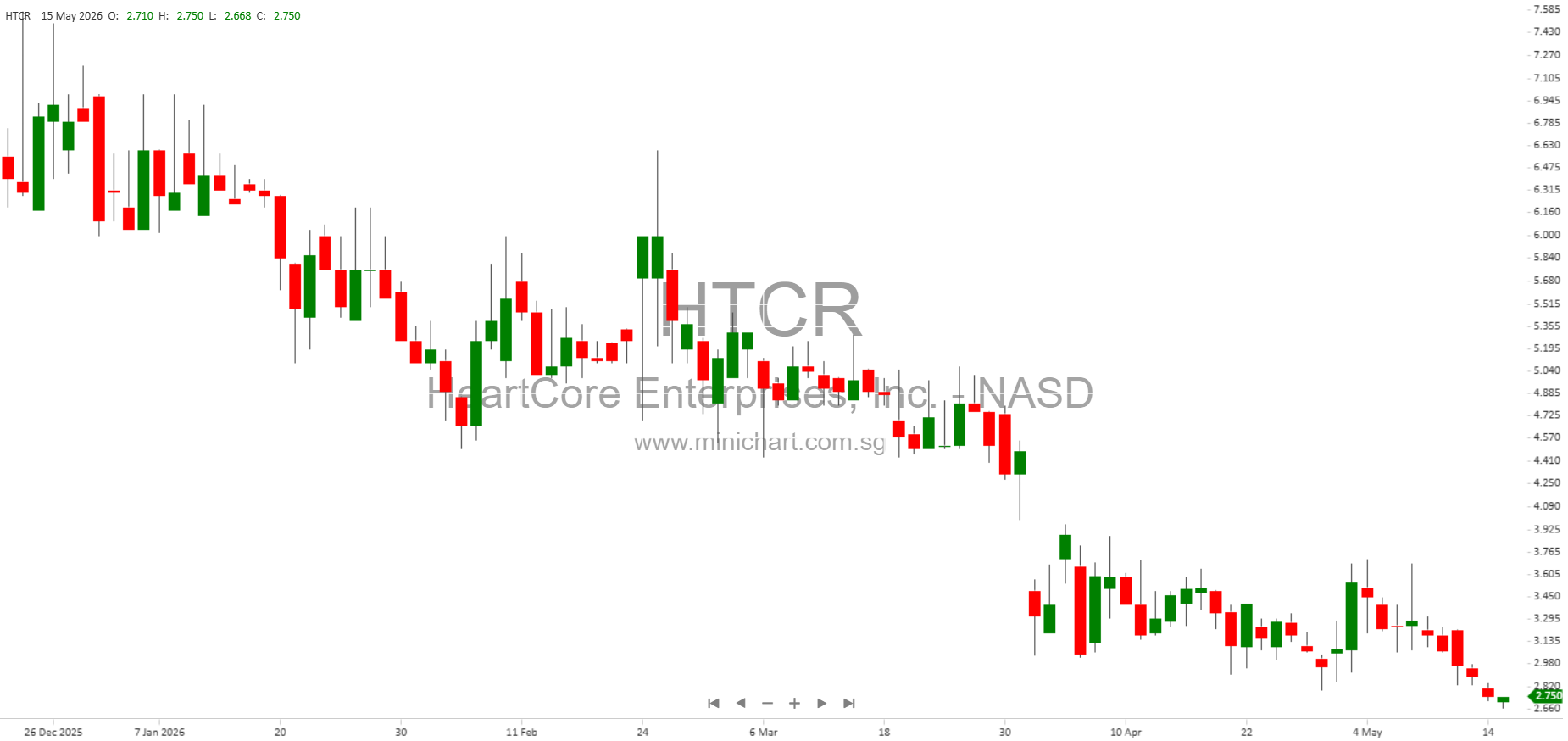
- Regained compliance with Nasdaq’s \$1.00 minimum bid price requirement.
- Announced a \$2.0 million share repurchase program.
- Cost pressures from increased outsourcing, rising salaries, and intense U.S. software market competition.
- Ongoing efforts to expand into digital securities and capital markets advisory services.
Operational and Strategic Developments
HeartCore Enterprises, Inc. (“HeartCore”, Nasdaq: HTCR), a Tokyo-based IPO consulting and financial services company, released its financial results for the quarter ending March 31, 2026.
During Q1 2026, HeartCore continued to focus on its core “Go IPO” business, which remains the primary revenue driver. The company is currently working with 16 Go IPO clients, including 6 clients in advanced stages of preparation for potential U.S. public listings. This is significant as it signals sustained demand for U.S. capital market access among Japanese and Asian companies, even as the Nasdaq listing environment becomes more selective and compliance-driven.
A key operational highlight is HeartCore’s regained compliance with Nasdaq’s \$1.00 minimum bid price requirement—an important milestone that reduces the risk of delisting and supports investor confidence. The board also authorized a \$2.0 million share repurchase program, a move that could be interpreted as a signal of management’s confidence in the company’s value at current share prices, potentially providing downside support for the stock.
The company is also positioning for future growth through its subsidiary, Higgs Field Co., Ltd., adding experienced financial personnel and developing its structure to pursue a Type I Financial Instruments business license in Japan. This strategic move is aimed at enabling HeartCore to expand into digital securities and capital markets advisory services, broadening its service offerings and diversifying revenue streams.
Financial Performance: Revenue Pressure and Cost Increases
HeartCore’s Q1 2026 revenue fell to \$1.2 million from \$2.1 million in the prior year period. The main reason for this decline was a significant drop in customized software development and services revenue, which was pressured by intensifying competition in the U.S. software market.
Gross profit shrank to \$74,000 from \$543,774 a year ago, due to both declining Go IPO consulting margins (affected by higher outsourcing fees and additional customer experience investments) and squeezed software development margins (due to lower revenues and higher subcontracting costs amid rising salary levels).
Operating expenses were trimmed to \$1.6 million from \$1.7 million, primarily reflecting reduced selling expenses. However, the company still recorded a net loss of \$2.0 million—an improvement over the \$3.1 million net loss in Q1 2025. The loss improvement was largely due to a reduction in the loss on the fair value of investments in marketable securities.
Adjusted EBITDA, a key non-GAAP performance measure, was negative \$1.6 million, compared to negative \$1.3 million last year. This worsening reflects ongoing operational challenges, despite some cost containment.
As of March 31, 2026, cash and cash equivalents had declined to \$774,033, down from \$1,985,962 at the end of 2025, signaling tighter liquidity and ongoing cash burn.
Balance Sheet and Liquidity Concerns
Total assets stood at \$11.8 million at quarter end, down from \$13.1 million at December 31, 2025. The company’s current assets of \$6.9 million include \$3.4 million in marketable securities and \$1.4 million in proceeds receivable from discontinued operations. However, the cash position has weakened substantially.
Total liabilities increased to \$6.5 million from \$5.8 million, with increases in accrued payroll, insurance premium financing, and new operating lease liabilities. Shareholders’ equity dropped to \$5.3 million from \$7.3 million.
Cash Flow Analysis
Net cash used in operating activities of continuing operations was \$1.2 million in Q1 2026, compared to \$1.7 million in Q1 2025, reflecting ongoing operating losses and working capital changes. Cash outflows from investing and financing activities were relatively minor this quarter, but the overall cash position deteriorated.
The company reported supplemental non-cash items including \$108,000 in insurance premium financing and \$27,968 in dividends accrued on Series A convertible preferred shares.
Additional Noteworthy Items for Shareholders
- Compliance with Nasdaq listing standards is re-established, materially reducing delisting risk.
- Share buyback authorization indicates board confidence but also suggests limited alternative uses of cash amid ongoing losses.
- Expansion plans into digital securities and financial instruments licensing in Japan could open new revenue streams, but likely require additional investment and regulatory approval.
- Cash position is tight, with less than \$1 million on hand, raising potential concerns about the need for future capital raises if losses persist.
- Adjusted EBITDA remains negative and is worsening, highlighting the urgency of operational improvements or new revenue sources.
Forward-Looking Statements and Risks
Management emphasized continued focus on expanding the Go IPO pipeline, targeting clients with higher listing readiness and long-term potential. The company also aims to diversify its revenue base and strengthen its compliance framework. However, the press release includes cautionary language regarding forward-looking statements, citing risks and uncertainties that could cause actual results to differ materially from expectations.
Investor Takeaways
- HeartCore is in a period of transition, facing significant revenue and margin pressure but pursuing new growth avenues.
- The share repurchase program and Nasdaq compliance are positives, but cash burn and operational losses remain key concerns for investors.
- Liquidity is tight and may necessitate further financing if loss trends continue.
- Strategic moves into digital securities could be transformative, but success is uncertain and execution risks are high.
Disclaimer
This article is for informational purposes only and does not constitute investment advice. Investors should conduct their own research and consult with professional advisors before making any investment decisions. This summary contains forward-looking statements subject to risks and uncertainties that could cause actual results to differ materially. The author assumes no responsibility or liability for any actions taken based on this information.