GT Biopharma, Inc. Q1 2026 Financial Results: Detailed Analysis & Shareholder Implications
Key Points from the Report
- Quarterly Net Loss Increased Sharply: GT Biopharma reported a net loss of \$2.83 million for the three months ended March 31, 2026, compared to a net loss of \$776,000 for the same period in 2025. This represents a significant widening of losses, which is a material development for shareholders and could impact share value.
- Stockholders’ Equity Improved: Despite the increased loss, stockholders’ equity rose to \$7.58 million as of March 31, 2026, up from \$5.79 million at December 31, 2025. This improvement is mainly due to capital raising activities.
- Common Shares Outstanding Increased: The number of common shares outstanding grew from 25,534,173 at December 31, 2025 to 26,657,989 at March 31, 2026. This increase was primarily due to the exercise of warrants, which brought in additional capital but also diluted existing shareholders.
- Warrant Exercises: During Q1 2026, the company issued 1,123,816 common shares through warrant exercises, raising \$1,000 in nominal value. This capital infusion is positive for liquidity but may exert downward pressure on the share price due to dilution.
- Preferred Stock Transactions: The company issued 4,611 Series L convertible preferred shares for cash and warrants. Additionally, 3,910 Series L shares were converted, reducing the total Series L preferred shares outstanding. No significant value was attached to these preferred shares in the equity table, suggesting limited direct impact, but the ongoing preference dividend (\$103,000 for Q1 2026) is a recurring expense.
- Accumulated Deficit Remains High: The company’s accumulated deficit stood at \$726.8 million as of March 31, 2026, underscoring the ongoing financial challenges and high risk profile.
- Dividend on Preferred Stock: The dividend paid on Series L convertible preferred stock was \$103,000 for the quarter, a new recurring cost that affects net income available to common shareholders and thus EPS.
- Net Loss Per Share Declined: Net loss per share for Q1 2026 was \$0.11 (basic and diluted), compared to \$0.33 per share in Q1 2025. The improvement in per-share loss, despite the larger absolute loss, is due to the increased share count from warrant exercises.
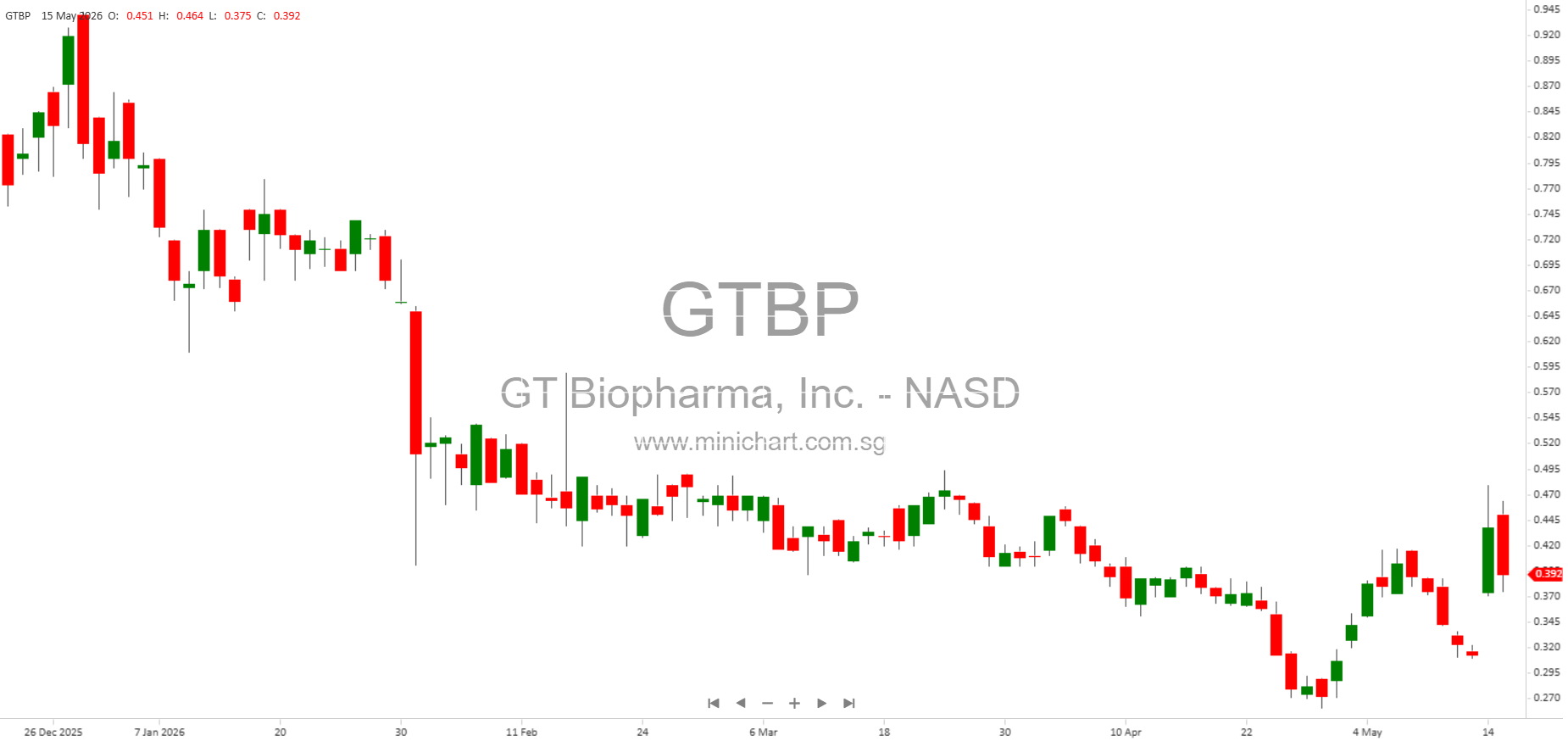
- Nasdaq Capital Market Listing: GT Biopharma’s common stock is listed on the Nasdaq Capital Market under the symbol “GTBP”. Compliance with listing requirements and ongoing capital raises are crucial for continued trading.
- No Transition Report: The filing is a regular quarterly report (10-Q), not a transition report.
- Company Is Not a Shell: GT Biopharma is not classified as a shell company.
- Non-Accelerated Filer and Smaller Reporting Company: The company is a non-accelerated filer and qualifies as a smaller reporting company, which impacts its reporting obligations and may signal a smaller market cap.
Important Shareholder Information & Price-Sensitive Issues
- Capital Raising & Dilution: The increase in shares outstanding from warrant exercises is a material event. While it improves liquidity and equity, it dilutes the interests of existing shareholders and could put downward pressure on the stock price.
- Widening Losses: The sharp rise in net loss signals increased operational challenges. Investors should be alert to the possibility of further losses or ongoing capital needs, which may negatively affect share price.
- Ongoing Preferred Dividends: The recurring dividend on Series L convertible preferred stock is a new expense that reduces net income available to common shareholders, impacting earnings per share and potentially the valuation.
- Large Accumulated Deficit: The company’s substantial accumulated deficit is a red flag for risk-conscious shareholders. It highlights the need for ongoing capital and the risk of future dilution or debt issuance.
- Stockholders’ Equity Growth: The increase in equity is positive but comes at the cost of dilution. It may provide a short-term boost to financial stability, but longer-term investors should weigh this against dilution risks.
- No Significant Non-Cash Investing Activity: There were no material non-cash investing or financing activities reported for the quarter.
- Listing Status: The company remains listed on Nasdaq, which is essential for liquidity and investor confidence. Any risk to this status could be highly price sensitive.
Detailed Financials
- Balance Sheet (March 31, 2026 vs December 31, 2025):
- Total liabilities and stockholders’ equity: \$9,996,000 (up from \$8,106,000).
- Stockholders’ equity: \$7,580,000 (up from \$5,787,000).
- Common shares outstanding: 26,657,989 (up from 25,534,173).
- Preferred shares (Series C and Series L): Series C unchanged at 96,230; Series L increased from 0 to 4,611, then reduced by conversion.
- Accumulated deficit: \$726,837,000 (up from \$721,000,000).
- Statement of Operations (Three Months Ended March 31, 2026 vs 2025):
- Net loss: \$2,833,000 (vs \$776,000).
- Dividend on preferred stock: \$103,000 (vs \$0).
- Net loss attributable to common stockholders: \$3,369,000 (vs \$776,000).
- Net loss per share: \$0.11 (vs \$0.33).
- Stockholders’ Equity (Q1 2026):
- Common stock: \$35,000.
- Additional paid-in capital: \$734,381,000.
- Accumulated deficit: (\$726,837,000).
- Cash Flows:
- Exercise of warrants for cash, net: \$1,000.
- No cash flows from investing activities.
- Preferred stock and warrants issued for cash, net: no significant value reported.
Potential Price Movers
- Substantial Dilution: The increase in common shares outstanding through warrant exercise is likely to impact share price by diluting existing shareholders.
- Widening Losses: The greater net loss and increased deficit may pressure the share price downward unless offset by positive developments or capital raising.
- Equity Increase: The boost in stockholders’ equity could provide stability and support for future capital raises, but is offset by dilution.
- Preferred Dividend: The recurring preferred dividend is a new expense that will impact future earnings per share for common shareholders.
Conclusion
GT Biopharma, Inc.’s Q1 2026 report presents a mixed picture for investors. While the company succeeded in raising new capital, increasing equity, and maintaining its Nasdaq listing, it also faced widening losses, significant dilution, and ongoing preferred dividend obligations. These developments are materially price sensitive and should be carefully considered by shareholders and potential investors. The balance between capital raising and dilution, as well as the company’s ability to control losses and manage its accumulated deficit, will be key drivers of future share price performance.
Disclaimer: This article is based on unaudited quarterly financial statements and should not be construed as investment advice. Investors are urged to conduct their own due diligence and consult with financial advisors before making investment decisions regarding GT Biopharma, Inc.