Coursera, Inc. Reports Q1 2026 Financial Results: Key Highlights and Investor Insights
Overview
Coursera, Inc. (NYSE: COU) has released its financial results for the quarter ended March 31, 2026. This report provides a comprehensive analysis of Coursera’s financial condition, operational performance, and other critical information that may impact shareholder value.
Key Financial Highlights
- Total Assets: \$1,000.0 million as of March 31, 2026. This reflects a stable asset base, consistent with the previous quarter.
- Stockholders’ Equity: \$635.7 million, up from \$631.8 million at year-end 2025, indicating continued capital strength.
- Net Income: Coursera reported a net loss of \$20.5 million for Q1 2026, which is an increase in losses compared to the net loss of \$7.8 million in Q1 2025.
- Earnings Per Share (Diluted): \$(0.12) for Q1 2026, compared to \$(0.05) in Q1 2025.
- Cash and Cash Equivalents: \$748.7 million, providing significant liquidity for ongoing operations and growth initiatives.
- Research and Development Expenses: \$31.3 million in Q1 2026, up from \$29.5 million in Q1 2025, reflecting ongoing investment in product and platform development.
- Weighted Average Shares Outstanding (Diluted): 168.7 million shares.
Operational and Strategic Updates
- No Dividend Announced: Coursera did not report or declare any dividends, which is consistent with its reinvestment strategy to drive future growth.
- Share-Based Compensation: Stock-based compensation expense for the quarter was \$22.3 million.
- Capitalized Internal Software Costs: \$2.0 million in stock-based compensation was capitalized as internal-use software costs, indicating ongoing platform enhancements.
- No Significant Changes in Outstanding Shares: Common stock shares outstanding increased modestly from 167.9 million at year-end 2025 to 169.3 million at March 31, 2026.
- Investments: Coursera maintains a conservative investment profile, with the majority of its cash equivalents in U.S. Treasury securities and money market funds.
Potentially Price-Sensitive and Shareholder-Relevant Information
- Increased Net Loss: The jump in net loss from \$7.8 million in the year-ago quarter to \$20.5 million may raise concerns about the company’s trajectory towards profitability. This could impact investor sentiment and share valuation.
- Strong Liquidity Position: With over \$748 million in cash and equivalents, Coursera has significant runway to invest in growth, weather market volatility, or pursue strategic initiatives.
- Rising R&D Investments: The continued increase in R&D spending signals Coursera’s commitment to innovation but could be scrutinized if not matched by accelerating revenue growth or a path to profitability.
- Stock-Based Compensation: The high level of stock-based compensation relative to net loss may be a point of focus for shareholders concerned about dilution or expense management.
- No Indication of M&A, Large Capital Raises, or Dividends: The report does not reveal any mergers, acquisitions, significant capital raises, or shareholder returns, which may indicate a status quo approach in the near term.
- Regulatory Updates: FASB’s new disclosure requirements (ASU 2024-03 and ASU 2025-01) are mentioned, but are not expected to materially impact the company’s financial statements in the short term.
Balance Sheet Strength
- No Preferred Stock Outstanding: The company is entirely common equity-financed with no preferred shares issued or outstanding.
- No Indication of Significant Debt: The balance sheet does not reflect any meaningful financial debt, underscoring Coursera’s conservative capital structure.
Shareholder Considerations and Risks
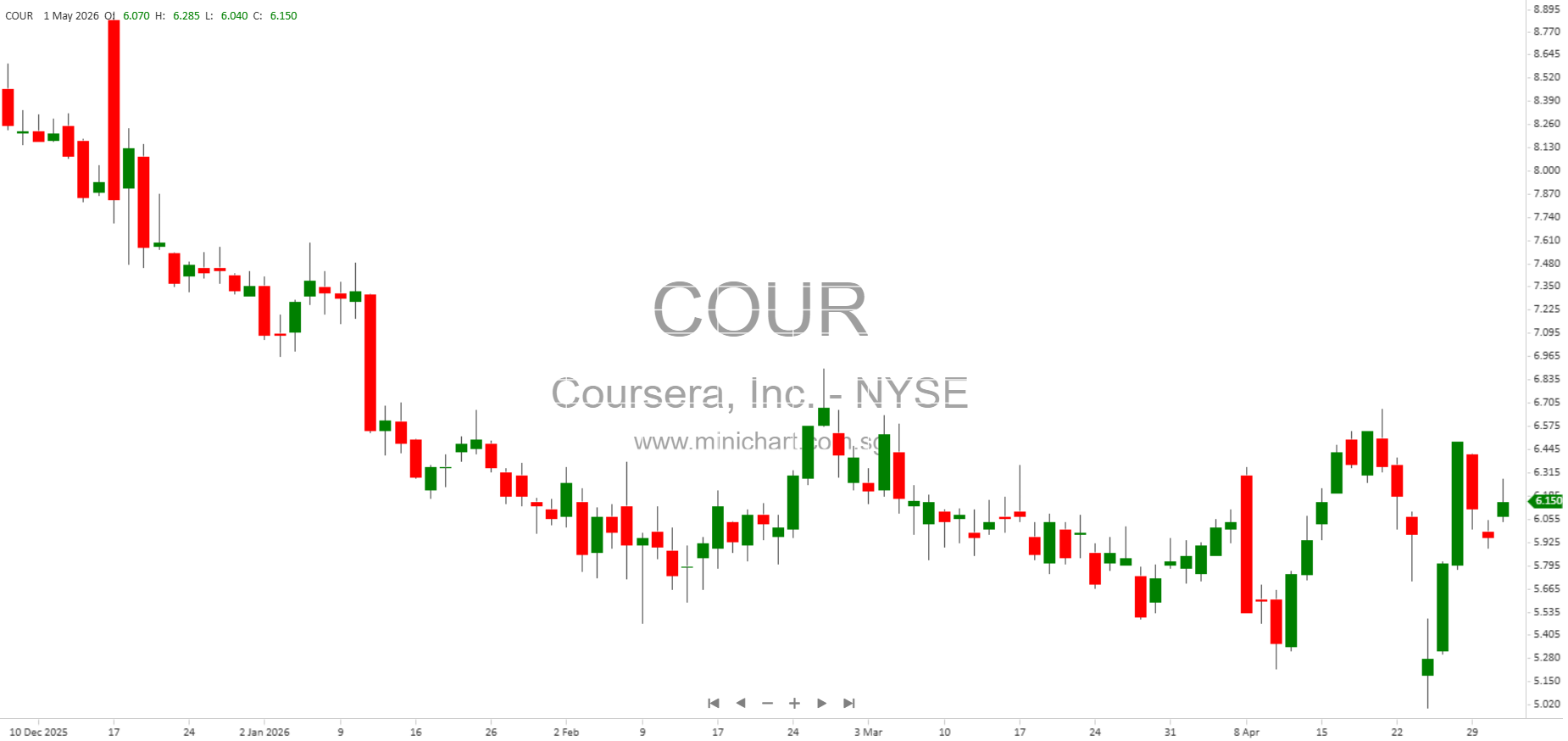
- Continued Losses May Pressure Shares: While the company is well-capitalized, ongoing quarterly losses and rising expenses may put downward pressure on the share price if not offset by accelerating revenue growth or a credible path to profitability.
- Potential for Strategic Actions: The robust cash position could support acquisitions, expansion projects, or other shareholder-friendly moves, though none are disclosed in this quarter.
- Dilution Risk: The increase in shares outstanding, coupled with high stock-based compensation, could result in shareholder dilution if not accompanied by enhanced company performance.
- Market Sensitivity: Investors should monitor future filings for signals of revenue inflection, cost management, or strategic pivots, all of which could prove price-sensitive.
Conclusion
Coursera’s Q1 2026 filings underscore its strong liquidity and commitment to platform development, but also highlight growing losses and increasing costs. Investors should weigh Coursera’s ample financial resources and growth investments against the lack of immediate profitability and the potential for ongoing dilution. No major strategic surprises or corporate actions are disclosed this quarter, but the trends in expenses and losses may affect investor sentiment and share price trajectory.
Disclaimer: This article is for informational purposes only and does not constitute financial advice or a recommendation to buy or sell any securities. Investors should conduct their own due diligence and consult with a qualified financial advisor before making investment decisions. The author and publisher make no representations or warranties as to the accuracy or completeness of the information provided herein.