Bicycle Therapeutics Q1 2026 Results & Business Update: Key Insights for Investors
Summary of Key Points
- Promising clinical and preclinical data for nuzefatide pevedotin, especially in EphA2-expressing cancers, including pancreatic cancer.
- Initial dose selection data from the Duravelo-2 trial for zelenectide pevedotin plus pembrolizumab in metastatic urothelial cancer to be presented at ASCO 2026.
- Significant strategic reprioritization, including workforce reduction of ~30% and discontinuation of certain trials, expected to extend cash runway to 2030.
- First quarter 2026 financials show a net loss of \$60.8 million, with research and development expenses down year-on-year, and a cash position of \$559.5 million as of March 31, 2026.
- Collaboration revenue sharply decreased due to termination of Genentech and Novartis partnerships.
- Multiple potential regulatory pathways being evaluated for zelenectide pevedotin in metastatic urothelial cancer (mUC).
Detailed Business and Pipeline Updates
1. Nuzefatide Pevedotin: Breakthroughs in Targeting EphA2-Expressing Cancers
Bicycle Therapeutics reported that nuzefatide pevedotin, their potentially first-in-class Bicycle® Drug Conjugate (BDC®) targeting EphA2, continues to display a differentiated safety and efficacy profile, both as a monotherapy and in combination with checkpoint inhibitors. This is particularly notable considering the historical challenges in targeting EphA2 with other modalities. Over 150 patients have been treated with nuzefatide to date.
- In a Phase 1/2 trial in metastatic urothelial cancer (mUC), nuzefatide plus nivolumab showed a 40% confirmed overall response rate (ORR) among EphA2+ tumors and a 100% ORR among MMAE-naïve EphA2+ tumors.
- Patients experiencing partial responses or at least 16 weeks of stable disease remained on treatment for at least 56 weeks, with most ongoing as of data cut-off.
- The combination was generally well tolerated, with no Grade ≥3 treatment-related adverse events of clinical interest and no treatment-related hemorrhages.
Preclinical studies reinforced the clinical findings, showing that nuzefatide had significant anti-tumor activity in both patient-derived xenograft models of pancreatic ductal adenocarcinoma (PDAC) and head and neck squamous cell carcinoma (HNSCC). Notably, high EphA2 expression was found in all PDAC models tested, and the majority were sensitive to nuzefatide.
Importantly, in March 2026, the company initiated a Phase 2 trial for nuzefatide in recurrent PDAC, with the first patient dosed in April 2026. The preferred dose for this trial has been set at 8mg/m² every two weeks.
2. Human Imaging Data for Bicycle® Radioligand Molecules
At AACR 2026, the company presented new human imaging data for a Bicycle® Imaging Agent (BIA) targeting EphA2 in PDAC patients. Seven patients underwent PET/CT imaging, with rapid tumor uptake observed in six out of seven and clear detection of metastases in multiple locations. These findings validate EphA2 as a cancer target and support the use of Bicycle® molecules in radiopharmaceutical imaging and therapy.
3. Duravelo-2 (Zelenectide Pevedotin) in Metastatic Urothelial Cancer
Initial dose selection data from the Duravelo-2 trial showed response rates comparable to current standards of care and a differentiated safety profile:
- Physician-assessed ORR: 65%
- Blinded independent central review (BICR) ORR: 58% at 27 weeks, rising to 62% with a subsequent confirmed response
- Only one patient discontinued therapy due to a treatment-related adverse event at the 27-week cutoff
The company is currently converting the Duravelo-2 trial into a randomized Phase 2 trial, deprioritizing the program for internal development while exploring regulatory pathways in the US and Europe. Initial dose selection data will be presented at ASCO 2026 (May 29 – June 2, Chicago).
4. Strategic Reprioritization and Cost Reductions
In March 2026, Bicycle Therapeutics announced a strategic reprioritization to focus resources on their most promising next-generation therapeutics, including nuzefatide and radiotherapeutics. Key actions:
- Discontinuation of the Phase 1/2 Duravelo-3 trial (zelenectide in NECTIN4-amplified breast cancer) and Duravelo-4 trial (zelenectide in NECTIN4-amplified NSCLC). Enrollment is closed, but current patients will complete treatment.
- Workforce reduction of approximately 30%, expected to reduce annual operating expenses by about 50%.
- These measures are projected to extend the company’s cash runway by two years, now into 2030.
Financial Results – First Quarter 2026
- Cash and Cash Equivalents: \$559.5 million as of March 31, 2026 (down from \$628.1 million at year-end 2025), primarily due to ongoing operations and clinical program payments.
- Collaboration Revenue: \$0.9 million (Q1 2026) vs \$10.0 million (Q1 2025), reflecting the end of partnerships with Genentech and Novartis.
- R&D Expenses: \$48.9 million, down from \$59.1 million a year ago, due to reduced clinical activity and workforce, offset by lower UK R&D tax credits.
- G&A Expenses: \$17.5 million, down from \$21.1 million, primarily due to lower professional fees and share-based compensation.
- Net Loss: \$60.8 million (\$0.87 per share), flat compared to Q1 2025 (\$60.8 million, \$0.88 per share).
- Working Capital: \$570.2 million as of March 31, 2026.
Business Outlook and Potential Share Price Sensitivities
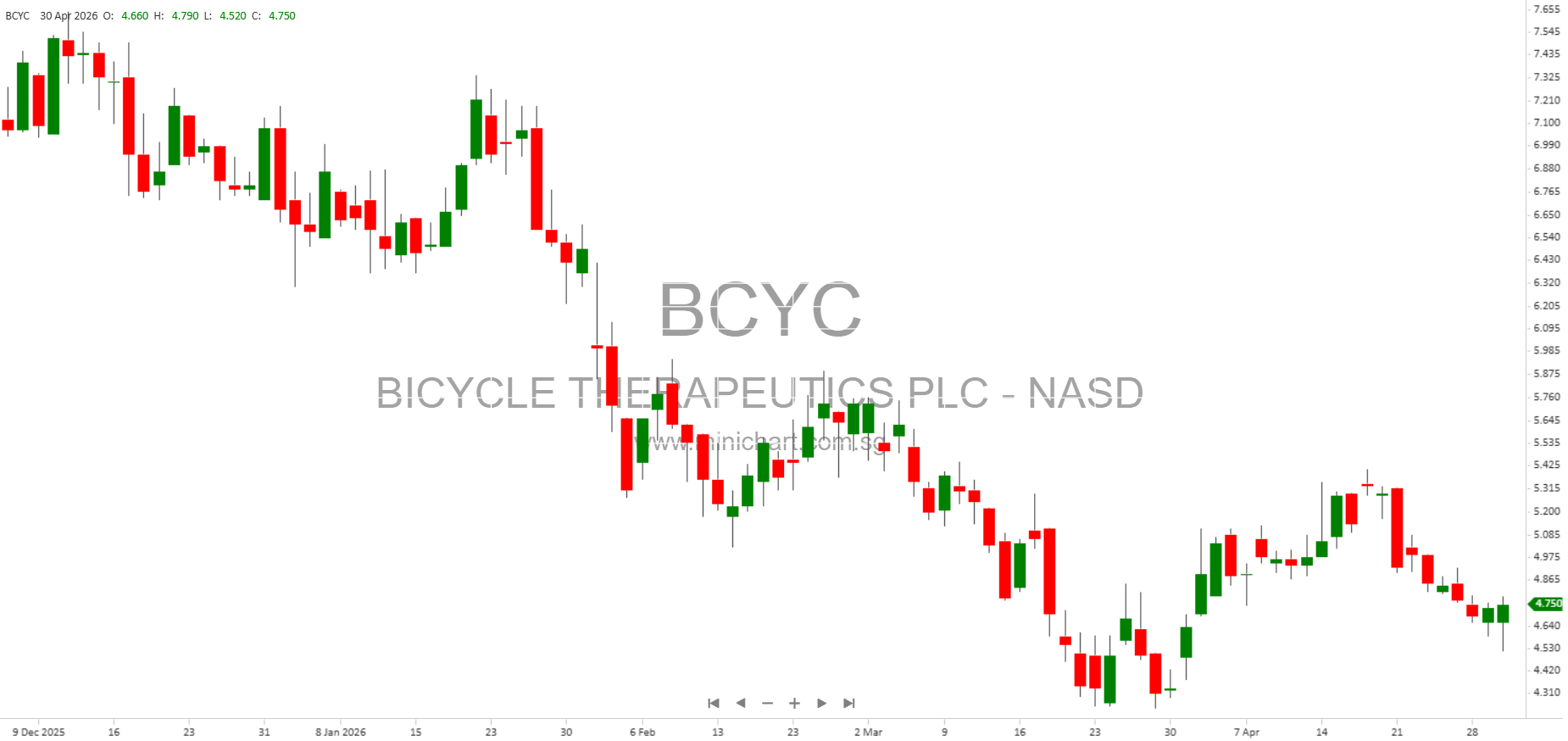
- Strong clinical and preclinical results for nuzefatide pevedotin, particularly its activity and safety in EphA2+ cancers, could drive optimism and upward movement in share value as the program advances, especially with new data anticipated at major conferences.
- Discontinuation of some programs and workforce reduction, while extending the cash runway, may be viewed positively by investors focused on capital efficiency and pipeline prioritization.
- Sharp decline in collaboration revenue and the end of key partnerships may prompt concerns about near-term revenue streams and external validation.
- Regulatory feedback and potential new pathways for zelenectide pevedotin in mUC remain price-sensitive events; future trial results and agency communications could significantly impact valuation.
- The company’s strong cash position and cost control measures substantially mitigate near-term financing risk.
About Bicycle Therapeutics
Bicycle Therapeutics is a clinical-stage pharmaceutical company developing a novel class of medicines based on bicyclic peptide (Bicycle®) molecules. The company’s pipeline includes nuzefatide pevedotin (EphA2-targeted BDC®), other Bicycle-based conjugates for radiopharmaceutical use, and zelenectide pevedotin (Nectin-4-targeted BDC®), as well as a tumor-targeted immune cell agonist, BT7480. Headquarters are in Cambridge, UK, with US leadership in Lexington, Massachusetts.
For more information, visit bicycletherapeutics.com.
Disclaimer
This article is for informational purposes only and should not be considered investment advice. The information is based on public filings and press releases as of April 30, 2026. Investors should conduct their own due diligence and consult with their financial advisors before making investment decisions. Forward-looking statements are subject to risks and uncertainties as detailed in the company’s SEC filings.