Texas Instruments Reports Q1 2026 Earnings: Key Highlights for Investors
Summary of Results
- Revenue: Texas Instruments (TI) reported revenue of \$3.89 billion for the quarter ended March 31, 2026, a decrease from \$4.37 billion in Q1 2025.
- Net Income: Net income for Q1 2026 was \$1.55 billion, up from \$1.18 billion in Q1 2025.
- Earnings Per Share (EPS):
- Basic EPS: \$1.69 (Q1 2025: \$1.29)
- Diluted EPS: \$1.68 (Q1 2025: \$1.28)
- Gross Profit: \$2.31 billion (Q1 2025: Not specifically stated, but inferred to be lower based on revenue and net income trends).
- Operating Income: \$1.81 billion (Q1 2025: \$1.32 billion)
- Research & Development (R&D) Expenses: \$517 million (Q1 2025: \$472 million)
- Selling, General & Administrative (SG&A) Expenses: \$464 million (Q1 2025: \$472 million)
- Comprehensive Income: \$1.55 billion (Q1 2025: \$1.17 billion)
Balance Sheet Strength
- Cash & Cash Equivalents: \$3.55 billion as of March 31, 2026, up from \$3.23 billion at December 31, 2025.
- Short-term Investments: \$1.55 billion (Q1 2025: \$1.31 billion)
- Total Current Assets: \$13.96 billion
- Total Liabilities: \$17.62 billion
- Total Stockholders’ Equity: \$16.78 billion
Shareholder Returns and Capital Allocation
- Dividends Paid: \$1.29 billion in Q1 2026 (Q1 2025: \$1.24 billion).
- Share Repurchases: \$158 million in Q1 2026 (Q1 2025: \$653 million).
- Number of Shares Outstanding: 910,092,791 as of April 15, 2026.
Cash Flow Performance
- Net Cash Provided by Operating Activities: \$2.22 billion (Q1 2025: \$2.19 billion).
- Net Cash Used in Investing Activities: \$47 million (Q1 2025: Net cash provided of \$1.25 billion).
- Net Cash Used in Financing Activities: \$1.14 billion (Q1 2025: \$2.52 billion).
Segment Information and Business Overview
Texas Instruments operates primarily in two segments:
- Analog: Representing the majority of revenue, focused on semiconductor components for signal processing.
- Embedded Processing: Encompasses digital processors for specialized equipment, such as industrial and automotive applications.
- Other: Includes DLP® products and calculators, which do not meet the quantitative thresholds for reportable segments.
Key Price-Sensitive and Shareholder-Relevant Information
-
Profitability Improvement Despite Lower Revenues:
Although revenue declined year-over-year, net income and EPS increased significantly, reflecting improved margins and cost control. -
Continued Strong Dividend and Shareholder Return Policy:
TI continues its policy of returning substantial capital to shareholders through dividends and share repurchases, maintaining its status as a strong income stock. -
Strong Balance Sheet and Liquidity:
The increase in cash and investments positions TI well for future investments or additional shareholder returns. -
Stable Share Count:
The number of outstanding shares has remained stable, reflecting modest repurchase activity this quarter. -
R&D Investment:
Growth in R&D spending signals continued investment in next-generation products and markets. -
No Preferred Stock Issued:
The company continues to be financed by common equity and debt, with no preferred shares outstanding. -
No Indication of Shell Company Status:
TI is not a shell company and continues to operate as a major industrial player. -
Debt Repayment:
TI repaid \$750 million in debt in Q1 2026, reducing financial leverage.
Potential Share Price Drivers
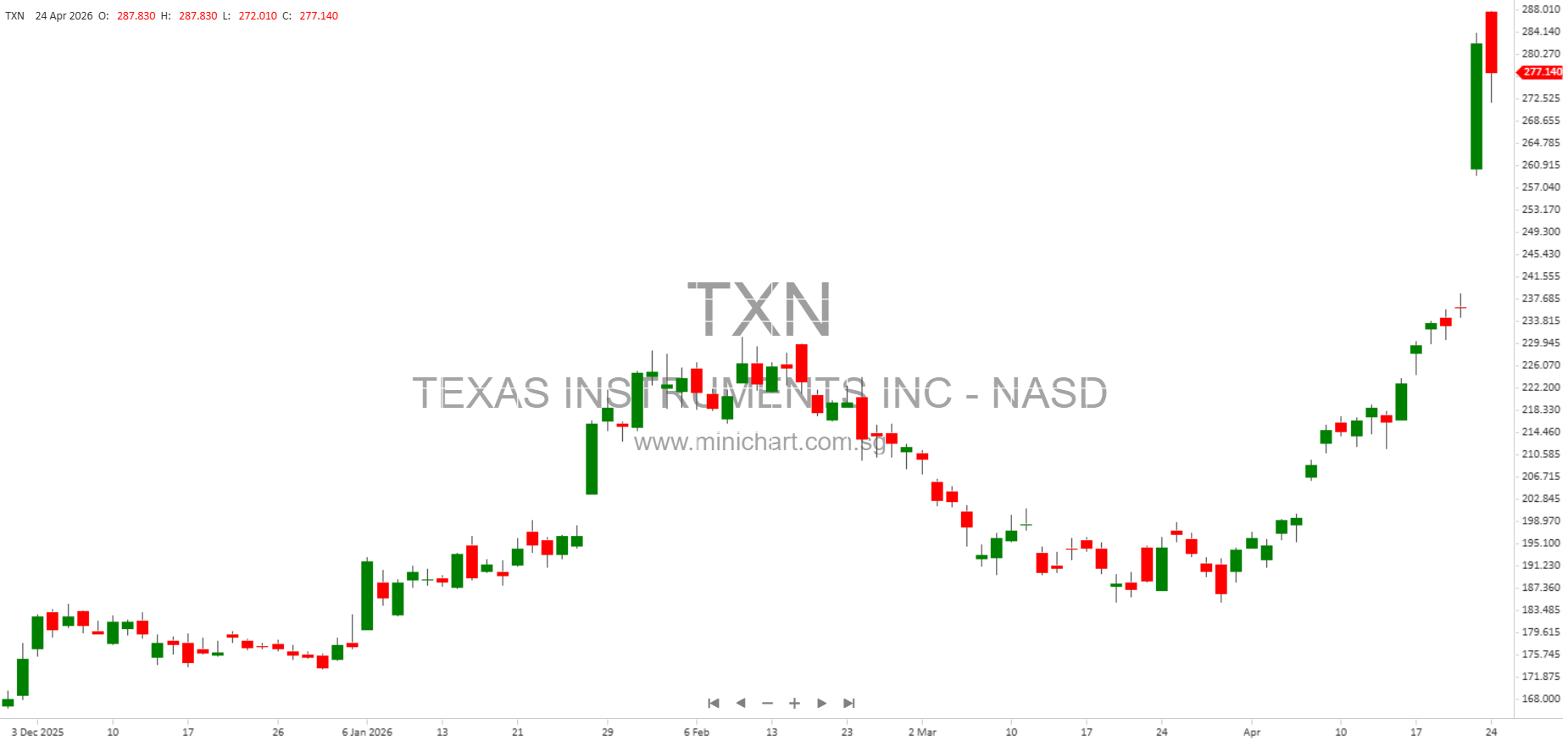
- Increase in EPS and Net Income: Could positively impact share price as it signals improved profitability and potentially higher future dividends.
- Strong Cash Generation and Capital Return: The company’s ability to generate cash and return it to shareholders supports the investment thesis for income and value investors.
- Revenue Decline: The year-over-year revenue drop may raise concerns about growth prospects, especially if it continues in future quarters.
- Cost Control and Margin Expansion: Management’s ability to sustain margins amid lower revenue is a key point to monitor going forward.
Other Noteworthy Items
- No restatements or amendments to prior filings were indicated.
- TI has complied with all SEC reporting requirements and is not an emerging growth company.
- No new or terminated Rule 10b5-1 trading arrangements were disclosed by insiders.
Conclusion
Texas Instruments delivered a solid performance in Q1 2026 with strong profitability and cash generation, despite a decline in revenue. The company’s commitment to shareholder returns through dividends and buybacks, stable share count, and prudent balance sheet management bode well for long-term holders. However, investors should keep a close eye on revenue trends in coming quarters, as sustained declines could eventually impact earnings power.
Disclaimer: This article is for informational purposes only and does not constitute investment advice. Investors should consult official company filings and speak with a financial advisor before making any investment decisions. The information presented here is based on the company’s quarterly report and may be subject to corrections or updates.