Tiong Seng Holdings Responds to SIAS Ahead of 2026 AGM: Key Details for Investors
Tiong Seng Holdings Limited has released detailed responses to questions from the Securities Investors Association (Singapore) (“SIAS”) in advance of its Annual General Meeting scheduled for 27 April 2026. The company’s disclosures contain several material updates on its operational challenges, ongoing project risks, financial performance, and strategic priorities, all of which are critical for shareholders and potential investors.
Revenue Decline and Project Delays
- Sharp Revenue Drop: The Group’s revenue fell by 44% to \$301.1 million for FY2025, attributed mainly to reduced construction activity and significant delays in securing Temporary Occupation Permits (TOPs) for two major projects. These delays were caused by the need to reconcile consultant designs with regulatory requirements, leading to substantial rework and cost overruns.
- Unrecognised Variation Order Revenue: Importantly, the company has not recognised certain variation order (VO) revenues as contract assets on the balance sheet, as negotiations with customers are still ongoing. The quantum and timing for conversion of these into recognised revenue and cash flow remain uncertain, though management expects to finalise most accounts in FY2026. This introduces ongoing uncertainty around future revenue recognition and cash flows, which may affect investor confidence and share price.
- Technical Capabilities: Despite recent challenges, Tiong Seng affirms it holds the highest BCA workhead grading (A1) for both general building and civil engineering, qualifying it to tender for unlimited value public sector projects, including large-scale infrastructures like Changi Airport Terminal 5 and Tuas Port.
Provisions, Fines, and Project Management Issues
- Penalties on PRC Development: Delays in a PRC development project resulted in penalties and an administrative fine. These arose from weaker-than-expected sales, which prompted the company to defer investment and construction on subsequent phases, extending the development timeline and incurring penalties for delayed land development.
- Onerous Contracts: The bulk of provisions taken in FY2025 relate to legacy projects affected by COVID-19–era disruptions, including cost escalation and productivity constraints. Additional work required for TOPs, not previously anticipated, was a key driver for these provisions. The company asserts it has strengthened project monitoring and cost controls but acknowledges these issues were only identified as sufficiently reliable estimates became available in FY2025.
- Other Fines and Penalties: The company recognised \$468,000 in fines and penalties in FY2025, primarily related to land appreciation tax and late payment charges on PRC projects, and not directly tied to the aforementioned land development penalties.
- Control Enhancements: In light of these setbacks, Tiong Seng reports enhanced controls—tighter project monitoring, escalation protocols to senior management, and Board-level oversight of project and financial risks.
Shareholder Value and Board Effectiveness
-
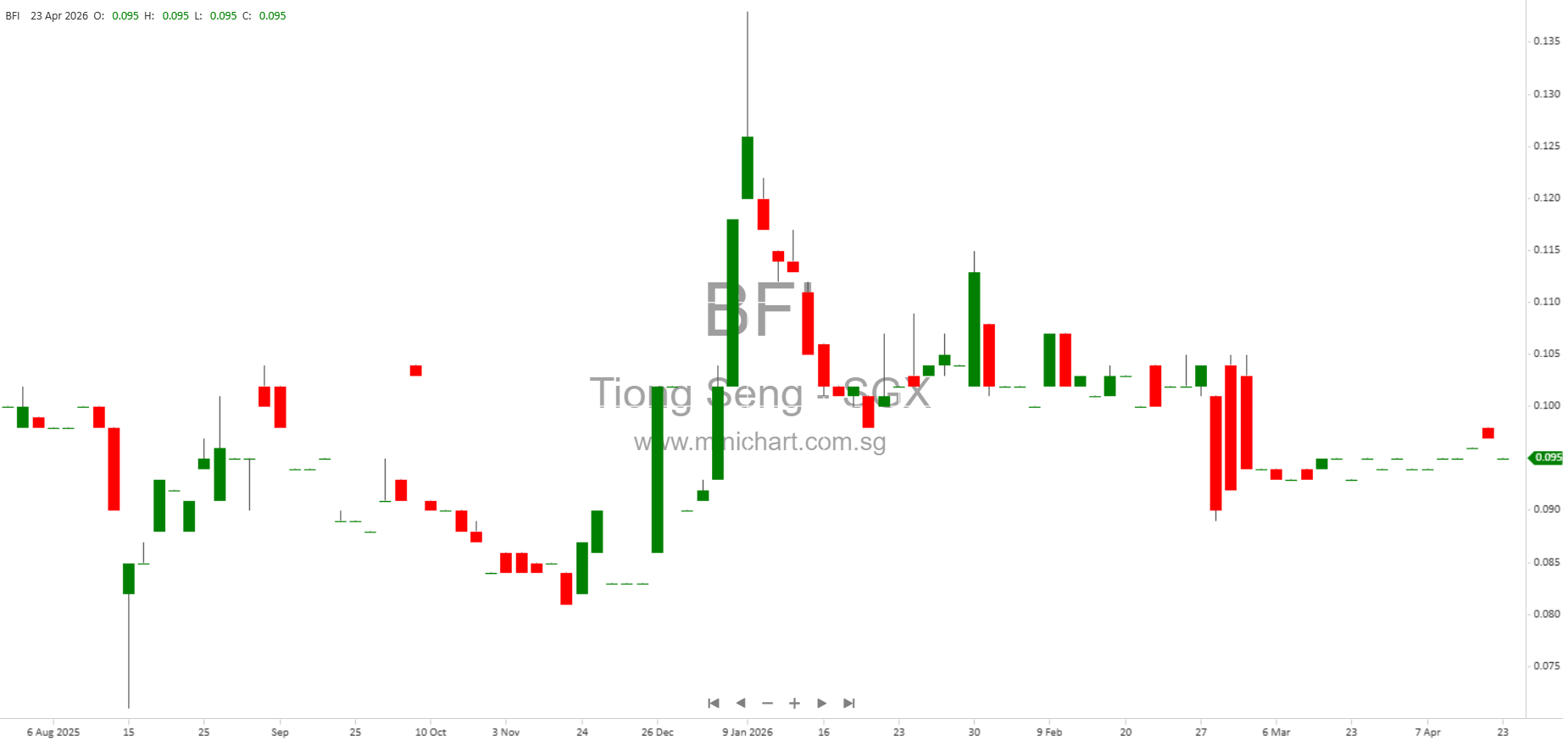
Poor Shareholder Returns: Since its IPO in 2010 at \$0.28 per share, the company’s shares now trade below \$0.10. Total Shareholder Return (TSR) is negative across all major periods:
- 5-year TSR: -31%
- 10-year TSR: -45%
- 16-year (since IPO) TSR: -37%
This reflects both share price decline and dividend payments over the period.
- Financial Erosion: As of 31 December 2025, accumulated losses at the company level total \$(128.3) million, with equity reduced to just \$4.8 million. Losses have been substantial since COVID, with net profit margins once peaking at 4.2% (FY2017) but now deeply negative, reaching as high as a 23.8% loss margin.
- Board and Leadership Review: The Board conducts annual performance evaluations, including assessments of strategic effectiveness, management oversight, and Board committee contributions. It recognises the impact of COVID-19 and industry cycles but continues to focus on strengthening execution, risk management, and capital discipline.
- KPIs and Management Actions: Management is evaluated on financial (revenue, profits, cash flow, contract delivery, working capital) and non-financial (project quality, safety, risk management) KPIs. Where targets are missed, corrective actions include operational restructuring and enhanced governance.
- Strategic Review: The Board, including Independent Directors, views strategic review as an ongoing process, with regular consideration given to market changes and business performance. There is openness to a more comprehensive review if warranted by circumstances.
Key Takeaways for Investors
- Material Risk Factors: Continued uncertainty surrounds the recognition and collection of variation order revenues, which could materially impact future earnings and liquidity.
- Financial Weakness: Accumulated company losses and a shrinking equity base highlight significant financial vulnerability.
- Operational Turnaround Not Evident: Despite enhanced controls, recurring issues with penalties and onerous contracts suggest ongoing challenges in project execution and risk management.
- Board Acknowledges Challenges: The company is candid about its poor share price performance and the profound impact of pre-pandemic contracts, but a clear turnaround in profitability and shareholder value is not yet evident.
Potential Share Price Sensitivity
- News of ongoing uncertainty around the recognition and conversion of significant variation order revenue may weigh on the share price until resolved.
- The company’s cumulative losses and low equity level raise concerns about capital adequacy and future fund-raising needs.
- Persistent execution risks and the need for strengthened controls may be viewed negatively unless accompanied by improved financial performance in FY2026 and beyond.
Disclaimer: This article is for informational purposes only and does not constitute investment advice or a recommendation to buy or sell any securities. Investors should conduct their own research and consult professional advisers before making any investment decisions. The information herein is based on company disclosures and may be subject to change or revision.