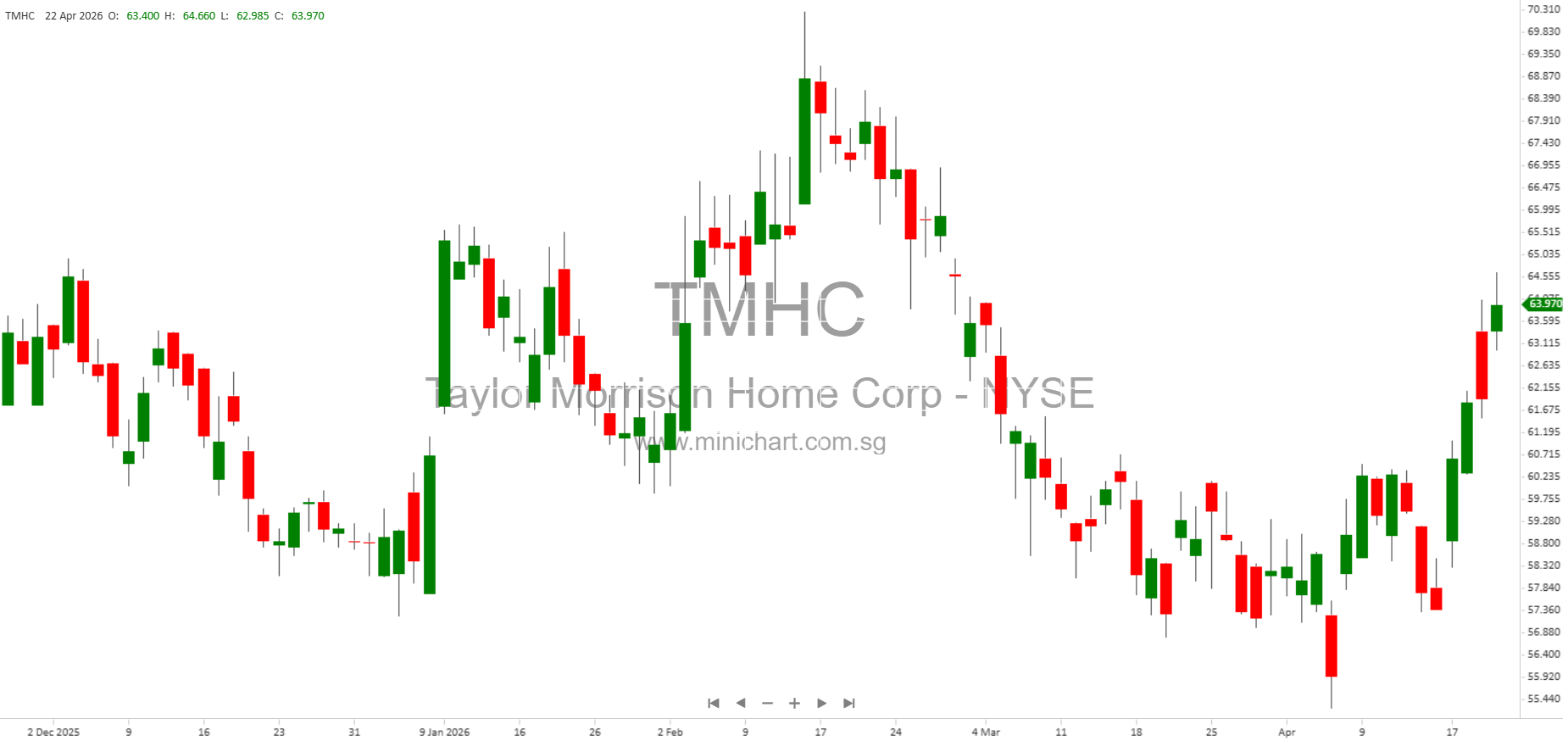
Taylor Morrison Home Corporation Reports Q1 2026 Results: Key Highlights and Investor Takeaways
Overview
Taylor Morrison Home Corporation (NYSE: TMHC), a leading national homebuilder and community developer, released its financial results for the first quarter ended March 31, 2026. Despite facing a challenging housing market, the company delivered solid operational performance, highlighted by disciplined capital allocation, an increase in to-be-built order mix, and a robust liquidity position.
Key Financial Highlights
- Net Income: Reported net income was \$99 million (\$1.01 per diluted share); adjusted net income was \$109 million (\$1.12 per diluted share).
- Home Closings Revenue: \$1.3 billion, down 28% year-over-year, with 2,268 homes closed at an average sales price of \$578,000.
- Gross Margins: Home closings gross margin was 20.0% (reported) and 20.6% (adjusted, excluding \$8.2 million in inventory impairment charges).
- SG&A Ratio: Selling, general and administrative expenses represented 11.4% of home closings revenue, up from 9.7% a year ago.
- Net Sales Orders: 2,914 homes, down 14% year-over-year, at an average selling price of \$603,000 (up 2% year-over-year).
- Backlog: 3,465 homes (up 23% sequentially), valued at \$2.3 billion.
- Land Investment: \$503 million invested in land and development during the quarter.
- Share Repurchases: Approximately 2.5 million shares repurchased for \$150 million; \$863 million remains under the repurchase authorization expiring December 2027.
- Liquidity: \$1.6 billion total liquidity, including \$653 million in cash and \$905 million in undrawn revolver capacity.
- Debt Metrics: Gross homebuilding debt-to-capital ratio: 26.6%; net homebuilding debt-to-capital ratio: 20.5%.
Operational and Strategic Insights
- Sales Mix Shift: Notably, the share of to-be-built orders increased to 38% from 28% in Q4, signaling a move away from speculative inventory and toward more build-to-order sales. Finished spec home count declined 30% sequentially to 863 units.
- Incentive Reduction: The company achieved a sequential reduction in sales incentives of over 100 basis points.
- Sales Pace: Monthly net sales pace was 2.7 per community (up from 2.4 in Q4 2025, but down from 3.3 a year ago).
- Backlog Customer Deposits: Averaged \$45,000 per home, indicating strong buyer commitment.
- Land Position: 75,626 homebuilding lots owned and controlled, with 51% controlled off-balance sheet, representing 6.2 years of supply (3.0 years owned).
- Financial Services: Mortgage capture rate remained strong at 88%, with borrowers averaging a 750 credit score, \$181,000 household income, and 80% loan-to-value ratio.
- Community Count: Active selling communities rose 4% year-over-year to 356.
- Cancellation Rate: Improved to 10% from 11% a year ago.
Segment Performance
| Region | Homes Closed (Q1 2026) | YOY Change | Net Sales Orders (Q1 2026) | YOY Change | Backlog (Q1 2026) | YOY Change | Average Selling Price (Q1 2026) | YOY Change |
|---|---|---|---|---|---|---|---|---|
| East | 869 | -21.7% | 1,155 | -17.0% | 1,432 | -29.0% | \$565k (Orders) | +9.1% |
| Central | 558 | -36.8% | 736 | -15.1% | 675 | -37.6% | \$466k (Orders) | -10.0% |
| West | 841 | -20.3% | 1,023 | -8.3% | 1,358 | -31.0% | \$745k (Orders) | +0.3% |
Total homes closed fell 25.6% year-over-year, and total net sales orders decreased 13.6%. Backlog declined 31.6% year-over-year but grew 23% sequentially.
Shareholder-Important and Potentially Price-Sensitive Information
- Guidance Reaffirmed: Despite the evolving market, Taylor Morrison reaffirmed its full-year 2026 guidance across all key metrics, including approximately 11,000 home closings, average closing price of \$580,000-\$590,000, mid-10% SG&A ratio, ~\$2 billion land investment, and \$400 million in planned share repurchases.
- Margin Compression: Home closings gross margin fell by 400 basis points year-over-year (from 24.0% to 20.0% reported and from 24.8% to 20.6% adjusted), which may be a point of concern for investors focused on profitability.
- Revenue and Closings Down: Both revenue and closings declined sharply year-over-year, reflecting market headwinds. Revenue fell 27% and closings 26%, which could weigh on near-term sentiment.
- Backlog Recovery: The sequential increase in backlog (+23%) and the shift to more build-to-order homes indicate a potential for improved future revenues and less speculative inventory risk.
- Strong Balance Sheet: The company’s substantial liquidity and conservative leverage (20.5% net homebuilding debt to capitalization) provide flexibility to weather ongoing market volatility and invest strategically.
- Share Repurchase Activity: Robust buyback activity (\$150 million in Q1, with \$863 million remaining) supports shareholder returns and could provide downside protection for the share price.
- Risks Highlighted: The company cited multiple potential risks, including housing market volatility, labor and material shortages, regulatory challenges, macroeconomic uncertainty, and the impacts of geopolitical events, all of which may drive future share price volatility.
- Strategic Focus: Taylor Morrison is prioritizing its entry-level, move-up, and resort lifestyle segments, aiming to open more than 125 new communities in 2026 and laying the groundwork for growth reacceleration in 2027 and beyond.
- Recognition: Taylor Morrison continues to be recognized for its brand strength, including accolades from Lifestory Research, Fortune, and Forbes.
2026 Guidance (Key Metrics)
- Ending Community Count: 365-370
- Home Closings: ~11,000
- Average Closing Price: \$580,000-\$590,000
- Home Closings Gross Margin (Q2): At least 20% (full year not provided)
- SG&A as % of Home Closings Revenue: Mid-10% range
- Effective Tax Rate: 25%
- Average Diluted Shares: ~95 million
- Homebuilding Land Investment: ~\$2 billion
- Share Repurchases: ~\$400 million
Conclusion
Taylor Morrison’s Q1 2026 results reflect a company navigating a challenging market with discipline and strategic agility. While facing declines in revenue and closings, the company’s increased backlog, shift to a more build-to-order model, and substantial liquidity position it for future stability and growth. Margin compression and lower sales volumes are near-term headwinds, but continued share repurchases and a reaffirmed full-year outlook may provide support for the stock. Investors should closely monitor margin trends, backlog conversion, and the macro environment for future share price impacts.
Disclaimer
This article is for informational purposes only and does not constitute investment advice. Investors should conduct their own research or consult a financial advisor before making investment decisions. All financial figures are based on Taylor Morrison’s Q1 2026 earnings report and are subject to change and risks as disclosed by the company.