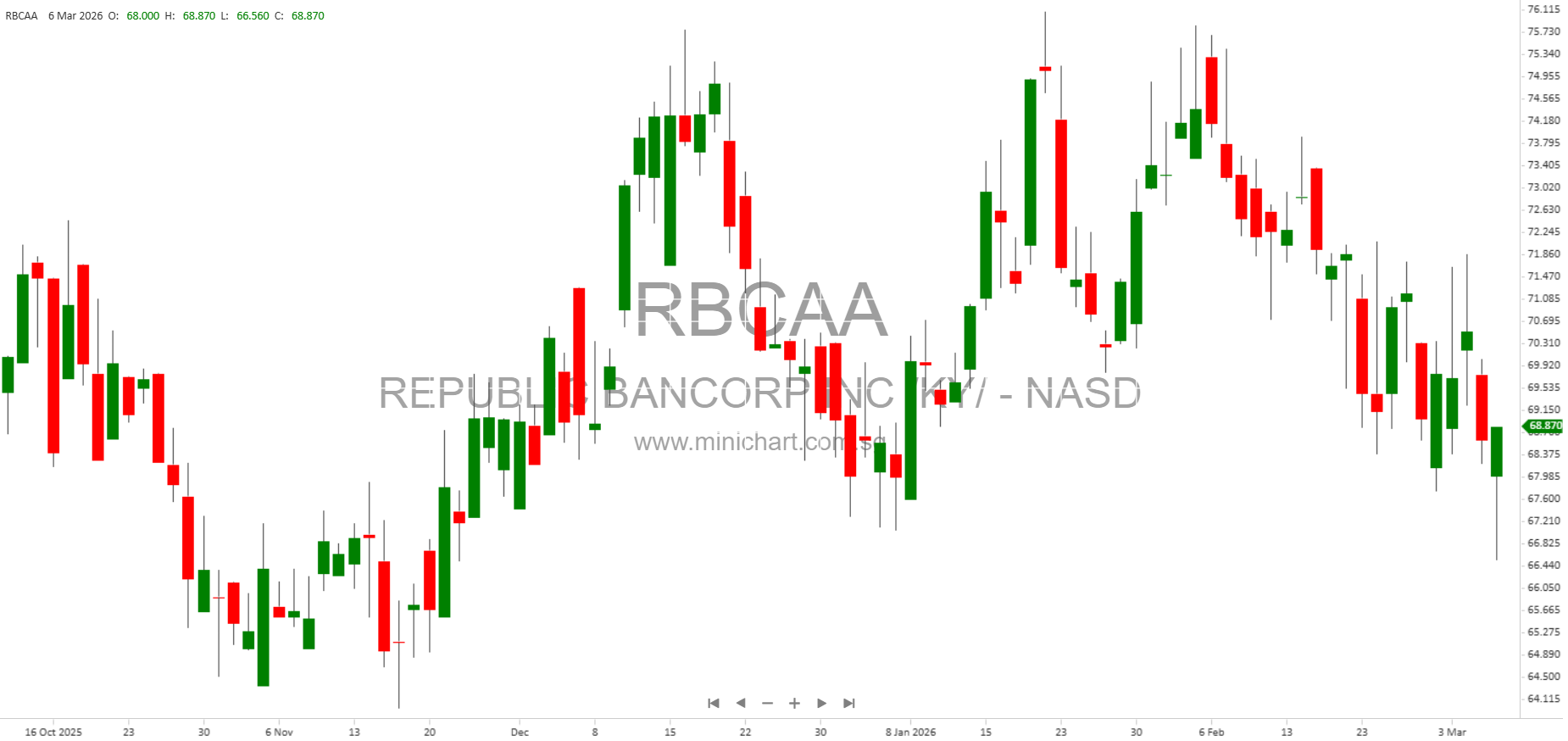
- Republic Bancorp operates multiple business segments, including:
- Traditional Banking
- Warehouse Lending
- Republic Processing Group
- Republic Credit Solutions Division
- Tax Refund Solutions
- Republic Payment Solutions
- Core Banking Activities
- Each segment is tracked for a variety of product lines, such as deposit accounts, credit and debit cards, transfer agent activities, and gain/loss on other real estate owned.
- The company is actively involved in consumer loans, short-term installment loans, lines of credit, and specialized lending (e.g., aircraft, warehouse, and tax refund lending), highlighting a diversified revenue base.
- Republic Bancorp applies internal credit risk assessments, categorizing loans as Pass, Special Mention, or Substandard.
- For loans and leases, the company analyzes relationships above \$1,000,000 through its internal loan review department, indicating a focus on managing large credit exposures.
- The company discloses performance periods for loans to be returned to accrual status, such as a minimum of six months for certain products.
- Property, plant, and equipment useful lives are clearly stated (e.g., furniture and fixtures: minimum 3 years; leasehold improvements: minimum 3 years).
- The company has a Stock Incentive Plan 2025, with option awards exercisable over one year and restricted stock vesting over three years.
- Deferred compensation arrangements are available for directors, with board and committee fees deferrable for up to two years.
- The effective income tax rate is heavily influenced by state and local jurisdictional contributions, particularly in Kentucky (the company’s state of incorporation).
- No outstanding preferred stock or other hybrid equity instruments are listed, simplifying the capital structure.
- The company provides detailed fair value hierarchy disclosures for recurring and nonrecurring assets and liabilities, including mortgage-backed securities, consumer loans held for sale, and derivative instruments such as interest rate swaps.
- Valuation techniques include discounted cash flow models for certain asset classes, with Level 2 and Level 3 inputs highlighted.